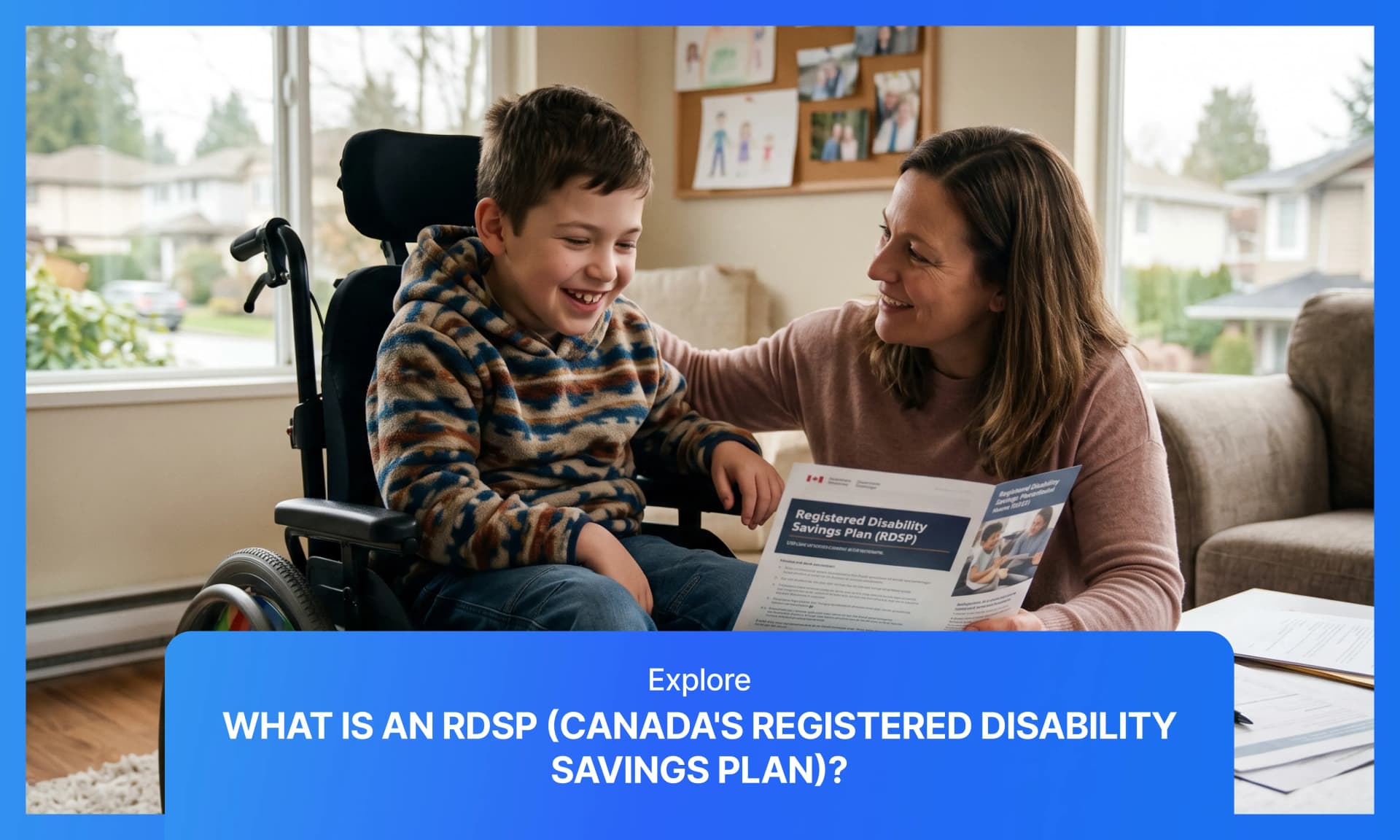
An RDSP (Registered Disability Savings Plan) is a long-term savings plan for Canadians approved for the Disability Tax Credit (DTC).
The federal government can add up to $70,000 in matching grants and $20,000 in bonds over the beneficiary's lifetime — and the bond requires zero personal contributions.
The lifetime private contribution limit is $200,000 (with no annual cap), contributions are not tax-deductible, and investments grow tax-deferred. Regular withdrawals must begin by the end of the year the beneficiary turns 60.
For eligible Canadians with disabilities, the RDSP is one of the most generous registered accounts available — particularly for low-income beneficiaries who can receive $1,000/year in bonds without depositing a cent.
In this article, we'll be going through:
- How to open an RDSP step by step
- Contribution limits and age deadlines
- Grant matching rates and bond income thresholds for 2026
- How the DTC requirement works (and why it is not the same as provincial disability benefits)
- How withdrawals are taxed and the 10-year repayment rule
- What happens if DTC approval is lost
TLDR: RDSP at a Glance
Here is the quick-reference summary.
| Feature | Detail |
|---|---|
| DTC required? | Yes (Disability Tax Credit approval) |
| Lifetime contribution limit | $200,000 |
| Annual contribution limit | None |
| Grant (CDSG) | Up to $3,500/year, $70,000 lifetime |
| Bond (CDSB) | Up to $1,000/year, $20,000 lifetime (no contribution required) |
| Contributions deductible? | No |
| Growth | Tax-deferred |
| Mandatory withdrawals | Must begin by December 31 of the year the beneficiary turns 60 |
Should You Open an RDSP?
The RDSP is almost always worth exploring for anyone who qualifies for the DTC — even if no personal contributions are possible right now. The bond alone can deposit $1,000/year for eligible low-income beneficiaries without a single dollar contributed.
An RDSP likely makes sense if the beneficiary meets all of these:
- Under 60 years old
- Approved for the Disability Tax Credit
- Qualifies for government grants, bonds, or both
- Expected to benefit from long-term financial security planning
An RDSP may be less suitable if the beneficiary needs the money within the next 10 years (the 10-year repayment rule complicates early withdrawals) or if DTC approval is uncertain and likely temporary.
Who Qualifies and What Is the DTC?
The gateway to every RDSP benefit is DTC approval — not a medical diagnosis, not provincial disability benefits, and not a doctor's letter alone.
DTC Eligibility
The Disability Tax Credit requires a completed Form T2201, certified by an eligible medical practitioner, and approved by the CRA.
The impairment must be severe and prolonged (expected to last at least 12 continuous months) and must markedly restrict at least one basic activity of daily living — or the cumulative effect of multiple restrictions must be equivalent.
A specific diagnosis (lupus, MS, autism, cerebral palsy) does not automatically qualify or disqualify anyone. DTC eligibility depends on how the condition affects daily functioning, not what the condition is.
RDSP Beneficiary Checklist
- Canadian resident with a valid SIN
- Approved for the Disability Tax Credit
- Under age 60 (plan must be opened before December 31 of the year the beneficiary turns 59)
Children can have an RDSP (a parent or legal representative opens and manages the plan). Adults who can legally contract with a financial institution can open their own.
How Do RDSP Grants and Bonds Work?
Government incentives are the RDSP's strongest feature. The grant and the bond operate on completely different rules.
Canada Disability Savings Grant (CDSG)
The grant matches personal contributions at rates of 100%, 200%, or 300% depending on family income and contribution amount.
| Family Income (2026) | Grant Matching |
|---|---|
| $117,045 or less | 300% on first $500 + 200% on next $1,000 |
| Above $117,045 | 100% on first $1,000 |
A $1,500 contribution from a lower-income beneficiary can attract up to $3,500 in grant money — a return no other investment matches. The lifetime grant maximum is $70,000, and grants are available until the end of the year the beneficiary turns 49.
Canada Disability Savings Bond (CDSB)
The bond is deposited without any personal contribution. Eligibility is purely income-based.
| Family Income (2026) | Bond Amount |
|---|---|
| $38,237 or less | Up to $1,000 |
| $38,237–$58,523 | Partial |
| Above $58,523 | None |
The lifetime bond maximum is $20,000. For low-income beneficiaries, opening an RDSP and filing annual tax returns is all that is needed to receive $1,000/year in free government money.
Carry-Forward
Unused grant and bond entitlements from prior eligible years (back to 2008, or the year the beneficiary turned 18) can be claimed retroactively, subject to annual limits.
Opening an RDSP late does not mean losing all past entitlements — carry-forward can recover a significant amount of missed government money.
How Are RDSP Withdrawals Taxed?
RDSP payments contain two components, and each is taxed differently.
| Component | Taxed When Withdrawn? |
|---|---|
| Original private contributions | No |
| Grants, bonds, investment income, rollovers | Yes (included in beneficiary's income) |
The 10-Year Rule
Any grants and bonds deposited within the 10 years preceding a withdrawal may need to be repaid to the government (the "assistance holdback amount").
For every $1 withdrawn, $3 of recent grants and bonds may be clawed back. The rule exists because the RDSP is designed for long-term savings — not short-term access. Withdrawing early without checking the holdback amount is one of the most expensive RDSP mistakes.
Mandatory Withdrawals
Regular lifetime disability assistance payments (LDAPs) must begin by December 31 of the year the beneficiary turns 60. The formula for mandatory amounts takes into account the plan's fair market value and the beneficiary's age.
What Happens If DTC Approval Is Lost?
Since 2021, losing DTC approval does not automatically force the RDSP to close.
The plan holder can keep the account open (with restrictions on new contributions, grants, and bonds) or close it. If the plan stays open, existing investments continue to grow tax-deferred, but no new government money flows in until DTC is restored.
Does the RDSP Affect Provincial Disability Benefits?
In most provinces, RDSP assets and payments are generally exempt from disability assistance asset tests — but the rules vary by province and territory.
For beneficiaries receiving disability or income support, check with the specific provincial program before making withdrawal decisions. A misstep here can jeopardize benefits that the beneficiary depends on daily.
How Do You Open an RDSP?
The process follows a clear sequence, but the DTC step can take time.
- Confirm or apply for Disability Tax Credit approval (Form T2201)
- Gather the beneficiary's SIN and identification
- Choose a participating financial institution
- Determine who the plan holder will be (beneficiary, parent, legal representative)
- Open the plan and apply for CDSG and CDSB
- Choose investments based on time horizon and risk tolerance
- File tax returns every year (income verification is required for grant and bond calculations)
- Review grant and bond entitlements annually to capture carry-forward room
How Does the RDSP Compare to Other Accounts?
Here's an overview of RDSP compared with other accounts:
| Account | Best For | Main Advantage | Main Limitation |
|---|---|---|---|
| RDSP | Long-term disability savings | Grants, bonds, tax-deferred growth | DTC required, complex withdrawal rules |
| TFSA | Flexible savings | Tax-free withdrawals, no restrictions | No disability-specific grants or bonds |
| RRSP | Retirement savings | Tax deduction | Withdrawals taxable, not disability-specific |
| Trust | Estate and support planning | Customizable | Legal setup costs, ongoing administration |
Frequently Asked Questions
Does the RDSP Bond Really Require No Contribution?
Yes. The Canada Disability Savings Bond is deposited entirely by the federal government based on income eligibility — no personal contribution is needed. A qualifying beneficiary with family income of $38,237 or less (2026 threshold) receives up to $1,000 per year, up to the $20,000 lifetime maximum. Opening the RDSP, registering for the bond, and filing annual tax returns (to verify income) is all that is required. Low-income beneficiaries who open an RDSP at age 18 and qualify every year could receive $20,000 in bond money over 20 years — entirely for free.
Can Family and Friends Contribute to an RDSP?
Yes. Anyone can contribute to an RDSP with the plan holder's written permission. Parents, siblings, grandparents, extended family, and friends can all make contributions that count toward the $200,000 lifetime limit and may attract matching grants. The contributor does not receive a tax deduction (RDSP contributions are never deductible), but the contribution triggers government grants at the applicable matching rate. A $1,500 contribution from a grandparent for a low-income beneficiary could attract up to $3,500 in matching grants — making the RDSP one of the most impactful ways to support someone with a disability financially.
Are RDSP Contributions Tax-Deductible?
No. RDSP contributions do not reduce the contributor's or beneficiary's taxable income — a common point of confusion for people familiar with RRSPs. The tax benefit comes from three other sources instead. Investments inside the RDSP grow tax-deferred (no annual tax on interest, dividends, or capital gains while sheltered). The government grants and bonds represent free money added to the plan. When contributions are eventually withdrawn, the contribution portion is not taxable — only grants, bonds, investment income, and rollover proceeds are included in the beneficiary's income. The tax structure is closer to a TFSA than an RRSP.
What Is the 10-Year Rule in Plain Terms?
The 10-year rule (formally the "assistance holdback amount") means that grants and bonds deposited into the RDSP within the 10 years before a withdrawal may need to be repaid to the government. For every $1 withdrawn, $3 of recent grants and bonds may be clawed back — up to the total amount of grants and bonds received in the preceding 10 years. The rule discourages using the RDSP as a short-term savings vehicle and protects public funds. Before making any withdrawal, check with the RDSP issuer to calculate the holdback amount and avoid accidentally returning thousands of dollars in government money.
Does an RDSP Affect Provincial Disability Benefits?
In most provinces, RDSP assets and payments are exempt from disability assistance asset and income tests — meaning the RDSP does not reduce provincial disability benefits. However, rules vary by province and territory, and exemptions may have conditions (such as limits on non-RDSP assets or income thresholds). Alberta, British Columbia, Ontario, and most other provinces have confirmed RDSP exemptions, but the specific details differ. Always verify the current rules with the applicable provincial disability benefits program before making large withdrawals, because a payment that exceeds provincial exemption limits could trigger a temporary reduction in benefits.