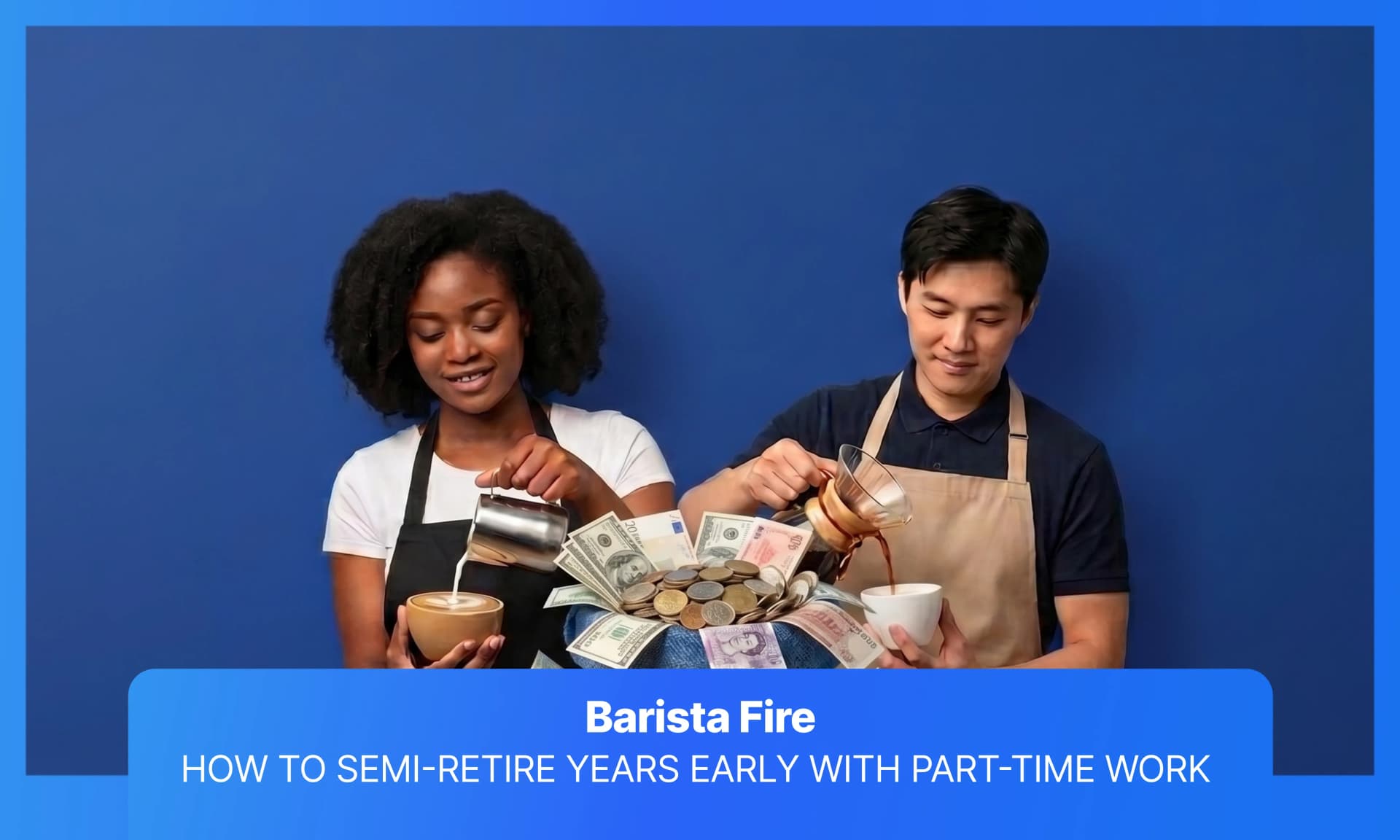
Barista FIRE is a semi-retirement strategy where your investment portfolio covers most of your living expenses, and part-time or flexible work fills the remaining gap.
The name comes from the idea of taking a low-stress job (like a barista at Starbucks) that provides a modest income — and, in the U.S., employer-sponsored health insurance.
So if you spend $60,000/year and earn $25,000 part-time, your portfolio only needs to support $35,000. At a 4% withdrawal rate, that requires $875,000 instead of the $1.5 million needed for full retirement.
The trade-off is that you keep working. But the work is on your terms — lighter, flexible, and chosen for enjoyment rather than survival.
In this guide, you'll learn:
- The risks most people underestimate
- How to calculate your Barista FIRE number
- How healthcare, taxes, and Social Security fit in
- How Barista FIRE differs from Coast and Lean FIRE
- Why part-time work is a financial lever (not just a paycheck)
TLDR: Barista FIRE at a glance
Here is the quick-reference summary.
| Feature | Detail |
|---|---|
| What it is | Portfolio withdrawals + part-time income to cover living expenses |
| Target portfolio | (Annual expenses - part-time income) × 25 |
| Typical work hours | 15-25 hours/week |
| Key benefit | Exit high-stress career 10-20 years early |
| Healthcare strategy | Employer benefits (Starbucks, Costco, UPS) or ACA subsidies |
| Primary risk | Part-time income unreliable; portfolio must last 40-50+ years |
How do you calculate your Barista FIRE number?
The formula subtracts part-time earnings from total expenses, then applies the standard 25× multiplier. The four steps are:
- Estimate annual living expenses (housing, food, insurance, discretionary)
- Project realistic part-time income (15-25 hours/week at your target role)
- Subtract income from expenses to find the "funding gap"
- Multiply the gap by 25 (based on a 4% safe withdrawal rate)
Let's look at an example. $50,000 annual spend - $20,000 part-time income = $30,000 gap. At 25×, the target portfolio is $750,000. Without part-time work, the same lifestyle requires $1.25 million.
For retirement horizons longer than 30 years (common in Barista FIRE, since practitioners often start in their 30s or 40s), many advisors recommend a 3%-3.5% withdrawal rate instead of 4% — which raises the multiplier to 28-33× but adds a meaningful safety buffer against sequence-of-returns risk.
Why is part-time work more than a paycheck?
The "barista" job serves three functions that go beyond the hourly wage.
Portfolio protection
Part-time income reduces withdrawal pressure during market downturns. If equities drop 30%, a fully retired person must still sell assets to cover expenses. A Barista FIRE practitioner can lean on their paycheck and let the portfolio recover — the single most powerful defence against sequence-of-returns risk.
Healthcare access
In the U.S., securing health insurance before Medicare at 65 is the biggest financial wildcard of early retirement. Companies like Starbucks, Costco, UPS, REI, and Southwest Airlines offer benefits to part-time workers (often at 20+ hours/week), making the insurance value of the job worth more than the wages themselves.
Structure and purpose
Full retirement sounds appealing until it arrives. Many early retirees report a loss of identity, social connection, and daily structure. Working 15-25 hours/week in a role chosen for enjoyment (not obligation) provides a "softer landing" than going from 50-hour weeks to zero overnight.
How does Barista FIRE handle taxes and accounts?
Tax efficiency requires sequencing withdrawals from the right accounts at the right time.
Account priorities
The standard approach:
- Draw from taxable brokerage accounts first (no age restrictions, preferential capital gains treatment)
- Use Roth conversion ladders during low-income years to shift tax-deferred 401(k) funds into Roth accounts at minimal tax cost
- Leave tax-deferred accounts (Traditional IRA, 401(k)) untouched until age 59½ to avoid early withdrawal penalties
- Build passive income streams (dividends, rental income) to reduce portfolio drawdown
Social Security advantage
Unlike full early retirement, Barista FIRE practitioners continue paying into Social Security through part-time wages — potentially increasing future benefits by filling zero-earning years in their 35-year average.
What are the biggest risks?
Barista FIRE is not risk-free, and the risks are amplified by the 40-50+ year time horizon.
- Healthcare coverage is tied to employment — lose the job, lose the insurance
- Sequence-of-returns risk is heightened over multi-decade withdrawal periods
- Age discrimination can make finding new part-time roles harder in your 50s and 60s
- Part-time income can disappear (hours cut, employer closes, health declines with age)
- Inflation erodes both the portfolio's purchasing power and the real value of part-time wages
The primary mitigation is Barista FIRE's flexibility. If the market drops or income disappears, practitioners can temporarily increase hours, reduce discretionary spending, or pause portfolio withdrawals — options that fully retired people do not have.
Frequently asked questions
Here are some commonly asked questions about the Barista FIRE approach:
What is a good Barista FIRE number?
A good Barista FIRE number depends on annual spending, expected part-time income, taxes, and how much safety margin you want. If you spend $50,000 per year and expect to earn $20,000 from part-time work, your portfolio only needs to cover the remaining $30,000. At a 4% withdrawal rate, that means a target of about $750,000. At 3.5%, the target rises to roughly $860,000. Many Barista FIRE plans fall between $500,000 and $1 million, which is often far less than traditional FIRE. The key is making sure the part-time income is realistic, steady, and not overly stressful.
Can I do Barista FIRE in Canada?
Yes, Barista FIRE can work in Canada, although the healthcare reason is less urgent than in the United States because eligible residents are covered by provincial or territorial health insurance. The basic idea is the same: build a large enough investment portfolio to cover part of your expenses, then use part-time income to cover the rest. Canadians often use a mix of TFSAs, RRSPs, and non-registered accounts to manage withdrawals, taxes, and flexibility. Part-time work can also provide structure, social contact, and a buffer during market downturns. The main challenge is coordinating income, taxes, benefits, and long-term withdrawal plans.
What if I can't find part-time work later?
This is one of the most important risks to plan for before choosing Barista FIRE. Part-time work may be harder to find than expected, especially if the economy weakens, your health changes, or your skills become less current. Stress-test your plan by assuming part-time income stops 5 to 10 years earlier than expected. If the portfolio cannot support full withdrawals at that point, the target number may need to be higher, or spending may need to be more flexible. Good planning includes keeping skills fresh, maintaining a professional network, avoiding high fixed costs, and having a fallback withdrawal strategy.
How is Barista FIRE different from Lean FIRE?
Barista FIRE and Lean FIRE both reduce the amount needed for early retirement, but they do it in different ways. Lean FIRE depends mainly on very low spending and a smaller portfolio, while Barista FIRE uses part-time income to reduce pressure on the portfolio. Someone pursuing Lean FIRE may try to fully stop working, while someone pursuing Barista FIRE expects to keep earning some money through a lower-stress job, freelance work, seasonal work, or consulting. Barista FIRE usually offers more flexibility and comfort, but it also depends on the continued ability and willingness to work. It is semi-retirement rather than full retirement.
What kinds of jobs work best for Barista FIRE?
The best Barista FIRE jobs are flexible, low-stress, and reliable enough to cover the income gap without taking over your life. Common options include retail, coffee shops, tutoring, freelance writing, bookkeeping, consulting, seasonal work, library jobs, fitness instruction, delivery work, or part-time roles in a previous career. The ideal job depends on your skills, health, schedule, and tolerance for customer service or physical work. Benefits can matter as much as pay, especially in countries where employer health insurance is important. A good Barista FIRE job should support your lifestyle, not recreate the stress that made you want financial independence.
Does Barista FIRE still count as retirement?
Barista FIRE is better described as semi-retirement than complete retirement. You are no longer dependent on a full-time career, but you still earn some income to reduce withdrawals, preserve your portfolio, and create more flexibility. For many people, that is the main appeal. They can leave a demanding job years earlier without needing a traditional FIRE portfolio large enough to cover every expense. The tradeoff is that work remains part of the plan. Whether it feels like retirement depends on the job, hours, stress level, and personal expectations. Barista FIRE works best when the work is chosen, limited, and sustainable.