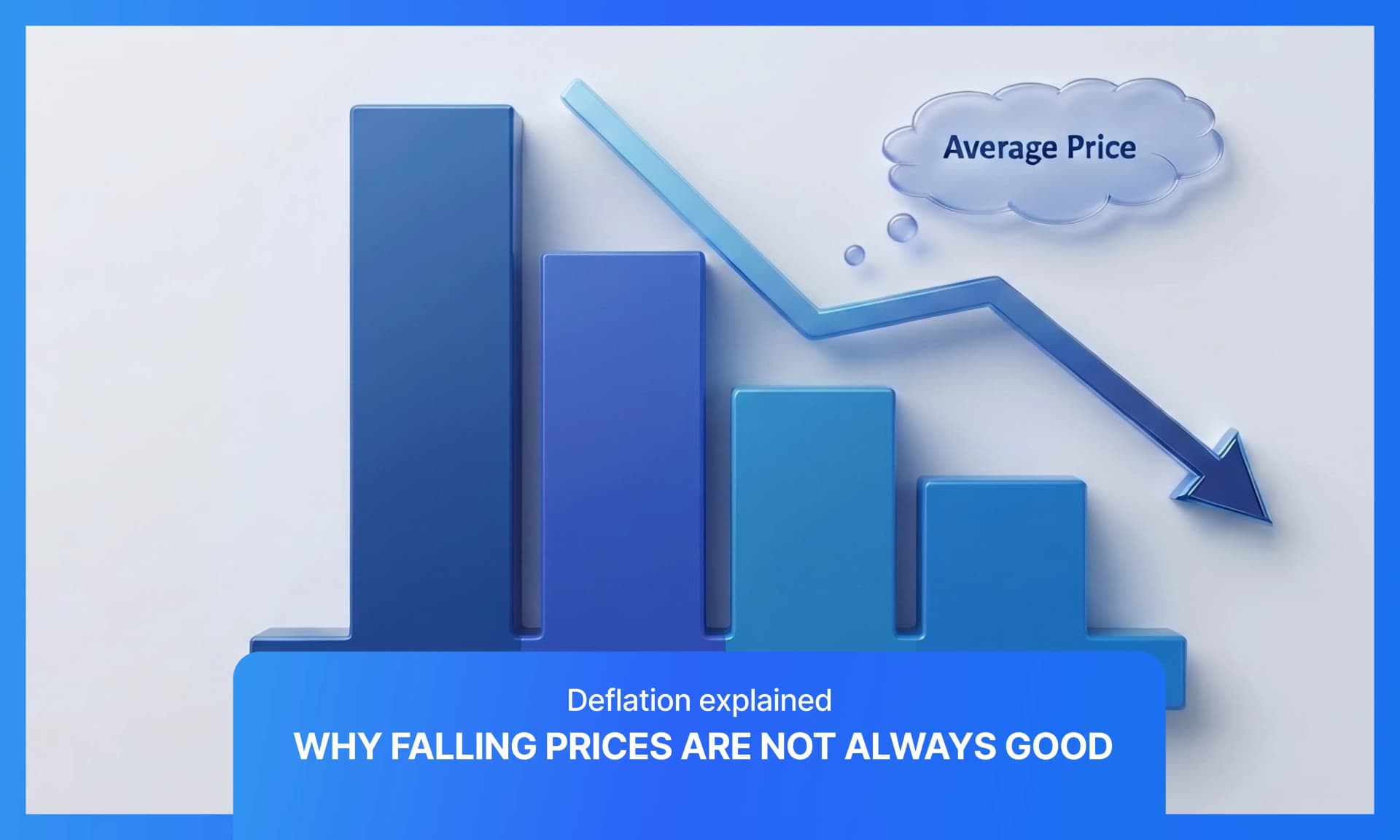
Deflation is a sustained decline in the general price level — the opposite of inflation.
On the surface, cheaper goods sound like a gift. In practice, deflation is one of the most destructive forces in economics because it increases the real burden of debt, discourages spending, triggers layoffs, and can lock an entire economy into a self-reinforcing downward spiral that rate cuts alone cannot break.
China's consumer prices fell 0.8% year over year in January 2024 — the steepest drop in 15 years — while Japan spent three decades proving that deflation, once entrenched, is extraordinarily hard to reverse.
Eswar Prasad, former head of the IMF's China division and professor at Cornell University, described the Chinese signals as "a multitude of indicators flashing red."
Now let's go beyond the surface level, and explore:
- The mechanics of a deflationary spiral
- Japan and China as real-world case studies
- How deflation differs from disinflation and inflation
- Why falling prices paradoxically damage an economy
- What central banks and governments do to fight back
Why are falling prices dangerous?
Lower prices feel good at the checkout counter. The problem is what happens behind the counter — and inside the debt contracts that hold the economy together.
Spending delays
When consumers expect prices to keep falling, they delay purchases. Waiting six months for a cheaper car or television is rational for an individual, but when millions of households postpone spending simultaneously, total demand collapses.
Rising debt burden
Deflation increases the real value of debt.
A $500,000 mortgage stays $500,000 in nominal terms, but if wages and prices fall 10%, the borrower now owes the equivalent of $555,000 in purchasing-power-adjusted terms.
Economist Irving Fisher formalized this in his 1933 debt-deflation theory — the insight that falling prices amplify debt crises rather than curing them.
Business losses
Businesses face lower revenue while many of their costs (rent, loan payments, multi-year contracts) remain fixed. The gap between falling income and fixed expenses leads to layoffs, which further reduce demand, which pushes prices down again.
What is a deflationary spiral?
A deflationary spiral is the self-reinforcing loop where falling prices cause reduced spending, which causes further price declines, which causes more layoffs and less spending.
The Great Depression is the most extreme historical example.
Between 1929 and 1933, the U.S. price level fell approximately 25%, unemployment reached 25%, and nominal GDP collapsed by nearly half. The deflationary spiral was broken only through massive fiscal intervention and eventual wartime spending.
How does deflation differ from inflation and disinflation?
These three terms describe different price dynamics. Confusing them leads to wrong conclusions.
Disinflation is typically a healthy sign — inflation moderating toward target.
Deflation is the alarm bell, because once prices start falling and expectations shift, reversing the trend becomes extremely difficult.
For investors watching how GIC rates respond to falling inflation, the distinction between disinflation and deflation determines whether safe-haven returns remain positive in real terms.
What do Japan and China reveal about deflation?
Let's look at some extremely prominent real-world cases of deflation:
Japan's three decades
Japan's asset bubble burst in 1990, triggering a deflationary era that lasted (with brief interruptions) until 2022.
A 2024 Bank of Japan study by Furukawa, Hogen, Otaka, and Sudo documented that decades of deflation created a measurable "zero-inflation norm" among Japanese firms — a psychological anchor where businesses became deeply reluctant to raise prices or wages, even as conditions improved.
A separate 2024 BOJ study by Takemasa Oda found that prolonged deflation interacted with Japan's aging population to reduce long-run productivity growth, capital allocation, and labour market dynamism.
The Bank of Japan raised its policy rate to 1% in 2026 — the highest level in 31 years — yet Japan's government economic blueprint still explicitly states that monetary policy should continue supporting demand to avoid a return to deflation. After 30 years, the fear has not fully receded.
China's warning signs
China's CPI fell 0.8% year over year in January 2024, marking the largest consumer-price decline in 15 years.
Producer prices (PPI) have been in deflation for 33-34 consecutive months, with wholesale deflation persisting even as some sectors — particularly export demand — grew strongly.
As of mid-2026, Reuters reported that overall industrial profits rose 21.1% year over year in May 2026, yet automobile profits fell 19.8% and furniture profits fell 58.4%.
The Chinese case shows that deflation can be sectoral rather than uniform — some industries thrive on export demand while domestic-facing sectors collapse simultaneously.
Can deflation ever be a good thing?
Economists distinguish between "good" and "bad" deflation.
Productivity-driven deflation
When prices fall because technology or manufacturing efficiency makes goods cheaper to produce, consumers benefit without the economy suffering.
Computer prices have fallen steadily for decades — that is productivity-driven deflation and it typically raises living standards rather than lowering them.
Demand-driven deflation
When prices fall because consumers stop spending (due to financial crises, credit contraction, or collapsing confidence), the economy shrinks. This is the dangerous variant — and it is the version that keeps central bankers awake at night.
The practical test is whether falling prices come with rising or falling employment. If unemployment is rising alongside falling prices, the deflation is almost certainly demand-driven and destructive.
How do central banks fight deflation?
Monetary and fiscal authorities have several tools, but all lose effectiveness as deflation deepens.
Rate cuts
Lowering interest rates reduces borrowing costs and encourages spending (but rates cannot go below zero in conventional policy, creating the "zero lower bound" trap).
Quantitative easing
Central banks buy bonds and other assets to inject money into the financial system and push down long-term rates.
Fiscal stimulus
Governments increase spending directly (infrastructure, transfers, tax cuts) to replace the private-sector demand that deflation has destroyed.
Forward guidance
Central banks commit to keeping rates low for a specified period, influencing expectations and encouraging borrowing.
Japan tried all four for decades.
The lesson — as a 2023 survey of empirical studies by Goran Petrevski concluded — is that inflation targeting alone does not eliminate deflation risk. Institutional coordination, fiscal support, and credible communication are equally important.
When investing in stocks during deflationary periods, the policy response matters as much as the economic data itself.
Frequently asked questions
Here are some commonly asked questions about deflation:
Is deflation worse than inflation?
Most economists consider deflation more dangerous than moderate inflation because deflation is harder to reverse. Central banks can raise rates to slow inflation, but once rates hit zero, the primary monetary tool loses its power. Deflation also increases the real burden of existing debt — a problem that compounds over time. Moderate inflation (2-3%) is generally considered healthy because it gives central banks room to cut rates during downturns and gently erodes debt burdens. The Bank of Canada, Federal Reserve, and most major central banks target approximately 2% inflation rather than zero specifically to maintain a buffer against deflation.
Is China currently in deflation?
China experienced consumer-price deflation in late 2023 and early 2024, with CPI falling 0.8% year over year in January 2024. Producer prices (PPI) remained in deflation for 33-34 consecutive months. As of mid-2026, consumer-price readings have fluctuated near zero — technically escaping sustained deflation, but with ongoing deflationary pressure in housing, automobiles, and domestic consumer goods. The situation remains what economists call "disinflationary" with persistent deflation risk rather than a clear recovery to normal price growth.
What happens to mortgages during deflation?
Deflation increases the real burden of mortgage debt. Your monthly payment stays fixed in nominal terms, but the value of that payment rises in purchasing-power terms as wages and home prices fall. For homeowners, deflation is a double hit — the mortgage becomes harder to service and the home's market value declines, eroding equity and potentially pushing borrowers into negative equity. This is why Fisher's debt-deflation theory specifically identified homeowners and mortgage markets as the most vulnerable sector during deflationary episodes.
Can AI cause deflation?
AI could contribute to productivity-driven deflation by reducing production costs and automating tasks that currently require human labour. If AI makes goods and services dramatically cheaper to produce, prices would fall — but this is the "good" variant of deflation, similar to the decades-long decline in computing costs. The risk becomes demand-driven deflation only if AI displaces workers faster than the economy creates new roles, reducing aggregate income and spending. Bank of Canada Governor Tiff Macklem noted in February 2026 that early evidence suggests AI may be reducing entry-level job vacancies in some occupations, but the net economic effect remains unclear.
What assets perform well during deflation?
Cash and high-quality bonds tend to outperform during deflation because their fixed returns gain purchasing power as prices fall. Government bonds are particularly attractive because deflation typically coincides with central bank rate cuts, which push bond prices higher. Stocks generally underperform because falling prices reduce corporate revenue and profits. Real estate declines as property values fall and mortgage defaults rise. Gold is mixed — it can serve as a safe haven during financial crises, but it does not generate income and its deflationary track record is inconsistent.