This guide is a starting point for each part of the process, with deeper articles on the specifics. Here's what it covers:
- Tax rules on inward remittance
- Tips to maximize every dollar sent
- Transfer limits under RDA, MTSS, and OPGSP
- How to choose between mobile apps and banks
- Common reasons Canadians send money to India
- All available transfer methods (SWIFT, apps, money orders, UPI)
- Links to deeper guides on apps, taxes, mistakes, and documents
Why do people send money to India from Canada?
Every transfer carries more than currency — it carries care, commitment, and connection. For millions of Indian immigrants and NRIs in Canada, remittances are a direct lifeline.
Family support
From groceries and rent to utility bills and caregiving, monthly transfers help bridge inflation gaps and cover day-to-day living expenses.
Many senders use an NRE (Non-Resident External) or NRO (Non-Resident Ordinary) account to manage funds efficiently on the Indian side.
Education
Higher education in India remains expensive and competitive.
Canadians regularly send money for tuition fees, entrance coaching, hostel accommodation, and study materials.
For students, delays in receiving funds can mean missing deadlines or losing enrollment slots.
Real estate
Real estate remains a preferred investment for many Indian Canadians — from building a home in Kerala to managing a flat in Mumbai.
Construction payments, EMI dues, property taxes, and maintenance costs add up, and using reliable remittance channels helps keep payments traceable and compliant with Indian banking regulations.
Business payments
If you run a business, agency, or e-commerce store in Canada and hire freelancers, developers, or vendors from India, remitting project payments through platforms with fair exchange rates keeps your team paid without delays or unnecessary deductions.
Festivals and occasions
Weddings, housewarmings, pujas, and festivals like Diwali, Raksha Bandhan, or Eid — every occasion is an opportunity to give.
Whether it's ₹10,000 for a cousin's birthday or helping fund a community event, money carries your presence when you can't be there physically.
What are all the ways to send money to India?
Several methods exist, but they differ sharply on cost, speed, and convenience. Some are fast but expensive, others are cheap but slow.
Bank transfers via SWIFT
Sending through a Canadian bank (RBC, TD, Scotiabank) to an Indian bank account involves the SWIFT network.
It's secure but often slow and costly — intermediary bank fees can shrink the received amount by $15–$50.
You'll need the recipient's IFSC code, account number, and exact bank details.
Mobile money transfer apps
Apps like RemitBee, Wise, Remitly, XE, and Panda Remit offer low fees, real-time exchange rates, and fast transfers (often within 24 hours or less). Most are fully digital, letting you send from your phone. Some waive fees on transfers above a certain threshold.
Online transfer services
Web-based services like WorldRemit, Xoom, and InstaReM operate similarly to apps, often with browser-only interfaces.
They're useful if you prefer desktop management and still want tracking, rate locking, and scheduled payments.
Cross-border UPI
India's UPI is now integrated with platforms in the UAE, Nepal, Singapore, and other countries, and it's expanding toward North America.
While not fully accessible in Canada yet, some apps now simulate UPI routing for faster settlements in India.
Wire transfers (in-branch)
Traditional wire transfers at a Canadian bank branch remain common for high-value or regulated business transfers. Expect 2–5 day delivery and fees of $30+ per transaction.
International money orders
India Post offers International Money Order (IMO) services for 1,000–50,000 INR per transaction.
It's reliable but limited to physical payouts at India Post locations — a fallback option for recipients without bank accounts.
Foreign cheques and demand drafts
Foreign Currency Cheques (FCCs) and Foreign Demand Drafts (FDDs) are drawn in CAD, USD, or EUR.
Useful for business payments, legal settlements, and official gifts, but clearing takes 10–21 days and banks often charge verification or courier fees.
Should you use mobile apps or banks?
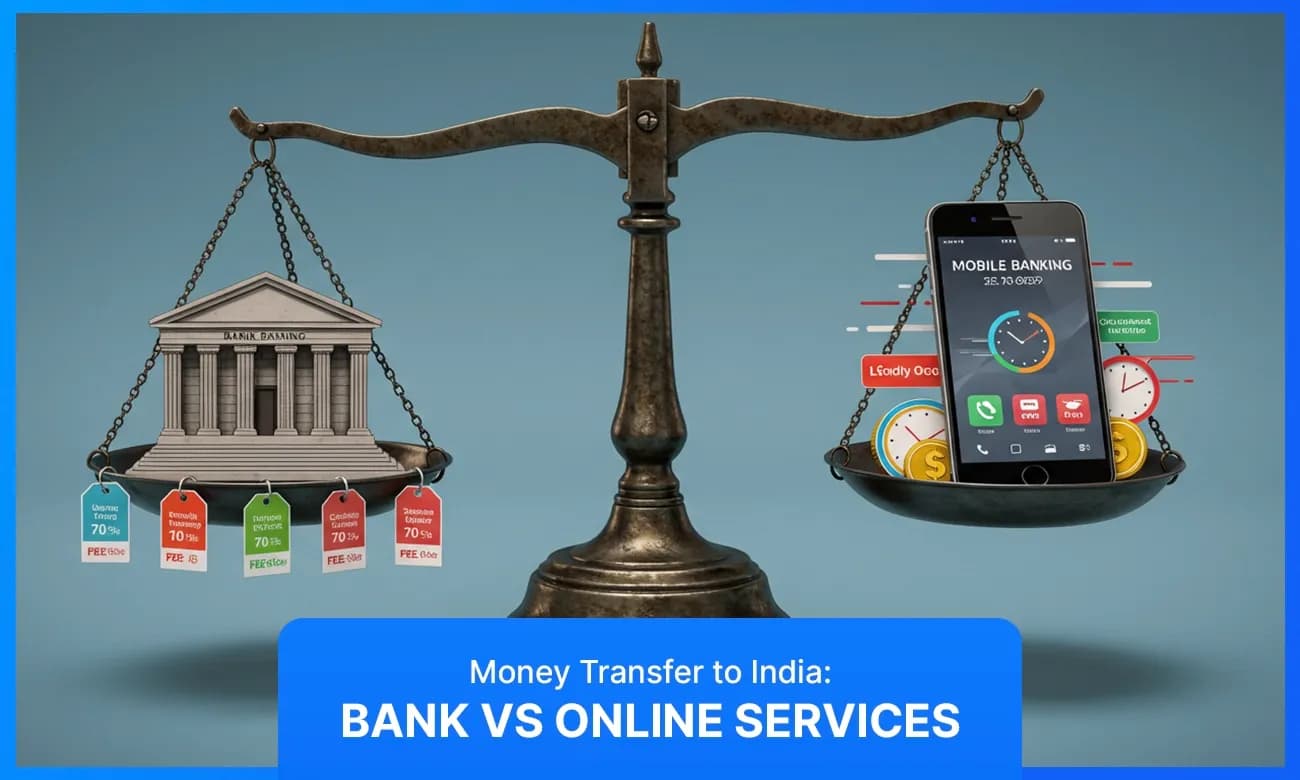
For most personal transfers, mobile apps outperform banks on nearly every measure. Here's how they compare across the factors that actually affect your recipient's bottom line.
Fees
Banks typically charge $30–$50 per international wire, not including intermediary deductions.
Worse, they rarely show how much your recipient will get after conversion. Apps like RemitBee and Wise show the final payout upfront, often waiving fees over $500 CAD.
Exchange rates
Banks use marked-up exchange rates (often 2–4% worse than mid-market). Mobile apps generally offer mid-market or near-market rates with a smaller, declared margin.
Getting the best exchange rate on India transfers comes down to timing, provider choice, and payment method — small variables that compound on regular transfers.
Speed
Bank wires take 3–5 business days depending on the intermediary network and holidays.
Apps like RemitBee and Remitly (Express) can deliver in hours — sometimes minutes — depending on payment method.
User experience
Banking portals often feel dated, with confusing menus and limited after-hours support. Apps are built mobile-first, letting you track in real time, set up recurring transfers, and send money at any hour.
Security
Both banks and top-tier apps are regulated by FINTRAC (Canada) and must follow KYC/AML rules. Apps like RemitBee use 2FA, fraud monitoring, and bank-level encryption — the regulatory bar is the same.
How do you choose the right money transfer service?
Choosing the wrong provider could mean delays, high fees, or a failed transfer. The right one could save you hundreds annually.
Total cost
Low fees don't always mean better value — some providers hide poor exchange rates behind a "zero fee" label. Compare both what you pay and what your recipient receives. That's the real cost.
Speed
For medical emergencies or payment deadlines, speed is critical. Check for instant or same-day options, whether holidays delay transfers, and how payment method affects delivery time (e-Transfer is faster than EFT).
Safety
Your money's security is non-negotiable. Choose FINTRAC-regulated services that use encryption and 2FA, and that offer digital receipts and FIRC/FIRS certificates for compliance.
Ease of use
If the process feels like solving a puzzle, it's the wrong platform. Look for real-time tracking, responsive support via live chat, intuitive mobile apps, and clear instructions for both sender and recipient.
Which money transfer apps work best for India?
The top mobile apps for sending money to India differ on fee structure, corridor speed, and rate transparency.
RemitBee offers the best value for Canadians with no fees over $500 CAD, competitive rates, and fast delivery.
Wise stands out for transparency with mid-market rates plus a digital FIRC. Remitly and Panda Remit offer strong first-time promos, but fees rise after initial transfers.
How do you send money with RemitBee?
RemitBee is built for Canadians who need fast, low-cost transfers to India.
You can sign up, verify your identity, add your recipient's details, and send money to India — most recipients see the money within 24 hours, often in just a few hours.
Are there limits to sending or receiving money in India?
Most personal transfers are unrestricted, but important rules apply depending on the route and purpose. India uses three main channels for inward remittance.
Rupee Drawing Arrangement (RDA)
RDA is the most commonly used channel for personal remittances into India. It allows unlimited inward remittances for personal use — family support, gifts, education, medical expenses. Trade-related payments through RDA are capped at ₹15 lakh (INR 1,500,000).
Money Transfer Service Scheme (MTSS)
MTSS handles smaller personal remittances, especially through money transfer agents. The limits are stricter.
Max $2,500 USD per transaction
Max 30 transactions per calendar year per recipient
No use for business, investment, or charitable contributions
Practical for recipients who prefer cash pickup or lack bank accounts
Online Payment Gateway Service Provider (OPGSP)
The OPGSP model applies to online business and export payments — e-commerce, freelance income, and similar flows.
Max $10,000 USD per transaction
Only for business-related transactions
Regulated by RBI via Authorized Dealer (AD) banks
The limits on foreign remittance to India vary by channel, and picking the wrong one can cap your transfer or trigger compliance flags on the recipient's end.
How is inward remittance taxed in India?
Most personal remittances are not taxable in India, but there are exceptions worth knowing about.
The tax rules on sending money to India from Canada depend on the recipient's relationship to the sender, the purpose of the transfer, and how the money is used after it arrives.
In short — gifts from close relatives (spouse, parents, siblings), education and medical remittances, repatriation of savings, and inheritance are generally non-taxable.
Gifts over ₹50,000 from non-relatives, interest earned on deposited remittance funds, and money received for services (salary, consulting) are taxable. Always request a FIRC or FIRS from the receiving bank to document the purpose and source.
What are the best tips to maximize every dollar?
Small adjustments in timing, method, and amount can save hundreds over a year. Here's what makes the biggest difference.
Time your transfers
Exchange rates shift multiple times a day, and even small swings cost real money on large transfers. Track the CAD–INR trend, use providers that let you lock in rates, and avoid weekends or holidays when rates tend to be less favorable.
Send over $500 CAD when possible
Most platforms (including RemitBee) waive fees above $500 CAD. Bundling smaller transfers into one larger transfer gives you better rates, fewer deductions, faster delivery, and simpler tracking on both ends.
Pick the right payment method
Your payment method affects both speed and cost.
Interac e-Transfer — fast and often free
EFT — slower but ideal for large, regular transfers
Credit/debit cards — fast but may incur extra fees (cash advance fees on credit cards often run 3–5%)
Confirm recipient details carefully
Incorrect recipient info is the number one reason for failed or delayed transfers. Double-check the IFSC code, branch address, and bank account name (must match the ID). Save trusted recipients for faster future transfers.
Get documentation for large transfers
If you're sending large sums for property, education, or investment, mention the correct purpose code during setup, save digital receipts and exchange rate confirmations, and request a FIRC or FIRS from the receiving bank.
The documents required for international transfers to India differ by transfer size and purpose — property transactions need more paperwork than a family support remittance.
What mistakes should you avoid?
Even with good apps, a few missteps can cost money, time, or compliance trouble. The most common mistakes when sending money to India come down to three things:
Defaulting to your bank without comparing rates
Sending small amounts frequently when batching saves fees
Failing to declare the correct purpose (which triggers compliance flags)
How should you handle sending money during festivals?
For the Indian diaspora in Canada, sending money home during Diwali, Eid, Raksha Bandhan, and Christmas is more than a transaction — it's tradition.
But festival seasons affect money transfer rates and processing times because remittance volume spikes in the days leading up to major dates.
Sending a few days early and choosing a provider with 24/7 support avoids the worst of the congestion.
Frequently asked questions
Here are some commonly asked questions on this topic:
What is the safest way to send money to India for a property purchase?
Use a regulated service that provides FIRC documentation, like Wise or RemitBee. Declare the transfer purpose as "property investment" and keep all receipts for future property registration and tax filing in India.
Can I send money to India from Canada using a credit card?
Several platforms allow credit card transfers, including Remitly and RemitBee. However, credit card transfers come with higher fees and potential cash advance interest — best for urgent, small transfers rather than regular remittances.
Are there apps that allow instant transfers to India?
Apps like RemitBee, Panda Remit, and Remitly (Express) offer instant to same-day delivery for many Indian bank accounts. The payment method matters — Interac e-Transfer and debit card funding tend to process fastest.
What happens if I send money to the wrong bank account?
The transaction may fail or get credited to the wrong person. Contact the remittance service immediately. Some services allow corrections if the money hasn't been delivered yet. Always double-check recipient information before confirming.
Can I send money to India without a bank account?
You can use card-to-bank or e-Transfer services from platforms like RemitBee (via debit) or Western Union. You still need to verify your identity and use a valid funding source.