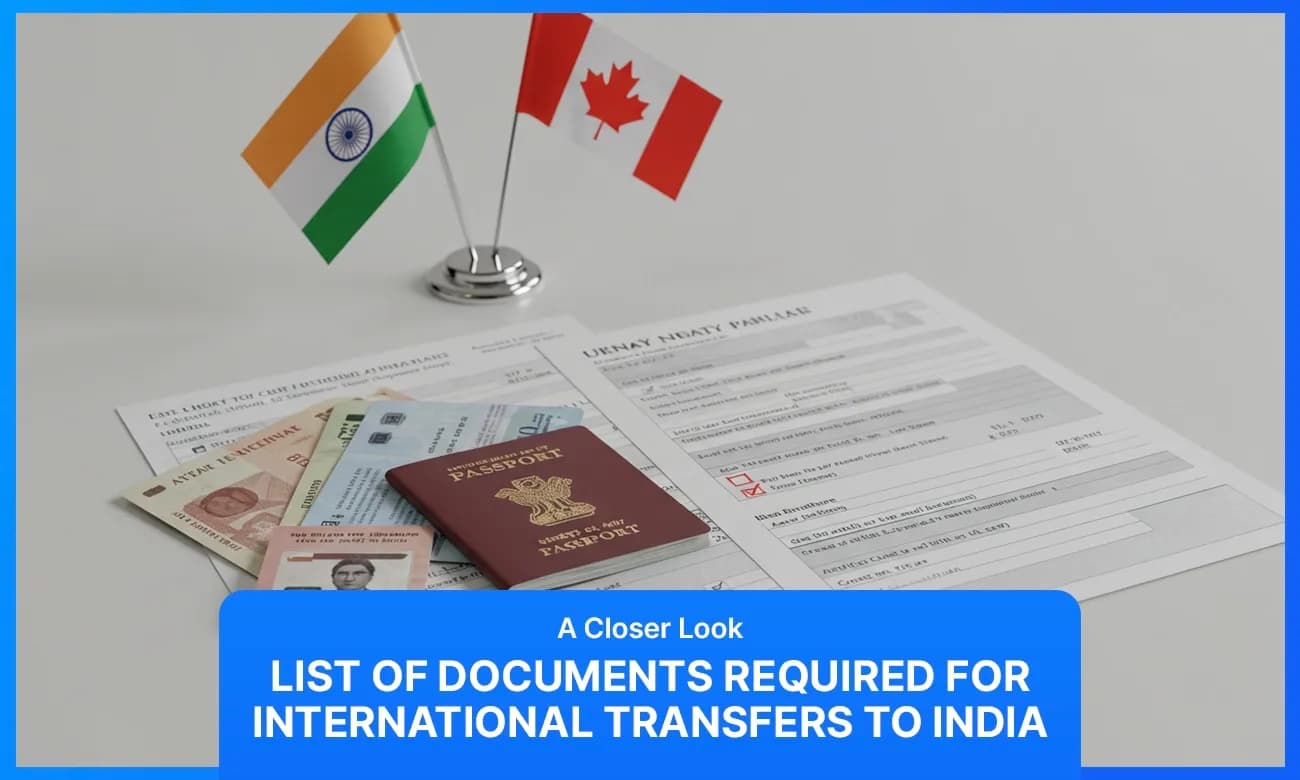
Countless people work tirelessly overseas to earn a reasonable sum for their families in India and send it regularly.
But what if your hard-earned money is held up, just because of a simple error or a missing document? It would be frustrating for you and your loved ones back home.
You deserve a smooth process in this day and age.
Let’s help your money flow freely to India with this detailed guide on all the documents and details you need to submit, ensuring a seamless transfer to India.
What Documents Are Required to Send Money to India?
If your documentation is complete, there’s no reason why you should face any delays in relaying your funds to India.
Here’s a quick skim on everything you need:
| Document/Detail | Purpose/Notes |
|---|---|
| Remitter’s Name & Address | Identification & compliance |
| Remitter’s Photo ID | KYC/AML compliance |
| Beneficiary’s Name | Identification |
| Beneficiary’s Bank Details | Account crediting |
| SWIFT/IFSC Code | Routing the funds |
| Purpose of Remittance | Regulatory compliance |
| Amount & Currency | Transaction processing |
Let’s examine the documents and details more thoroughly.
Remitter’s Identification and Details
Nothing trumps security as a priority when it comes to trusting payment gateways with your hard-earned money. That's why proving who you are matters.
Your identity keeps your transfer safe from bad actors. To start, you just need a few things:
- Your complete legal name.
- Your current home address.
- A government-issued photo ID.
Beneficiary’s Information
Next, you'll need the recipient’s full legal name. This name must exactly match the one on their official documents. A tiny typo can cause big problems.
Once you have the name, gather their bank details, which could include:
- The bank's name.
- The specific branch.
- Their correct account number.
This information ensures that money goes to the precise place. Also, you will need a SWIFT/BIC code (this is like a unique address for their bank). Without it, your transfer may be sent to the wrong bank or experience long delays.
Transaction Details
Every transfer needs a clear reason. Common reasons include:
- Medical costs.
- Education fees.
- Family support.
- Business payments.
Sometimes, your reason may require additional documents. You must also declare the exact amount you are sending. And name the currency, of course.
Key Compliance Requirements and KYC Verification
To ensure safe and secure transactions, KYC (Know Your Customer) is required for both the sender and the recipient when sending money to India. Here’s what you need:
For the sender
- Full Name
- Valid Government-Issued Photo ID (e.g., Passport, Driver’s License)
- Current Address
For the recipient (Beneficiary)
- Full Name
- Valid Government-Issued Photo ID (e.g., Passport, Aadhaar Card)
The KYC process helps prevent fraud and ensures that your transfer complies with international financial regulations.
If you still have questions, check out our 10 most common questions about international money transfers
Send Money to India with Ease and Confidence with Remitbee
Remitbee makes sending money to India easy and worry-free. With RemitBee, you get low fees and no hidden costs - see reasons why you should choose RemitBee over other money transfer companies. With Remitbee, you get:
- Low fees.
- No hidden costs.
- An easy-to-use platform.
- Competitive exchange rates.
Experience the smoothest way to get funds to your loved ones, help your business thrive, or grow your investments.
Send money to India today.