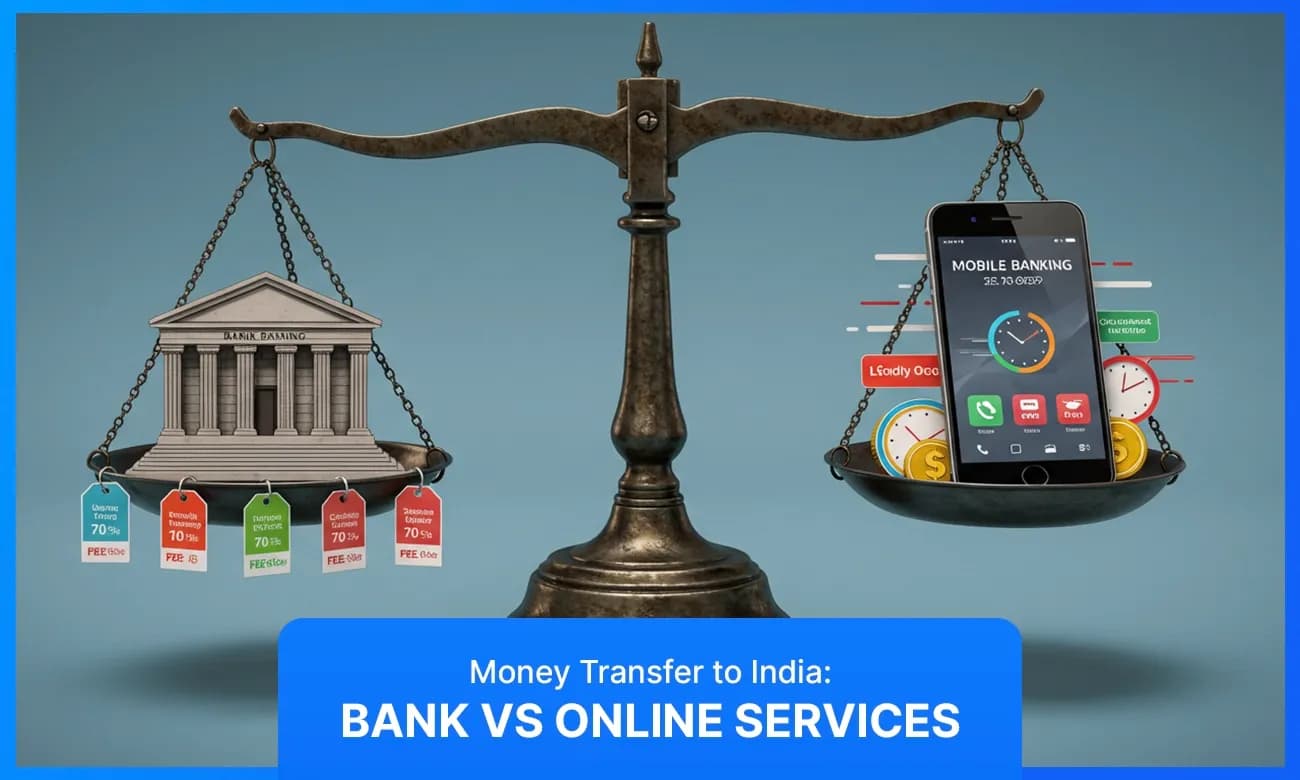
Banks used to be the go-to method for transferring money to India. But with the dramatic technological changes, several online services emerged to challenge the long-time monotony and monopoly of banking systems.
There was a time you waited days for your money to arrive via banks, and hefty fees chomped away at your cash. Online payment services closed this gap by providing good rates and better speed as an alternative.
In this guide, we'll compare banks vs online services over the following metrics and analyze the best way to send money to India from Canada:
- Security (keeping it safe)
- Speed (how fast it travels)
- Cost (where your money goes)
- Convenience (making your life easier)
Let's dive in.
How effective are banks for transferring money to India in 2025?
To sum it up, they do get the job done. Banks are still considered the go-to method to send money overseas by many (mostly because of their reliability).
The idea to send your money via a service that doesn't have a physical presence in your city, let alone your neighborhood, seems a little skeptical, especially in a third-world country.
That also has to do with the age factor, too, and that's why there's a sufficient chunk of people who trust banks with their hard-earned money. However, they lag behind online services in some regards, and it's surprising why, as they've been shuffling money across oceans for decades. Let's have a closer look:
The usual suspects
When you send money through your bank, you're dealing with these heavy hitters:
- Demand drafts transfer at the speed of snail mail
- Direct bank services skip some middlemen but still crawl along
- SWIFT wire transfers play hot potato between banks until it lands in India
Third-party wire services where banks often rely on Western Union, Visa, or MasterCard infrastructure, adding even more fees and delays to your transfer
These methods work. They just cost you time and cash while they lumber to the finish line. Yeah, the new app your bank just launched might make starting the transfer feel modern.
But in reality, most of these operate as the same old expensive, slow-motion money machines. Many banks don't even handle transfers in-house anymore, instead outsourcing to third-party providers that tack on additional charges.
Getting started with bank transfers
Here's what many people don't realize: to use your bank's transfer services, you need to be their client first. If you're not already banking with them, you'll need to:
- Book an appointment (which can take weeks)
- Visit their branch in person
- Provide extensive documentation
- Go through their full account opening process
- Wait for approval before you can even make your first transfer
This entire process can take weeks before you can send a single dollar, making banks incredibly inconvenient for anyone who needs to transfer money quickly or doesn't already have an established banking relationship.
What you'll actually pay
Banks surprise you with multiple bank charges :
- Processing charges that aren't disclosed upfront
- Intermediary bank fees that appear without warning
- Transaction fees ranging from 3% to 7% of your total transfer amount
- Hidden exchange rate markups that can cost hundreds on larger transfers 8 Additional third-party service fees when they use Western Union, Visa, or MasterCard networks
You send $1,000, but your family in India might only receive $920 after all the fees and poor exchange rates eat away at your money.
Online services flip this around with transparent pricing upfront.
How long you'll wait
If you're in a hurry, trusting banks is not a good idea.
SWIFT transfers typically take 3 to 7 days (if nothing goes wrong). When banks use third-party wire services, delays can stretch even longer as your money bounces between different systems. Even their "express" services can't keep up with online platforms, while online transfers are as quick as same-day delivery. There's almost no waiting around.
Security trade-offs
Banks provide excellent security through heavy regulation and established protocols, which makes them ideal for large transfers.
However, the security often requires extensive documentation and verification processes that can slow down your transfer.
Limited options
Bank transfers are limited to the recipient having a bank account. If your family member in India doesn't have easy access to banking, they're stuck.
Online services offer multiple options:
- Mobile wallets for tech-savvy users
- Bank deposits for traditional recipients
- Cash pickup locations for those without bank accounts
- Your recipient can choose what works best for them.
What makes online money transfers so popular?
Digital platforms have flipped the money transfer game upside down. They're faster, cheaper, and designed with you in mind.
The new players
Services like RemitBee, Wise, Remitly, Xoom, and Instarem have grabbed market share by doing what banks couldn't: making international transfers simple and affordable. These platforms have built their systems from the ground up for international transfers, unlike banks that often rely on decades-old infrastructure or third-party providers.
For example, Wise uses the real mid-market exchange rate, so you get maximum value for your money. Other services focus on speed and transparency, offering competitive exchange rates with minimal markup.
Real savings
Online services typically charge a flat fee of your transfer amount, plus a minimal markup on exchange rates. Compare that to banks charging up to 7% and then a markup on exchange rates (the savings add up quickly).
RemitBee takes it further by offering competitive exchange rates with minimal markup. More of your money actually reaches its destination instead of disappearing into fee structures and third-party charges.
Security without the hassle
Sure, banks have amazing security protocols, but they're painfully slow.
Modern online services use state-of-the-art encryption and multi-factor authentication. They comply with the same financial regulations as banks but without drowning you in paperwork.
For example, RemitBee is regulated by FINTRAC, pass all the audits and comply with AML.
You can see exactly where your money is at every step of the journey.
How much are you really paying?
Let's break down the real costs so you can see exactly what each option means for your wallet:
Can banks help with time-sensitive transfers to India?
Your transfer hits a snag at 11 PM on a Saturday, as most banks stick to their 9-to-5 schedule. That doesn't align well with your time-sensitive transfers.
You'll get shuffled through phone menus during business hours, then wait while they dig through paperwork to figure out what went wrong. Online services take a different approach. Whatever the time is, someone's there. Most offer live chat, email support, and phone lines that actually connect to humans.
You can track your transfer in real-time and solve most issues yourself through their help centers.
What about business transfers and large payments?
Business needs are different from personal transfers. Higher amounts, documentation requirements, and compliance issues all come into play.
Business account requirements
Banks built their reputation on big business moves and can handle six-figure supplier payments like it's nothing. Their transfer limits stretch as high as your business needs. Plus, they hand you tax-ready receipts that make your accountant smile.
However, every large transfer means forms, approvals, and waiting. Your urgent supplier payment gets stuck in their approval maze while your business deadline approaches.
Transfer limit realities
Online services are catching up fast. Many now process up to $250,000 daily through business accounts. That covers most small and medium companies without the traditional bank headaches.
Personal accounts start with lower limits, but a quick verification bump usually opens the floodgates. For those rare million-dollar moves, banks still rule the roost with unlimited potential.
Compliance and documentation
Both banks and online services must follow AML (Anti-Money Laundering) and KYC (Know Your Customer) regulations for business transactions. This means documentation and verification are required regardless of which service you choose.
Banks typically require detailed physical paperwork and in-person verification for large amounts, leading to slower processing due to manual procedures.
Online services offer digital KYC processes where you can upload documents directly through their platform, providing faster verification while maintaining thorough compliance standards. Many now offer the same level of accounting integration and vendor payment infrastructure that banks provide.
Which option actually fits your needs?
Your choice depends on what you're trying to accomplish. Let's break it down by use case.
For personal transfers
Banks work best in these situations:
- You already have an established banking relationship
- Your recipient has an established bank account in India
- You're not concerned about higher fees or slower processing
- You're sending very large amounts that need maximum security
Online services are ideal when:
- You want the best exchange rates and lowest fees (if you also send money to neighboring countries, you will find similar benefits, as detailed in our guide with pakistan transfer fees explained).
- Your recipient needs flexible payout options
- You prefer transparent, upfront pricing
- Speed matters for your transfers
You don't want to deal with bank account requirements and lengthy setup processes
For business transfers
Banks are the better choice when:
- You already have established business banking relationships
- You regularly send extremely large amounts
- You need comprehensive documentation for tax purposes
Online services work better when:
- Speed and transparency are essential for your operations
- You want real-time tracking with modern business tools
- You need competitive rates and lower fees
- You run an SMB
You need complex accounting integration and vendor payment infrastructure without traditional banking overhead
For emergency transfers
Banks aren't ideal for urgent situations because:
- Transfers take 3 to 7 days minimum
- Processing is too slow for time-sensitive needs
- They're better suited for planned, large transfers
- You need to be an existing client to access services quickly
- Online services excel in emergencies because:
- Recipients can get cash quickly without needing a bank account
- Multiple payout options provide immediate access
- They're available 24/7 for true emergencies
- They offer instant or same-day processing
your best move?
For most people, online services deliver what you actually want: reasonable fees, fair exchange rates, quick transfers, and zero headaches.
Banks still earn their keep for massive business deals or when you need that old-school banking relationship and already have established accounts.
But for regular family support, urgent situations, and typical business needs, online services simply work better. They've been built specifically for international transfers, while banks often rely on outdated systems or third-party providers that add complexity and cost.
The choice comes down to your priorities: if you value convenience, speed, and transparent pricing, online services are your best bet. If you prefer traditional banking relationships and don't mind paying extra for the familiar experience, banks remain a viable option.
Send money to India today
Frequently asked questions
Here are some commonly asked questions on this topic:
What's the real difference between bank transfers and online services?
Banks charge higher fees (3-7% vs 0.3-3%), take longer (3-7 days vs instant), and offer worse exchange rates. Online services provide transparent pricing, faster transfers, and better rates with more flexible payout options. Additionally, banks often require you to be an existing client, while online services let you start transferring immediately.
How quickly do online transfers to India actually process? Most online services offer instant or same-day transfers depending on the payout method. Bank transfers consistently take 3 to 7 days minimum, with additional delays possible when third-party wire services are involved.
Are online money transfers actually safe?
Yes. Online services use high-level encryption and multi-factor authentication just like banks. You also get real-time tracking so you can monitor your transfer every step of the way. They follow the same regulatory requirements as traditional banks.
Can I send money if the recipient doesn't have a bank account?
Absolutely. Online services offer cash pickup locations and mobile wallet options, so your recipient doesn't need a bank account to receive money. Banks typically only offer bank-to-bank transfers.
Do I need to be a bank customer to send money internationally?
Yes, for bank transfers you need to be an existing client or go through their full account opening process, which can take weeks. Online services let you start sending money immediately after a simple verification process.