Your work permit grants legal status to work in Canada — but a work permit alone doesn't authorize re-entry after international travel.
If you're from a visa-required country and plan to leave Canada (even briefly), you'll need a valid Temporary Resident Visa (TRV) to board your return flight and cross the border.
When you extend or receive a new work permit from inside Canada, IRCC doesn't automatically issue a fresh TRV. The visa must be applied for separately, and the process involves both an online application and physical passport mailing for the actual visa sticker.
This guide covers:
- When to submit your application
- Passport stamping and mailing procedures
- Why work permit holders need a separate TRV
- Step-by-step online process through IRCC
- Required documents and forms
What Documents Do You Need for an Inside-Canada TRV?
The document checklist generates automatically based on your answers in the IRCC online questionnaire, but work permit holders typically need the following.
Core Forms
- IMM 5707 (Family Information Form) — if listed in your checklist
- IMM 5257b (Schedule 1) — only if you answer "Yes" to background questions 3-6
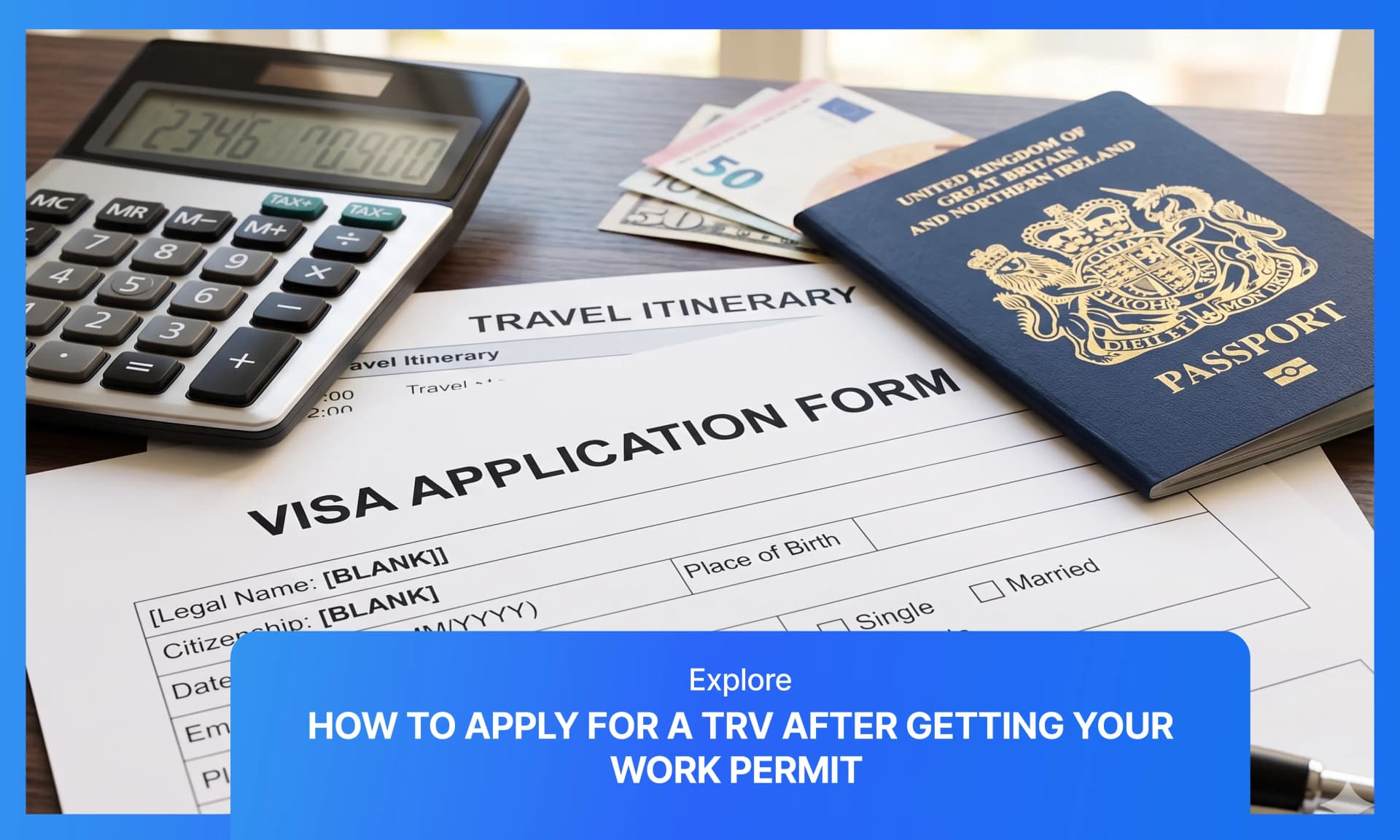
- IMM 5257 (Application for Visitor Visa Made Outside of Canada) — despite the confusing title, this is the correct form for inside-Canada applications
Supporting Documents
| Document | Purpose | Required for |
|---|---|---|
| Valid passport | Biodata page plus all pages with stamps, visas, or markings | Border authorization |
| Current work permit | Scanned front and back (or approval screenshot if physical copy hasn't arrived) | Proof of status |
| Digital photo | Recent color photo meets IRCC specifications | Identification |
| Proof of funds | Bank statements for the past 4 months, pay stubs, or employment letter | Financial capacity |
| Employment verification | Details covering the past 10 years with no gaps in history | Work history |
Important: The forms must be opened in Adobe Reader, completed digitally, and validated to generate the required barcodes before uploading. Submitting forms without barcodes results in returned applications (a frustrating but common mistake).
How Do You Apply for a TRV Through IRCC Online?
The entire application runs through your IRCC Secure Account. Paper applications are reserved only for applicants with disabilities preventing online access.
Questionnaire Setup
Sign in to your IRCC Secure Account and start a new application. The questionnaire determines your document checklist — answering correctly matters:
- Select "Canada" as the current country of residence
- Choose "Work" (not "Visit") for your purpose — selecting "Visit" generates the wrong checklist
- Indicate that you have a valid work permit
Application Steps
- Sign in to the IRCC Secure Account
- Complete the eligibility questionnaire
- Download and complete IMM 5257 in Adobe Reader
- Click "Validate" to generate barcodes
- Upload all required documents as consolidated PDFs
- Pay fees ($100 application + $85 biometrics if required)
- Submit and save confirmation
Completing the IMM 5257 Form
When completing the IMM 5257 form, the "Details of Visit to Canada" section requires specific dates:
- "From" date: Use the date you're submitting the application
- "To" date: Use the expiry date on your current work permit
Your TRV will typically be issued with the same expiry date as your underlying work permit — the two documents align to maintain a consistent status.
When Should You Apply for a TRV?
The processing time benchmark for inside-Canada TRV applications sits at approximately 16 days (as of late 2025). Still, this estimate excludes passport mailing time — a detail that catches many people off guard.
Apply at least 2-3 months before any planned international travel. The full timeline includes:
- Online application processing (roughly 16 days for 80% of cases)
- Passport mailing to Ottawa (varies by postal service)
- Visa stamping at the Case Processing Center
- Return mailing of stamped passport
After Permit Approval
You don't need to wait for your physical work permit to arrive by mail before applying for the TRV. As soon as you receive the approval notification in your IRCC Secure Account, you can submit your TRV application — just include a screenshot of the approval message as proof.
Critical: If you leave Canada before your TRV is issued, you'll face longer processing times at overseas visa offices, potential additional requirements (such as new biometrics or medical exams), and no guarantee of approval. Applying from inside Canada while you have a valid status is significantly faster and more predictable.
What Happens After Your TRV Is Approved?
Online approval doesn't mean you can travel immediately. The TRV is a physical sticker (counterfoil) that must be placed in your passport, and this requires mailing your passport to IRCC's Case Processing Center.
Passport Request
After approval, you'll receive a Passport Request (PPR) letter in your IRCC Secure Account with specific instructions. Don't mail your passport until you receive this letter — submitting early creates processing confusion.
Mailing Requirements
Purchase two prepaid Canada Post Xpresspost envelopes from a post office:
- One large envelope (318 x 241 mm) for sending your passport
- One standard envelope (260 x 159 mm) for return delivery
Write your full mailing address on the return envelope's "Deliver to" field so IRCC can send back your stamped passport.
Your package should contain:
- Original valid passport
- Copy of PPR letter showing UCI and application number
- Prepaid return envelope
Mailing Addresses
For Canada Post: Temporary Resident Visa Section, CPC-Ottawa, PO Box 9640, Ottawa, ON, K1G 6T2
For private courier: Temporary Resident Visa Section, CPC-Ottawa, 365 Laurier Avenue West, Ottawa, ON, K1A 1L1
Record tracking numbers for both envelopes — you'll want to monitor when IRCC receives your passport and when it ships back. The stamping process itself typically takes a few days to a couple of weeks, though this varies by volume.
What Causes TRV Application Delays?
Several factors extend processing beyond the 16-day benchmark, and most are avoidable with proper preparation.
Documentation Issues
Incomplete applications trigger the most common delays. Missing bank statements, outdated transcripts, or forms without validation barcodes all result in processing halts or returned applications. Additionally, unpaid fees at submission time prevent processing from starting.
Biometrics
If you haven't provided biometrics within the past 10 years, you'll receive a Biometrics Instruction Letter after submission. You have 30 days to visit a collection site — missing this deadline delays (or refuses) your application. Collection site closures during holidays or high-volume periods can further extend timelines.
Complex Cases
Applications involving previous visa refusals, irregular immigration history, or security screening requirements take months rather than weeks. Expired medical exams (valid for 12 months) also trigger additional steps that extend processing.
What Are the Fees for an Inside-Canada TRV?
The standard TRV application fee is $100 CAD, payable by credit or debit card through your IRCC Secure Account. If you need to provide biometrics (most applicants aged 14-79 who haven't given them in the past 10 years), add $85 CAD.
Additional costs include Xpresspost envelopes for passport mailing (approximately $20-30 total for both) — a small expense compared to the risk of being stranded abroad without valid entry documents.
Why Doesn't a Work Permit Include a TRV?
A work permit and a TRV serve different purposes — confusing them creates travel problems for thousands of permit holders each year.
Your work permit authorizes employment in Canada and establishes your legal status while inside the country. The TRV (a physical sticker placed in your passport) authorizes entry into Canada.
When you initially arrived in Canada, your TRV was likely issued alongside your work permit (either at the visa office abroad or the port of entry). However, that original TRV may have expired, been valid for single entry only, or may not match your extended permit dates. Moreover, extending your work permit from inside Canada doesn't trigger automatic TRV renewal — you must apply separately.
Citizens from visa-required countries (most of Asia, Africa, South America, and parts of Europe) need a valid TRV to return to Canada after any international travel. If you're a U.S. citizen or from a visa-exempt country, you'll need an Electronic Travel Authorization (eTA) instead — not a TRV.
| Document | Purpose | Required for |
|---|---|---|
| Work permit | Legal status to work in Canada | Employment authorization |
| TRV | Entry authorization | Boarding flights, crossing the border |
| eTA | Electronic entry authorization | Visa-exempt nationals only |
Frequently Asked Questions
What Happens If You Travel Outside Canada Before Your TRV Is Approved?
Leaving Canada before your TRV is issued creates complications. Your file may need to be transferred to an overseas office (significantly longer processing), and you'll face requirements that don't apply to inside-Canada applications. Apply from within Canada while you have a valid status — it's faster and more reliable.
What Happens If Your Work Permit Expires Before Your TRV Is Issued?
Your TRV is typically issued with the same expiry date as your work permit. If your permit expires before TRV processing completes, contact your institution's immigration advisor — you may need to extend your permit first before the TRV can be issued.
Are TRVs Issued From Inside Canada Valid for Multiple Entries?
Most TRVs issued from inside Canada are valid for multiple entries (not just a single entry), allowing you to travel in and out of Canada throughout the validity period. The specific entry terms appear on the visa sticker once placed in your passport.
Do Family Members Need Separate Applications When Applying for a TRV?
Applying for family members requires separate applications — the online system sometimes generates incorrect forms (like IMM 5708 for status change instead of the TRV form). Each family member needs their own complete application and fee payment.