Canada issues approximately half a million work permits annually to temporary foreign workers across healthcare, construction, agriculture, technology, and hospitality sectors.
The process involves two parties:
- Your employer (who often must prove no Canadian was available)
- You (who must demonstrate eligibility through IRCC)
Getting the sequence wrong — or missing employer obligations — results in returned applications and wasted months. This guide covers:
- Two permit types and when each applies
- Fees, processing times, and priority streams
- Pathways from temporary work to permanent residence
- Employer obligations before you can apply
- Step-by-step online application process
What Types of Work Permits Does Canada Offer?
Canada divides work permits into two categories based on flexibility:
- Employer-specific permits tied to one job
- Open permits allowing work for any employer
Your situation and eligibility determine which type applies.
| Permit Type | Flexibility | Job Offer Required | LMIA Required |
|---|---|---|---|
| Employer-specific | One employer, one location | Yes | Usually yes |
| Open work permit | Any employer, any location | No | No |
Closed Permits (Employer-Specific)
Employer-specific permits restrict you to a single employer, job title, and work location (all printed on the physical document).
Changing employers or roles requires applying for a new permit before starting the new position (not after — many people learn this the hard way).
Most closed permits come through two programs:
Temporary Foreign Worker Program (TFWP): Requires employers to obtain a Labour Market Impact Assessment proving no Canadian is available.
International Mobility Program (IMP): Allows LMIA-exempt permits for intra-company transfers, workers under CUSMA agreements, and others providing significant economic benefit.
Open Permits
Open work permits offer flexibility — work for any employer in any province without a specific job offer. However, IRCC issues them only in limited circumstances:
- Post-Graduation Work Permit (PGWP) holders
- Spouses of skilled workers or international students
- Bridging Open Work Permit applicants awaiting PR decisions
- International Experience Canada (Working Holiday) participants
- Spouses being sponsored for PR from within Canada
The tradeoff is that open permits cost more ($255 versus $155) and aren't available to everyone.
What Must Your Employer Do First?
For most employer-specific work permits, your employer handles critical groundwork before you can submit your application. The exact steps depend on whether the position requires an LMIA.
LMIA Positions
Under the Temporary Foreign Worker Program, employers must prove they couldn't find a Canadian to fill the role.
The process involves:
- Advertising on Job Bank and other channels for at least four weeks
- Applying to Employment and Social Development Canada (ESDC) for a Labour Market Impact Assessment
Once ESDC issues a positive LMIA, your employer provides you with:
- Formal job offer letter
- Copy of the LMIA document
- LMIA number for your application
LMIA processing typically takes 8-29 business days, though regular applications outside the Global Talent Stream can stretch to five months during peak periods.
Exempt Positions
For International Mobility Program positions, employers skip the LMIA but must still submit an official offer through the IRCC Employer Portal and pay a $230 compliance fee.
Your employer then provides the offer of employment number (format: "A" followed by 7 digits). Don't submit your application without this number — IRCC will reject it.
How Do You Apply For A Work Permit Online?
Once your employer completes their obligations, you can submit your application.
As of December 2024, most applicants already in Canada can no longer apply at a port of entry (flagpoling ended) — online applications are now mandatory for both initial permits and extensions.
Application Steps
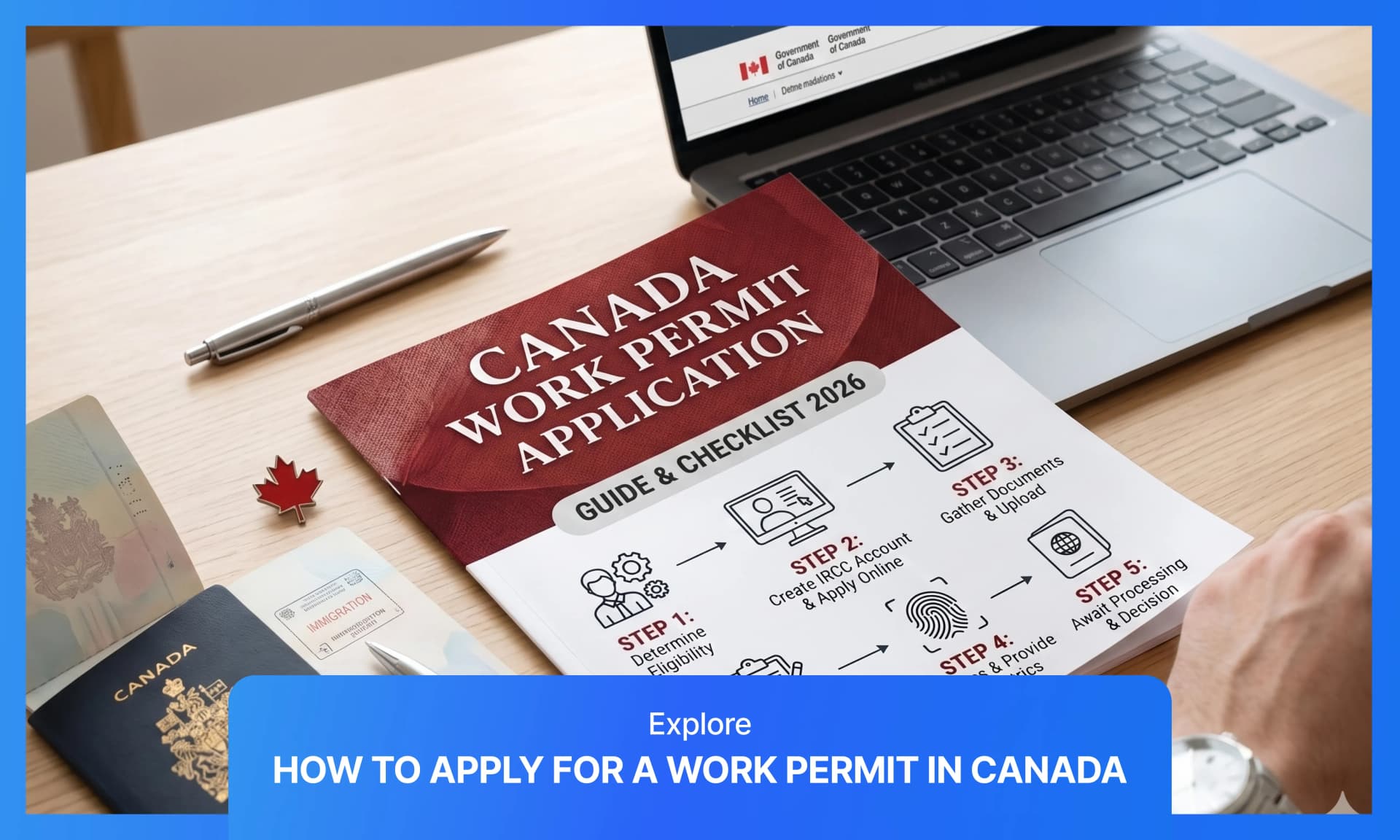
- Sign into your IRCC Secure Account and complete the eligibility questionnaire. Your answers generate a personalized document checklist.
- Create or sign into IRCC Secure Account
- Answer eligibility questionnaire
- Save personalized document checklist
- Gather required documents
- Complete application form digitally
- Pay fees ($155 + additional if applicable)
- Submit and save confirmation
Read the instruction guide before completing your application — the guide explains each field correctly.
Core Documents
Your specific checklist depends on permit type and country of residence, but common requirements include:
- Job offer letter or LMIA copy
- Digital photograph meeting IRCC specifications
- Offer of employment number (for LMIA-exempt positions)
- Valid passport (biographical page plus all stamped pages)
- Proof of qualifications (degrees, certifications, experience)
- Proof of funds (approximately CAD $2,500 for some programs)
Depending on your situation, you may also need:
- Biometrics (fingerprints and photo)
- Medical examination results
- Police clearance certificates
Where To Apply
Your pathway depends on current location:
| Application Location | Process | Eligibility |
|---|---|---|
| Outside Canada | Apply online, receive Port of Entry Letter of Introduction upon approval | Standard process for applicants outside Canada |
| Inside Canada | Apply online | Must hold a valid study/work permit, be a spouse of a permit holder, or meet other eligibility criteria |
| At Port of Entry | Apply directly at port of entry | Only available to U.S. citizens, U.S. permanent residents, and residents of Greenland or St. Pierre and Miquelon (visa-exempt applicants) |
Visitors in Canada on tourist status generally cannot apply from within the country — you'll need to apply from abroad unless you fit specific exceptions.
What Are The Fees and Processing Times?
Work permit fees vary by type, and processing times fluctuate based on application volume, country of residence, and whether your occupation qualifies for priority processing.
Fee Structure
| Fee Type | Amount (CAD) |
|---|---|
| Standard work permit | $155 |
| Open work permit holder fee | $100 (additional) |
| Biometrics | $85 |
| Employer compliance fee | $230 (paid by employer) |
Open work permit applicants pay $255 total ($155 + $100 holder fee). Biometrics fees apply to most applicants aged 14-79 unless they've provided fingerprints within the past 10 years.
Processing Duration
Processing ranges from 1 to 27 weeks depending on the stream and visa office handling your application. The Global Talent Stream offers fast-tracked processing (sometimes two weeks) for high-skilled tech and engineering positions.
IRCC prioritizes certain occupations performing essential services — healthcare workers, agricultural workers, and provincial nominees in specialized medical fields receive faster processing. To get priority, enter your NOC 2021 code in the "Job title" box (not the job title itself — common mistake).
What Happens After Approval?
After submitting your application, IRCC may request additional documents or schedule biometrics collection. Monitor your secure account regularly — failing to respond promptly to requests can result in refusal.
Arrival Process
If approved from outside Canada, you receive a Port of Entry Letter of Introduction (not the actual permit).
Present the letter to a Canada Border Services Agency officer at your arrival point — the officer issues your physical work permit after verifying your identity.
If approved from inside Canada, your permit arrives by mail at your Canadian address. Keep your address updated through IRCC's web form if you move during processing (permits sent to old addresses create significant complications).
Maintained Status
Applicants who submit extensions before current permits expire can continue working under "maintained status" while awaiting a decision. However, leaving Canada during maintained status ends your work authorization until the new permit is approved — a risk worth weighing before booking travel.
How Does A Work Permit Lead To Permanent Residence?
Canadian work experience significantly improves eligibility for permanent residence programs. Many temporary workers use permits strategically as stepping stones toward PR.
Express Entry
The Canadian Experience Class (CEC) specifically targets temporary workers with at least one year of skilled Canadian work experience. The Comprehensive Ranking System awards points for work experience, education, language ability, and age — high-scoring candidates receive Invitations to Apply for Express Entry.
Provincial Streams
Many provinces operate nominee streams specifically for temporary workers already employed within their jurisdiction.
The Atlantic Immigration Program offers pathways for workers in Nova Scotia, New Brunswick, Newfoundland and Labrador, and Prince Edward Island with valid job offers from designated employers.
Workers who've already applied for PR but face expiring permits can apply for a Bridging Open Work Permit — maintaining employment while awaiting the PR decision.
Frequently Asked Questions
What Are LMIA Exemptions, and Who Qualifies For Them?
Not all employer-specific permits require an LMIA. Intra-company transferees, workers under international agreements (CUSMA, CETA), and Global Talent Stream participants fall under LMIA-exempt categories. Your employer must still submit an offer of employment through IRCC's portal and pay the compliance fee.
How Do You Extend Your Work Permit In Canada?
Apply for extensions at least 30 days before your current permit expires. If you submit before expiry, you can continue working under maintained status while IRCC processes your renewal — but don't leave Canada during this period or you'll lose authorization.
Can You Change Employers On An Employer-Specific Work Permit?
Employer-specific permit holders cannot simply switch jobs. You must apply for a new work permit (and your new employer must complete their obligations) before starting work elsewhere. Working for an unauthorized employer violates permit conditions and can affect future immigration applications.