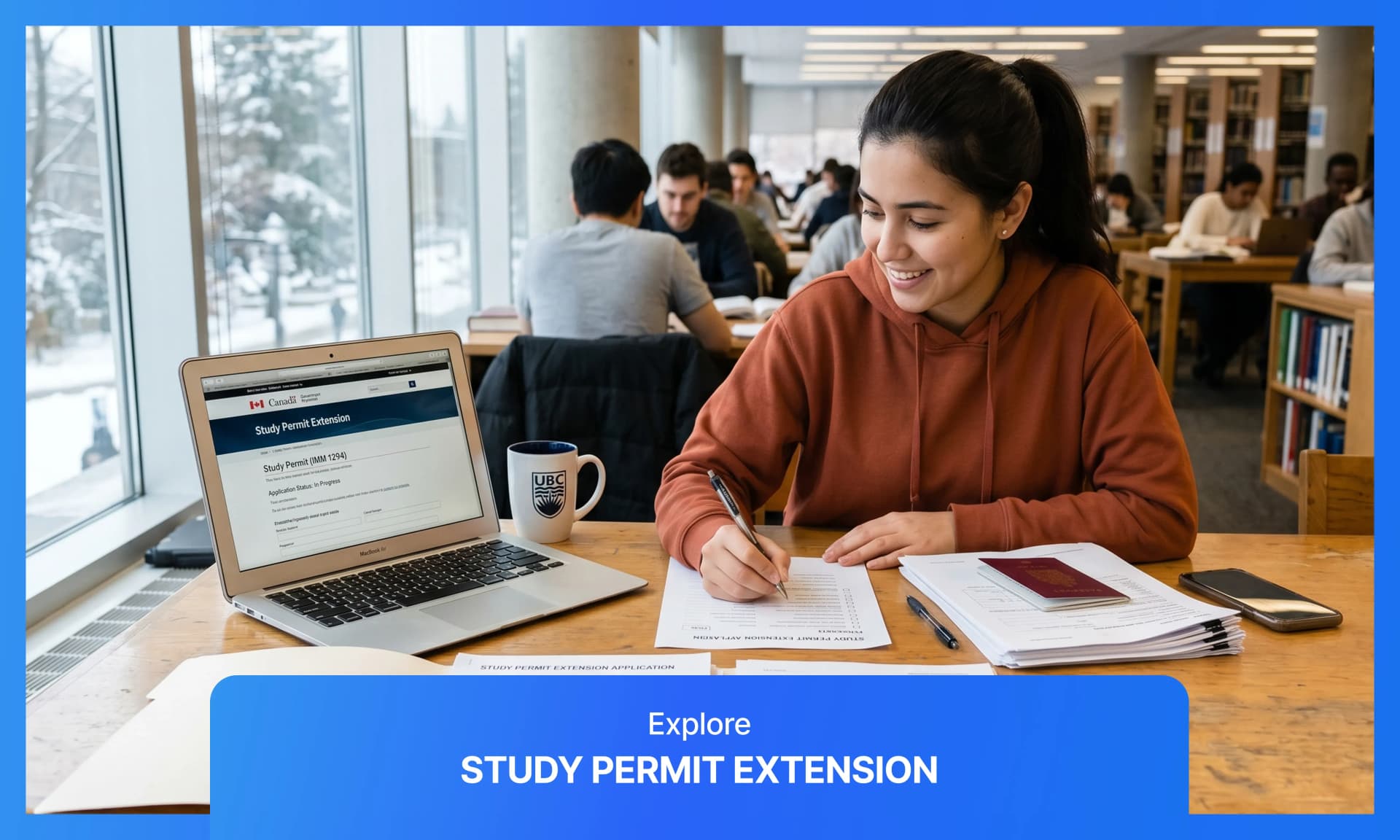
Your study permit has an expiry date printed under "additional information" - usually your program length plus 90 days. If you haven't finished your studies by then, you'll need to apply for an extension before that date passes.
Missing the deadline puts you out of status immediately (no studying, no working, and a more expensive restoration process to fix it).
The good news is that applying early grants you "maintained status," which lets you keep studying under your current permit conditions while IRCC processes your application.
When Should You Apply for a Study Permit Extension?
Submit your application 5 to 6 months before your current permit expires.
Processing times fluctuate (recent estimates range from 54 to 163 days, depending on application volume), so early submission helps protect you against unexpected delays.
The absolute deadline is 11:59 pm Coordinated Universal Time - not your local time - on the day your permit expires. Don't wait until that final day; technical glitches happen, and missing the cutoff means losing your status.
Passport Validity
Your study permit cannot extend beyond your passport's expiry date. If your passport expires before you finish your program, renew it first.
The same applies to your Quebec Acceptance Certificate (CAQ) if you're studying in Quebec - the CAQ must be valid past your current permit's expiration, or you'll need to renew the CAQ before applying for the study permit extension.
Changing Institutions
As of November 8, 2024, students changing schools must apply for a new study permit and receive approval before starting at the new institution.
One exception is that if you're transferring from a Canadian high school to a post-secondary institution, you can begin classes while your extension is being processed (provided you applied before your permit expired or within 90 days of finishing high school, whichever comes first).
What Documents Do You Need for a Study Permit Extension?
IRCC requires several documents to process your extension. Missing items delay processing or result in applications being returned.
Financial Requirements
For applications submitted after January 1, 2024, you must show $20,635 CAD in living expenses (plus tuition) for one year. Starting September 1, 2025, the threshold increases to $22,895 CAD.
Acceptable proof includes:
- Bank statements for the past four months
- GIC documentation
- Scholarship confirmation
- Letter from someone financially supporting you
Provincial Attestation Letter
Most students extending at the same institution and same level of study don't need a PAL - but you must upload proof of your exemption.
Include a letter explaining your situation along with your current study permit and confirmation of enrollment.
You will need a new PAL if you're:
- Applying for restoration after losing status
- Changing to a different Designated Learning Institution
- Moving to a different level of study (undergraduate to graduate, for example)
Graduate students (Master's and PhD) are exempt from PAL requirements as of January 1, 2026.
Required Documents Checklist
| Document | Purpose |
|---|---|
| IMM 5709 form | Main application form (must be validated with barcodes) |
| Passport scan | Biographical page plus all stamped/marked pages |
| Current study permit | Merged with the passport scan into one PDF |
| Letter of enrolment | Confirms active enrollment and expected graduation date |
| Proof of funds | Bank statements, GIC, scholarship letter, or loan documentation |
| Digital photo | IRCC technical specifications apply |
| PAL or proof of exemption | Required if changing schools or study levels |
How Do You Apply for a Study Permit Extension Online?
The application process runs entirely through IRCC's online system. Paper applications are no longer accepted unless you have a documented disability preventing online access.
Here's the step-by-step process:
- Sign in to your IRCC Secure Account (not the IRCC Portal - they're different systems)
- Select "Apply to come to Canada" and complete the eligibility questionnaire
- Save your personalized document checklist and reference code
- Download and complete the IMM 5709 form, then click "Validate" to generate barcodes
- Upload all required documents to your checklist
- Pay the $150 CAD processing fee (credit or debit card accepted)
- Submit and save your confirmation
After approval, IRCC mails your physical study permit to your Canadian address - a process that can take up to six weeks after the digital approval appears in your account.
What Is Maintained Status, and How Does It Protect You?
Maintained status (formerly called "implied status") kicks in automatically when you submit your extension application before your current permit expires.
While your application is being processed, you remain a temporary resident with the right to continue studying and working under your original permit conditions.
However, maintained status has one critical limitation: leaving Canada ends it. If you travel outside the country while your extension is being processed, you lose authorization to study or work until IRCC approves your new permit and it's in your hands. Re-entry might even be denied if you don't have valid documentation.
For students who must travel during processing, contact your institution's international student office before booking anything. The timing can be tricky to navigate without professional guidance.
What Happens If Your Study Permit Expires Before You Apply?
Missing the deadline puts you "out of status." Consequences are immediate:
- You must stop studying and working right away
- You cannot resume studies until your restoration is approved
- You have 90 days from the expiry date to apply for restoration
- The process costs more ($150 permit fee plus $246.25 restoration fee)
Restoration Process
Applying for restoration follows the same online process as a regular extension, but you must:
- Upload a letter explaining why you missed the deadline
- Answer "Yes" to the restoration question in the eligibility questionnaire
- Disclose any unauthorized study or work (failure to disclose can result in a five-year exclusion order for misrepresentation)
Unlike maintained status, restoration applicants cannot study or work while waiting for a decision. If your restoration is refused and you're outside the 90-day window, leaving Canada and applying from abroad becomes your only option.
How Long Does Study Permit Extension Processing Take?
Processing times vary significantly. Recent IRCC estimates for in-Canada extensions have ranged from 54 to 163 days, though the official website updates these figures regularly. Check the current processing times before planning your application timeline.
| Scenario | Estimated Timeline |
|---|---|
| Extension (inside Canada) | 54-163 days |
| Restoration | Similar to extension, plus additional review |
| Receiving a physical permit after approval | Up to 6 weeks |
Biometrics can add time if you haven't provided them within the past 10 years. After submitting your application, you'll receive a Biometrics Instruction Letter if fingerprints and photos are required.
Stay Ahead of Your Deadlines
Extending your study permit is time-sensitive - and so are your finances. While you handle your study permit extension, the last thing you need is delays when sending or receiving money across borders.
RemitBee keeps things simple, fast, and student-friendly:
- Send money home without inflated bank fees
- Lock competitive exchange rates before they shift
- Stay prepared for tuition, rent, or emergency expenses
- Transfer funds quickly when proof of funds is time-critical
- Manage payments easily while on maintained status in Canada
Stay ahead of deadlines by using RemitBee for fast, reliable transfers while you confidently handle your study permit extension.
Frequently Asked Questions
Can you travel while your study permit extension is processing?
Technically, your application continues processing. However, leaving Canada while on maintained status strips your authorization to study and work until you receive your new permit. You might also face complications upon re-entry without a valid study permit.
Do you need a Provincial Attestation Letter for a study permit extension?
Not if you're continuing at the same institution and study level - but you must upload proof of your exemption. Changing schools or study levels requires a new PAL. Quebec students can use their valid CAQ as an attestation letter.
What if your CAQ expires before your study permit?
Apply for your CAQ renewal first. Your study permit extension cannot proceed until you have a valid CAQ that extends past your current permit's expiry date. Contact your institution's international student services if both documents are expiring simultaneously.
How much does a study permit extension cost?
The standard processing fee is $150 CAD. If you're applying for restoration, add $246.25 CAD for the restoration fee. Biometrics (if required) costs an additional $85 CAD.