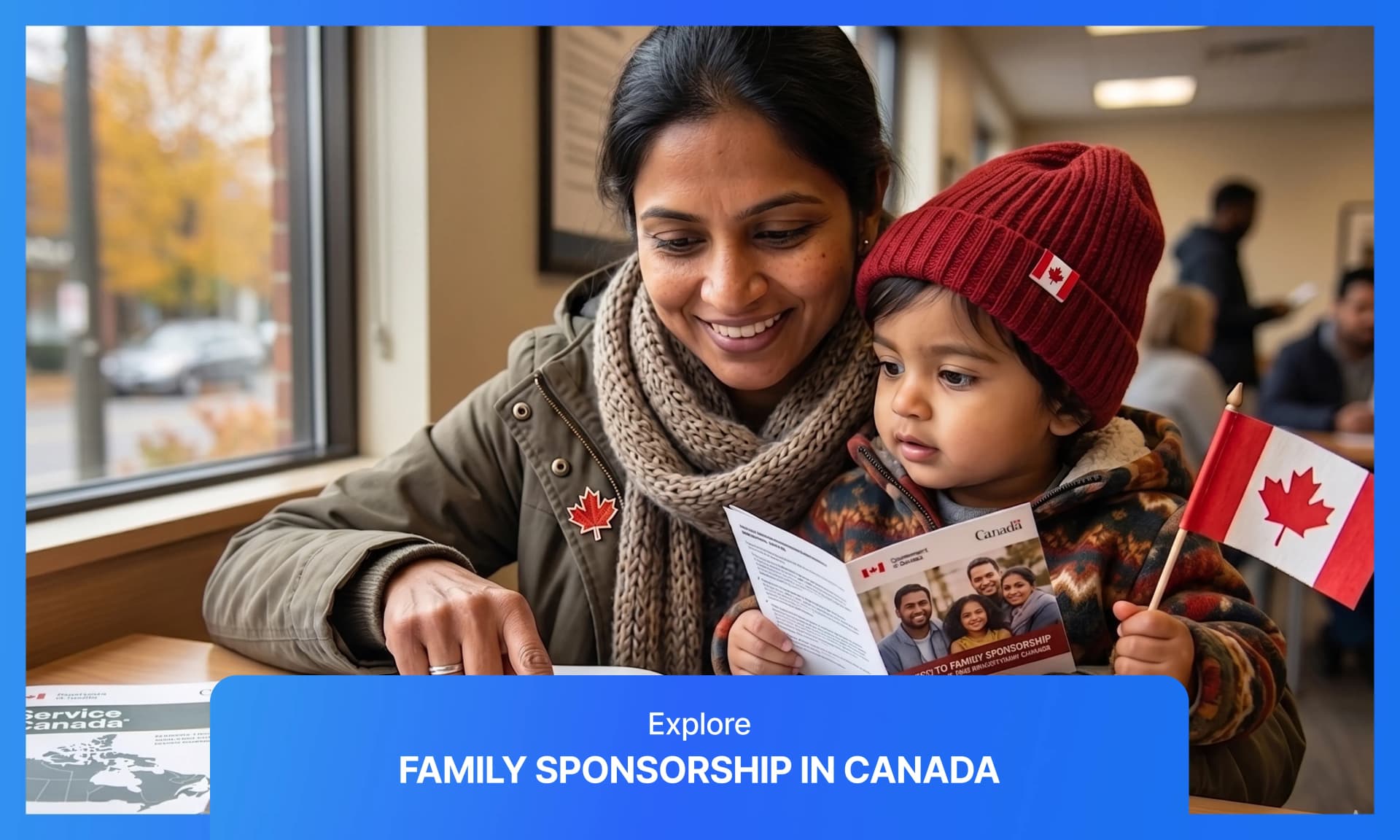
Family sponsorship is Canada's immigration pathway that allows citizens and permanent residents to bring close relatives — spouses, partners, children, parents, and grandparents — to Canada as permanent residents.
The sponsor signs a legally binding undertaking to financially support the newcomer for 3 to 20 years (depending on the relationship), and IRCC processes both the sponsor's eligibility and the applicant's admissibility simultaneously.
As of 2026, spousal sponsorship costs approximately $1,290 in government fees and takes 15-24 months to process, while parent sponsorship runs 20-24 months and requires meeting a minimum income threshold for three consecutive tax years.
In this guide, we'll be exploring current fees and processing timelines, what can disqualify a sponsor or applicant, how long the financial undertaking lasts and what it requires, the step-by-step application process for inland and outland streams, who can sponsor and what residency rules apply, and which relatives qualify.
TLDR — Family sponsorship in Canada
Here's the entire article summarized in a structured way for those short on time:
| Topic | Summary |
|---|---|
| Who can sponsor | Canadian citizens, permanent residents, or persons registered under the Indian Act — must be 18+ and generally residing in Canada |
| Who can be sponsored | Spouses, common-law/conjugal partners, dependent children, parents, grandparents, and certain orphaned relatives |
| Undertaking length | 3 years (spouse) · 10 years (children) · 20 years (parents/grandparents) |
| Government fees | ~$1,290 for spousal sponsorship (no children) |
| Processing time | 15 months outland / 21-24 months inland (spousal, as of March 2026) |
| 2026 admission target | 84,000 for spouses, partners, and children (drops to 81,000 in 2027-2028) |
Who can sponsor a family member to Canada?
A sponsor must be at least 18 years old and hold status as a Canadian citizen, permanent resident, or person registered under the Indian Act. Beyond that baseline, residency, finances, and legal history all determine whether IRCC accepts the application.
Residency rules
Canadian citizens living abroad may sponsor a spouse, partner, or dependent child — but only if they can prove they intend to live in Canada once the sponsored person becomes a permanent resident.
Citizens cannot sponsor parents or grandparents from outside the country. Permanent residents face a stricter rule — they must be physically residing in Canada at the time of application, regardless of who they are sponsoring.
Income standards
Income requirements depend on who you are sponsoring.
Spouses and dependent children generally have no minimum income requirement. That means the sponsor must still demonstrate they can meet basic needs and are not receiving social assistance for reasons other than disability.
Parents and grandparents require proof of meeting the Minimum Necessary Income (MNI) for three consecutive tax years, calculated against total household size.
A spouse or common-law partner can act as a co-signer to help meet the MNI, sharing equal legal liability for the undertaking.
Disqualifying factors
Several conditions bar someone from sponsoring, even if they meet the age and status requirements:
- Being in prison or subject to a removal order
- Receiving social assistance for reasons other than disability
- Criminal convictions for violent or sexual offenses, or offenses against a relative
- Having unpaid immigration loans, child support, or court-ordered family support
- Being in an undischarged bankruptcy or defaulting on a previous sponsorship undertaking
- The 5-year spousal bar (if you were sponsored as a spouse, you cannot sponsor a new spouse until five years after you became a permanent resident)
Which relatives are eligible for sponsorship?
The family class covers close relatives only. Adult siblings, aunts, uncles, cousins, and friends are generally excluded — though narrow exceptions exist for orphaned relatives and the "Lonely Canadian" provision.
Spouses and partners
Legally married spouses (including same-sex marriages), common-law partners (who have lived together for at least 12 consecutive months), and conjugal partners (in a committed relationship for at least one year but prevented from living together by circumstances beyond their control, such as immigration barriers or persecution).
Dependent children
Children under 22 who do not have a spouse or partner of their own. Both biological and adopted children qualify. Children 22 or older may still qualify if they have relied on parental financial support since before turning 22 and cannot support themselves due to a physical or mental condition.
Parents and grandparents
Sponsored through the Parents and Grandparents Program (PGP), which typically operates through a lottery system. Sponsors submit an "Interest to Sponsor" form, and only those randomly selected can proceed with a full application. The income bar is higher here — three years of MNI proof, tied to total household size including the people being sponsored.
Other relatives
In very limited cases:
Orphaned siblings, nieces, nephews, or grandchildren (under 18, unmarried, both parents deceased or legally abandoned).
Also, one extended relative of any age under the "Lonely Canadian" rule (only if the sponsor has no other living close relative who is a citizen, PR, or eligible for sponsorship).
What does the sponsorship undertaking require?
The undertaking is a legally binding contract with the federal government (and, for Quebec residents, a separate provincial contract).
The sponsor agrees to provide food, clothing, shelter, and health needs not covered by public health insurance — and to repay any social assistance the sponsored person receives during the undertaking period.
| Relationship | Undertaking length |
|---|---|
| Spouse, common-law, or conjugal partner | 3 years from the date they become a PR |
| Dependent children | 10 years, or until age 25 (whichever comes first) |
| Parents and grandparents | 20 years |
| Other relatives | 10 years |
The obligation does not end if the sponsor loses a job, the relationship breaks down, or the sponsored person becomes a Canadian citizen. It also does not end if the sponsor moves to a different province.
If the sponsored person receives welfare during the undertaking period, the government can pursue the sponsor for every dollar as a sponsorship debt.
The sponsored person (except dependent children under 22) also signs the sponsorship agreement, committing to make every reasonable effort to become financially self-supporting.
How does the application process work?
Family sponsorship applications are submitted online through the IRCC Permanent Residence Portal. IRCC processes both parts simultaneously: the sponsor's eligibility and the applicant's admissibility.
Inland sponsorship
Used when the spouse or partner already lives in Canada.
The sponsored person can apply for a Spousal Open Work Permit (typically issued within 3-4 months of acknowledgement of receipt), allowing them to work for any Canadian employer during processing.
The catch is that if the sponsored person leaves Canada and border services denies re-entry, the application is cancelled. There is also no right of appeal if refused (only judicial review, which is expensive).
Outland sponsorship
Used when the relative lives outside Canada. The applicant typically waits abroad during processing but may visit Canada. Outland applicants retain a right of appeal to the Immigration Appeal Division (IAD) if refused — a significant advantage over the inland stream.
Required documents
Both streams require a thorough package including police certificates, immigration medical exams, civil documents (birth certificates, marriage certificates), completed IRCC forms (including IMM 5532 for relationship evaluation), CRA Notices of Assessment (for PGP sponsors or those needing to prove income), and proof of relationship (photos, chat logs, travel records, shared financial accounts, cohabitation evidence).
Completeness is not optional. In 2025, roughly 27% of inland applications were returned as incomplete — costing applicants months of delay and non-refundable fees.
How much does family sponsorship cost and how long does it take?
Fees and processing times vary by relationship category and the applicant's country of origin.
Spousal sponsorship fees
For a spouse with no dependent children, government fees total approximately $1,290:
- $85 sponsorship application fee
- $545 principal applicant processing fee
- $575 Right of Permanent Residence Fee (RPRF — the only refundable portion)
- $85 biometrics fee
Third-party costs (medical exams, police certificates, certified translations) add $300 to $800 depending on the country. Quebec residents pay an additional $328 provincial fee and face an intake cap — as of early 2026, MIFI is not accepting new spousal undertaking applications until June 25, 2026.
Processing times
As of March 2026, IRCC estimates:
- Parents and grandparents: ~20-24 months
- Dependent children: varies by country of origin
- Outland spousal sponsorship (outside Quebec): ~15 months
- Inland spousal sponsorship: ~21-24 months
Canada's 2026 immigration levels plan allocates 84,000 admissions for spouses, partners, and children. That number drops to 81,000 in both 2027 and 2028 — which means applications submitted in 2026 compete for a larger pool of available spots.
What can disqualify a sponsor or applicant?
Disqualification can hit from either side of the application. IRCC evaluates the sponsor's eligibility and the applicant's admissibility in parallel.
Sponsor bars
The full list of sponsor disqualifications is covered in the eligibility section above (criminal history, financial defaults, social assistance, the 5-year spousal bar).
One additional rule worth flagging: if you are still financially responsible for a previous spouse who has been a PR for less than three years, you cannot sponsor a new spouse.
Applicant bars
The sponsored person can be found inadmissible for security concerns (espionage, terrorism, organized crime involvement), criminal convictions (including DUI, assault, or fraud — even if committed outside Canada), misrepresentation (providing false or incomplete information can result in a multi-year ban), or medical conditions that pose a public health risk or would cause excessive demand on health/social services (spouses and dependent children are generally exempt from the "excessive demand" rule).
Relationship bars
IRCC also examines the relationship itself. If the relationship is not genuine — or was entered into primarily for immigration purposes — the application will be refused.
Undeclared family members are another trap: if a spouse or child existed but was not declared during the sponsor's own immigration process, that person may be permanently barred from sponsorship under IRPR 117(9)(d).
For newcomers settling in Canada, understanding these bars before applying saves months of delay and non-refundable fees.
Frequently asked questions
What is the "Lonely Canadian" provision?
The "Lonely Canadian" rule allows a Canadian citizen or permanent resident to sponsor one extended relative of any age (an adult sibling, aunt, uncle, or cousin) if they have no other living close relative who is a citizen, permanent resident, or eligible for standard family sponsorship. The sponsor must prove they have no spouse, partner, child, parent, or grandparent available to sponsor or already holding Canadian status. Only one person can be sponsored under this provision.
Can refugees sponsor family members?
Resettled refugees and protected persons in Canada can apply to reunite with non-accompanying immediate family members (a spouse and dependent children) through the One Year Window of Opportunity. The application must be submitted within one year of the refugee's arrival or receipt of permanent residence. A pilot project also allows some refugees to sponsor a spouse or child who was not declared during their initial immigration processing.
Does the undertaking end if we divorce?
No. The financial undertaking is unconditional and irrevocable. It does not end if the relationship breaks down, the sponsor loses employment, or the sponsored person becomes a Canadian citizen. The sponsor remains legally responsible for the full duration of the undertaking regardless of personal circumstances.
What happens if a sponsor defaults on the undertaking?
If the sponsored person receives social assistance during the undertaking period, the sponsor must repay every dollar to the provincial government. The debt is treated as a sponsorship default, which prevents the sponsor from sponsoring anyone else until the full amount is repaid. Provincial governments can pursue collection through standard debt recovery channels.
What are Quebec's additional requirements?
Quebec sponsors must meet separate provincial eligibility standards and sign a second undertaking with the Ministère de l'Immigration, de la Francisation et de l'Intégration (MIFI). Beyond financial support, Quebec sponsors are responsible for helping the newcomer learn French and access public services. Sponsors of individuals aged 18-55 must also sign a formal welcome and integration plan. As of early 2026, MIFI has reached its intake cap and is not accepting new spousal undertaking applications until June 25, 2026.
What is IRPR 117(9)(d)?
IRPR 117(9)(d) is a regulation that bars sponsorship of a family member who existed but was not declared during the sponsor's own immigration process. If a spouse or child was alive at the time the sponsor became a permanent resident — but was not disclosed and examined — that person is generally permanently ineligible for family class sponsorship. A limited pilot project allows some exceptions for refugees.
Can I sponsor my fiancé to Canada?
Canada does not have a fiancé visa. To sponsor a romantic partner, the relationship must already qualify as a marriage, common-law partnership (12+ months of cohabitation), or conjugal partnership (1+ year commitment with an immigration or persecution barrier preventing cohabitation). If none of these categories apply, the partner may need to explore other pathways such as a visitor visa, study permit, or Express Entry.