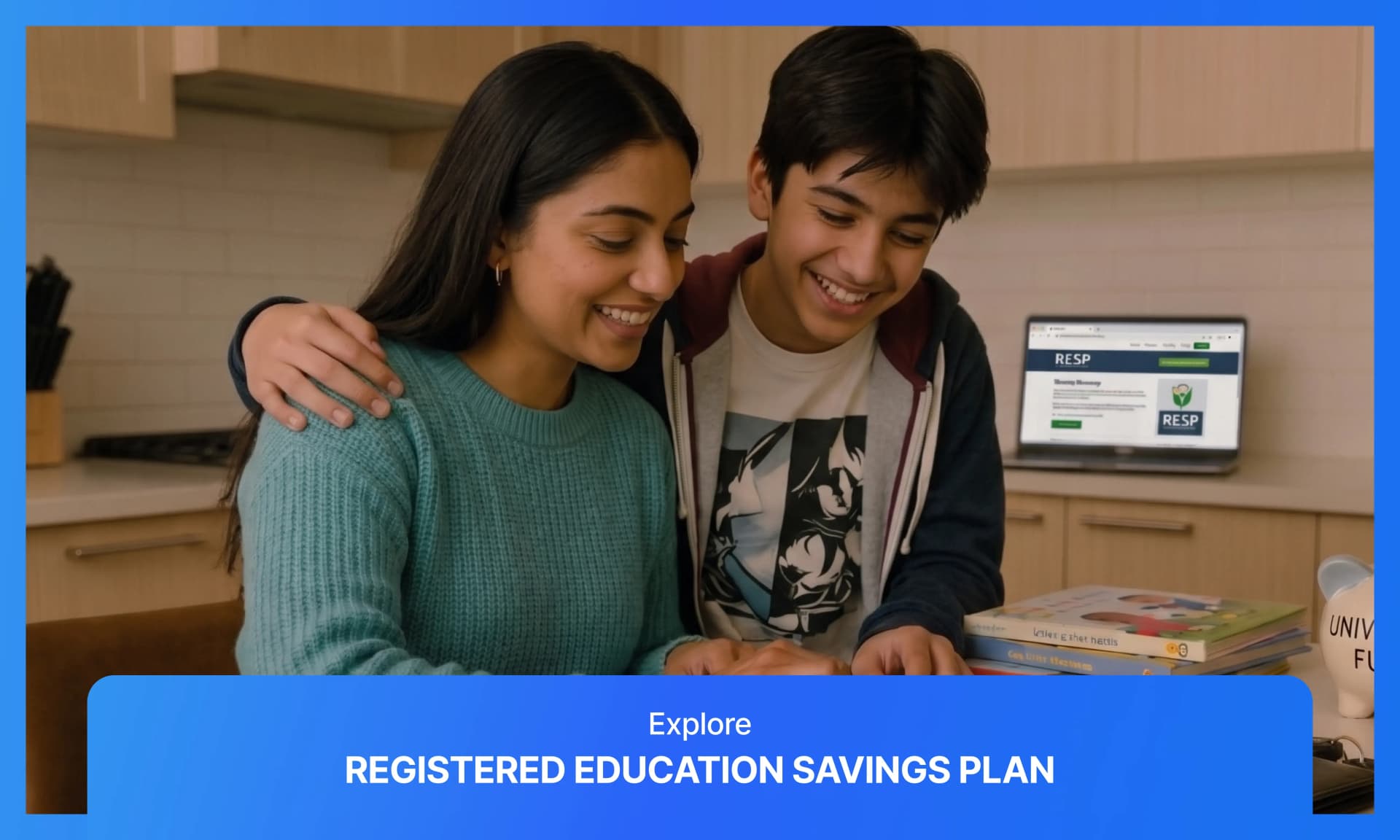
An RESP (Registered Education Savings Plan) is a tax-sheltered Canadian savings account designed to help families save for a child's education after high school — including university, college, trade school, CEGEP, and apprenticeship programs.
Contributions grow tax-deferred, and the federal government adds free money through the Canada Education Savings Grant (up to $7,200 per child) and the Canada Learning Bond (up to $2,000 for eligible lower-income families). The lifetime contribution limit is $50,000 per beneficiary, with no annual cap.
In this read, we'll be exploring:
- Plan types and which one fits your family
- CESG and CLB grant amounts and how to maximize them
- How withdrawals and taxes work when the student enrolls
- What happens if the child does not attend post-secondary
- How contributions, grants, and investment earnings work as three separate pools
TLDR: RESP at a glance
Here is the quick summary before the detailed breakdown.
| Feature | Detail |
|---|---|
| Lifetime contribution limit | $50,000 per beneficiary |
| Annual contribution limit | None (but $2,500/year maximizes the basic CESG) |
| Basic CESG | 20% match on first $2,500/year ($500/year, $7,200 lifetime) |
| Canada Learning Bond | Up to $2,000 for eligible families (no contribution required) |
| Contributions tax-deductible? | No |
| Growth | Tax-deferred |
| Student withdrawals | Grants + growth taxed to student (usually at a low rate) |
How does an RESP actually work?
An RESP holds three separate pools of money — and each one is treated differently for tax purposes and withdrawals.
Contributions
Money deposited by the subscriber (parent, grandparent, or other adult). Contributions are not tax-deductible, but they can be withdrawn tax-free later because they were made with after-tax dollars.
Government grants
The CESG and CLB are deposited directly into the RESP by the federal government. Provincial grants (BCTESG in British Columbia, QESI in Quebec) may also apply. Grant money belongs to the beneficiary, not the subscriber.
Investment earnings
Interest, dividends, and capital gains generated by the RESP's investments. Growth is tax-deferred inside the account — and taxed in the student's hands when withdrawn as educational assistance payments (usually at a very low rate, since most students have minimal income).
For families planning finances around a new child, opening an RESP early maximizes compounding time and grant eligibility.
How much government money can you get?
The grant structure rewards consistent annual contributions — and rewards lower-income families even without contributions.
| Benefit | Who qualifies | Contribution needed? | Maximum |
|---|---|---|---|
| Basic CESG | Most eligible children | Yes ($2,500/year for full match) | $7,200 lifetime |
| Additional CESG | Lower/middle-income families | Yes | Extra amount by income |
| Canada Learning Bond | Eligible lower-income families | No | $2,000 lifetime |
| BCTESG | Eligible B.C. children (age 6) | No | $1,200 (one-time) |
| QESI | Eligible Quebec residents | Depends | Provincial rules |
The CLB is the most under-claimed benefit in the RESP system. Eligible families receive it without making any contribution — the government deposits it directly.
All that is required is an open RESP with the child's SIN registered and annual tax filing (to verify income). Families who have never claimed CLB can receive retroactive payments for all eligible years.
How do RESP contribution limits work?
The $50,000 lifetime limit applies per beneficiary across all RESPs combined.
There is no annual contribution limit (a common misconception), but contributing $2,500 per year is the strategic benchmark because it captures the full basic CESG match ($500/year).
Contributing more than $2,500 in a year does not attract additional CESG — the extra money still grows tax-deferred, but without the 20% government top-up. Over-contributing beyond $50,000 lifetime triggers a 1% monthly penalty on the excess.
For families starting late, dollar cost averaging into the RESP can capture unused CESG grant room from previous years (up to $1,000 in catch-up grants per year, on top of the regular $500). Contributing $5,000 per year when catch-up room exists captures the maximum.
Which RESP plan type should you choose?
Three plan structures exist, and the right choice depends on your family situation.
Individual plan
One beneficiary per plan. Anyone (even an adult saving for themselves) can be the beneficiary. Most flexible for single-child families and for grandparents opening a plan for one specific grandchild.
Family plan
Multiple related beneficiaries can share the plan. CESG can be used by any eligible child named in the RESP (up to $7,200 per child). Useful for families with two or more children — if one child does not attend school, earnings and some benefits may be redirected to a sibling.
Group plan
Pooled savings plan with fixed contribution schedules and plan-specific rules. Group plans may have stricter conditions, higher fees, and less investment flexibility. Read the cancellation terms and withdrawal rules carefully before enrolling — some families have lost significant money by exiting group plans early.
How are RESP withdrawals taxed?
The tax treatment depends on which pool the money comes from.
| Money type | Tax treatment when withdrawn |
|---|---|
| Original contributions | Not taxable (already after-tax money) |
| CESG, CLB, and investment earnings (EAP) | Taxable to the student as income |
Because most full-time students earn little income, educational assistance payments are often taxed at a very low rate — or not at all, after basic personal amount credits.
The subscriber controls how much EAP vs. contribution to withdraw, which creates room for tax-efficient planning. Eligible education expenses include tuition, books, tools, transportation, and rent.
What happens if the child does not go to school?
The fear of "locking money away" is the biggest objection to opening an RESP — but the options are more flexible than most people realize.
- Wait — the RESP can stay open for up to 35 years from the year it was opened
- Change the beneficiary to another eligible child (sibling, niece, nephew)
- Withdraw original contributions tax-free at any time
- Return unused CESG and CLB to the government (forfeited, not penalized)
- Transfer up to $50,000 of accumulated investment income to your RRSP (if contribution room exists), avoiding the harshest tax treatment
The worst outcome — closing the RESP, forfeiting grants, and paying tax plus a 20% penalty on accumulated investment income — is almost always avoidable with planning.
How does an RESP compare to a TFSA or RRSP?
Here's RESP compared to TFSA and RRSP:
| Account | Best for | Government education grants? | Tax treatment |
|---|---|---|---|
| RESP | Child's education | Yes (CESG, CLB) | Growth taxed to student on withdrawal |
| TFSA | Flexible savings | No | Tax-free growth and withdrawals |
| RRSP | Retirement | No | Deductible contributions, taxable withdrawals |
For education savings specifically, the RESP wins because of the 20% CESG match — an instant, guaranteed return before any investment growth. Using a TFSA instead of an RESP forfeits $7,200+ in free government money for each eligible child.
What RESP mistakes should you avoid?
Several errors can cost you grant money or trigger penalties.
- Over-contributing beyond the $50,000 lifetime limit
- Investing too aggressively close to the child's enrolment date
- Choosing a group plan without reading the cancellation and fee terms
- Not filing tax returns (income verification is required for CLB and Additional CESG)
- Waiting years to open the RESP (every year of delay is a year of missed grant room)
- Forgetting provincial benefits (BCTESG in B.C. and QESI in Quebec require separate applications)
- Assuming there is an annual contribution limit (there is not — but only $2,500/year attracts the full CESG)
Frequently asked questions
Here are some commonly asked questions on this topic:
Can grandparents open an RESP?
Yes. Any adult can open an RESP as a subscriber for an eligible beneficiary — including grandparents, aunts, uncles, and family friends. Grandparent-opened RESPs work identically to parent-opened plans for CESG and CLB eligibility. Total contributions from all sources (across all RESPs for that child) count toward the single $50,000 lifetime limit. If a grandparent contributes $2,500 and a parent contributes $2,500 in the same year, only the first $2,500 attracts the basic CESG for that year. Coordinating contributions between family members prevents over-contributing and captures the maximum grant.
Is there an annual RESP contribution limit?
No. The only cap is the $50,000 lifetime limit per beneficiary. You can legally contribute the entire $50,000 in one year if you choose, but only $2,500 per year attracts the basic CESG match ($500). Contributing more than $2,500 in a single year does not generate additional CESG for that year (although catch-up room from missed prior years can allow up to $1,000 in grants if $5,000 is contributed). The line between the legal contribution cap and the grant-maximizing amount confuses many families — plan around the $2,500/year benchmark for CESG purposes.
What is the best age to start an RESP?
As early as possible — ideally within the first year of the child's life. More time means more compounding, more CESG grants (up to 18 years of $500/year), and more flexibility to adjust contributions around income changes. A child enrolled at birth who receives full CESG each year accumulates $7,200 in grants alone before turning 18. Starting late is still worthwhile (catch-up grants exist), but every year of delay is a year of missed grant money and missed investment growth. The CLB can also be claimed retroactively for all eligible years, making RESP opening valuable even for families who cannot contribute immediately.
What happens to an RESP if the child does not go to school?
The money is not lost. The RESP can remain open for up to 35 years, giving the beneficiary time to pursue education later. If the child ultimately does not attend eligible post-secondary schooling, the subscriber can change the beneficiary to another eligible child, withdraw original contributions tax-free, return grants and bonds to the government, or transfer up to $50,000 of accumulated investment income to an RRSP (if contribution room exists). The last option avoids the 20% additional tax that applies to accumulated income payments not rolled into an RRSP. Planning ahead prevents the worst-case scenario entirely.
Can I lose money in an RESP?
Yes, if the RESP is invested in assets that decline in value. Investment risk depends entirely on the products chosen — GICs protect principal but offer lower returns, while equity-based funds offer higher growth potential with higher volatility. Government grants (CESG, CLB) are deposited as cash and invested according to your instructions, meaning they are also subject to market risk once invested. Match the investment choice to the child's age and your risk tolerance, shifting toward more conservative holdings as the child approaches enrolment. A 30% equity drop in September before a January tuition payment creates genuine financial stress.