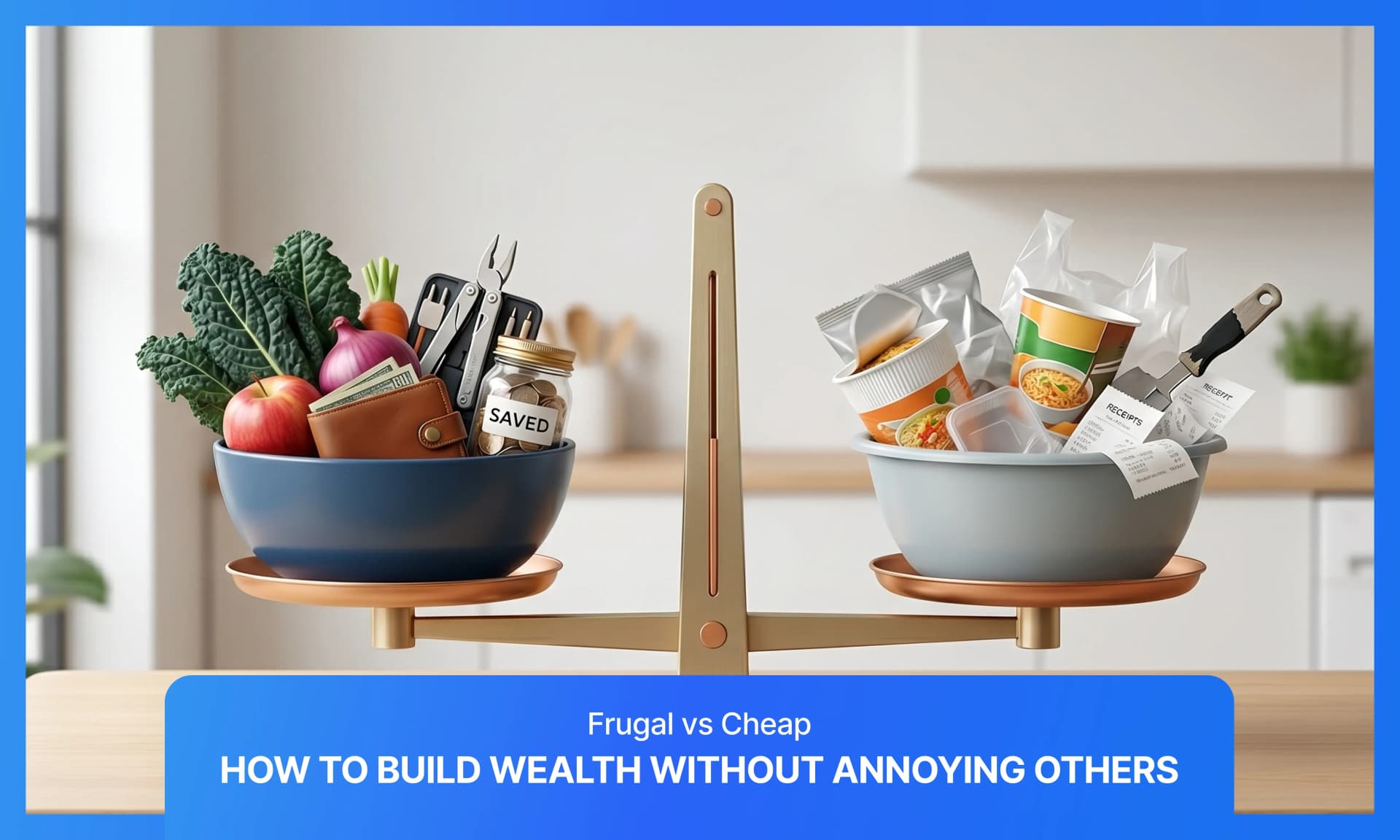
Frugal people maximize value. Cheap people minimize price.
The difference sounds subtle, but it determines whether you build lasting financial stability or just accumulate low-quality possessions, strained relationships, and higher long-term costs.
A frugal person buys $200 boots that last a decade. A cheap person buys $25 boots five times. The frugal person spent less.
The real dividing line is not how much you spend — it is who absorbs the cost of your savings. Frugality affects you. Cheapness affects others. In this article, let's explore:
- The mindset difference (value vs. price)
- How cheapness costs more in the long run
- Practical frugal habits that actually build wealth
- When spending more is the frugal choice
- Social behaviors that separate the two
TLDR: the core distinction
Here is the quick-reference comparison.
| Dimension | Frugal | Cheap |
|---|---|---|
| Primary focus | Value and longevity | Lowest price |
| Time horizon | Long-term | Immediate |
| Impact on others | Minimal (personal choice) | Often burdens others |
| Quality preference | Quality over quantity | Quantity over quality |
| Emotional root | Confidence and intentionality | Fear and scarcity |
| Social behaviour | Tips well, contributes fairly | Avoids contributing, stiffs servers |
What separates the frugal mindset from the cheap mindset?
The frugal mindset treats money as a tool for maximizing life satisfaction.
Spending decisions are intentional, well-researched, and aligned with long-term goals (such as financial independence or early retirement). A frugal person does not feel the urge to "keep up with the Joneses" because spending decisions come from confidence, not comparison.
The cheap mindset treats money as something to hoard. Every purchase is evaluated solely by its sticker price, and the instinct is always to spend less — even when spending less produces a worse outcome. Cheapness often stems from a scarcity mindset (a fear of losing money) rather than a strategic plan to grow wealth.
The psychological shorthand is that frugality is non-attachment to spending. Cheapness is an aversion to spending. One is a strategy. The other is a reflex.
How does cheapness actually cost more?
The "boots theory" (popularized by Terry Pratchett) illustrates the paradox perfectly. A cheap person buys $25 boots that fall apart in a year. A frugal person buys $200 boots that last ten years. Over a decade, the cheap person spends $250 (and has wet feet most winters). The frugal person spends $200 and stays dry.
Cheapness creates hidden costs across every category:
- Buying the lowest-priced appliance (then replacing it in two years)
- Choosing the cheapest mattress (then developing chronic back pain)
- Skipping preventive maintenance on a car (then paying for emergency repairs)
- Bulk-buying food for the price alone (then throwing away nearly 30% when it expires)
- Attempting dangerous DIY to avoid professional fees (then paying more to fix the damage)
Frugal people use a "cost-per-use" framework. A $500 winter coat worn 200 days over five years costs $0.50 per use. A $50 jacket that lasts one season costs $0.33 per use — but you buy five of them ($250 total, $0.25 per use if they all last). The math favors quality when you factor in durability, comfort, and time spent shopping for replacements.
Where does the social line fall?
The clearest marker is that frugal people save money by changing their own behavior. Cheap people save money by shifting costs to others.
Frugal social behavior
- Brings a thoughtful homemade dish to a potluck
- Uses coupons for planned purchases (not hoarding)
- Cooks at home to save money, but tips generously when dining out
- Drives a modest car but keeps it well-maintained
- Cancels unused subscriptions (hurts no one)
Cheap social behavior
- "Forgets" their wallet when it is their turn to pay
- Avoids events to escape contributing to a group bill
- Stiffs servers or haggles aggressively with small vendors
- Asks friends for rides without offering gas money
- Brings leftover office cookies to a dinner party
The social cost of cheapness compounds over time. Friends stop extending invitations. Colleagues avoid shared meals. Partners feel resentment. Cheapness is a reputation problem disguised as a money mindset issue.
What does practical frugality look like?
Frugal habits are specific, repeatable, and measurable. A few high-impact practices:
- Research large purchases before buying (total cost of ownership, not sticker price)
- Buy generic for commodities (cleaning supplies, basic medications) and premium for daily-use items (mattress, shoes, cookware)
- Cook at home most nights (the single highest-impact frugal habit for most households)
- Switch to cloth napkins and reusable containers (saves money and reduces waste)
- Use budgeting apps to track where money actually goes
- Practice "loud budgeting" — tell friends openly about your financial goals instead of silently skipping events
- Barter services when appropriate (childcare for home repairs, for example)
- Focus "big wins" on housing, transportation, and food (not on optimizing the price of toothpaste)
The frugal endgame is not deprivation. It is spending deliberately on what brings genuine satisfaction and cutting ruthlessly on what does not.
A frugal person might own one beautiful winter coat, eat at home six nights a week, and then fly business class once a year — because the trip is what brings joy, and the daily discipline is what funds it.
Frequently asked questions
Here are some frequently asked questions on this topic:
Is frugality the same as minimalism?
Not exactly. Minimalism is mainly about owning less, while frugality is about using money carefully and getting lasting value from what you buy. A minimalist may reduce possessions because clutter feels distracting or unnecessary. A frugal person may own more items, but each purchase still has to justify its price, usefulness, and durability. The two ideas overlap when they reject impulse buying and status spending. They differ in their end goal. Minimalism asks, "Do I need this at all?" Frugality asks, "Is this worth the money compared with better uses?" A person can be frugal without being minimalist.
Can you be frugal and generous?
Yes. Healthy frugality often makes generosity easier because money is not wasted on low-value habits or purchases that do not matter. A frugal person may cook at home, drive a modest car, and avoid impulse purchases, then still tip properly, bring a good gift, help family, or donate to a cause. The difference is that frugality saves money through personal choices, while cheapness often saves money by making other people pay, wait, or feel used. Generosity does not require overspending. It requires fairness, thought, and willingness to absorb a cost when it is yours to carry.
How do I stop being cheap and become frugal?
Start by changing the question from "What is the lowest price?" to "What gives the best long-term value?" That means considering quality, repair costs, time, comfort, safety, and how your choice affects other people. Build a budget that includes savings, planned spending, and generosity, so every dollar is not treated as an emergency. Pay your fair share in group settings, tip properly where tipping is expected, and stop delaying necessary maintenance. Use cost per use for items you rely on often. Cheapness is a reflex to spend less. Frugality is a skill for spending better.
Does frugality actually lead to financial independence?
Frugality can strongly support financial independence because it helps on both sides of the equation. It increases the amount available to save and invest, and it lowers the income needed to maintain your lifestyle later. Under the common 4% rule, every $1,000 of annual spending generally requires about $25,000 in invested assets to support it, though this is only a planning guideline, not a guarantee. Frugality also helps people avoid lifestyle inflation as income rises. The point is not deprivation. It is building a life where recurring expenses match your real priorities instead of social pressure.
How do you know when spending more is actually frugal?
Spending more is frugal when the higher price reduces total long-term cost or clearly improves everyday use. A durable coat, supportive mattress, reliable appliance, safe repair, or well-made pair of shoes can be cheaper over time than repeated low-quality replacements. The test is not whether the item feels premium. The test is whether it will be used often, last longer, reduce waste, prevent larger costs, or solve a real problem better. Spending more is not frugal when it is driven by status, impulse, or vague promises of quality. The higher price must earn its place in your budget.
Is buying in bulk always frugal?
No. Buying in bulk is frugal only when the item will be used before it expires, the unit price is truly lower, and the purchase does not crowd out better uses of cash or storage space. Bulk buying works well for shelf-stable goods, household basics, and items your family uses consistently. It fails when people buy oversized packages of food they cannot finish, products they do not like, or quantities that encourage overuse. Food waste is a real cost, not a small mistake. USDA estimates that 30% to 40% of the U.S. food supply is wasted.
Can frugality go too far?
Yes. Frugality becomes harmful when saving money starts damaging health, relationships, safety, or basic quality of life. Skipping medical care, refusing necessary car repairs, eating poorly to cut costs, avoiding every social event, or arguing over tiny shared expenses is no longer wise money management. Those choices may reduce spending today but create larger costs later. A useful test is whether the habit supports your values or makes your life smaller and more anxious. Good frugality should create margin, choices, and calm. When money-saving becomes constant fear or control, it has crossed into cheapness or deprivation.
What are the highest-impact frugal habits?
The highest-impact habits usually come from large recurring expenses, not tiny one-time savings. Housing, transportation, food, subscriptions, insurance, and debt payments deserve the most attention because small percentage improvements there can save thousands. Cooking more meals at home, buying a reliable used car, negotiating bills, avoiding high-interest debt, and choosing housing below your maximum budget usually matter more than chasing small discounts. Tracking spending also helps because it shows where money actually goes. Frugal people do not optimize every penny equally. They focus on the decisions that repeat, compound, and shape monthly cash flow over many years.
How can I be frugal without looking cheap around friends?
Be clear, fair, and generous within limits. Suggest lower-cost plans before the group commits, such as coffee, a walk, a potluck, or dinner at home. Once you agree to a plan, pay your share without drama. Do not "forget" your wallet, underpay a bill, or let others subsidize your preferences. When declining an invitation, give a simple reason tied to your budget and offer another idea. Frugality is usually respected when it is honest and self-contained. Cheapness irritates people because it creates extra work, awkwardness, or unfair costs for everyone else at the table.