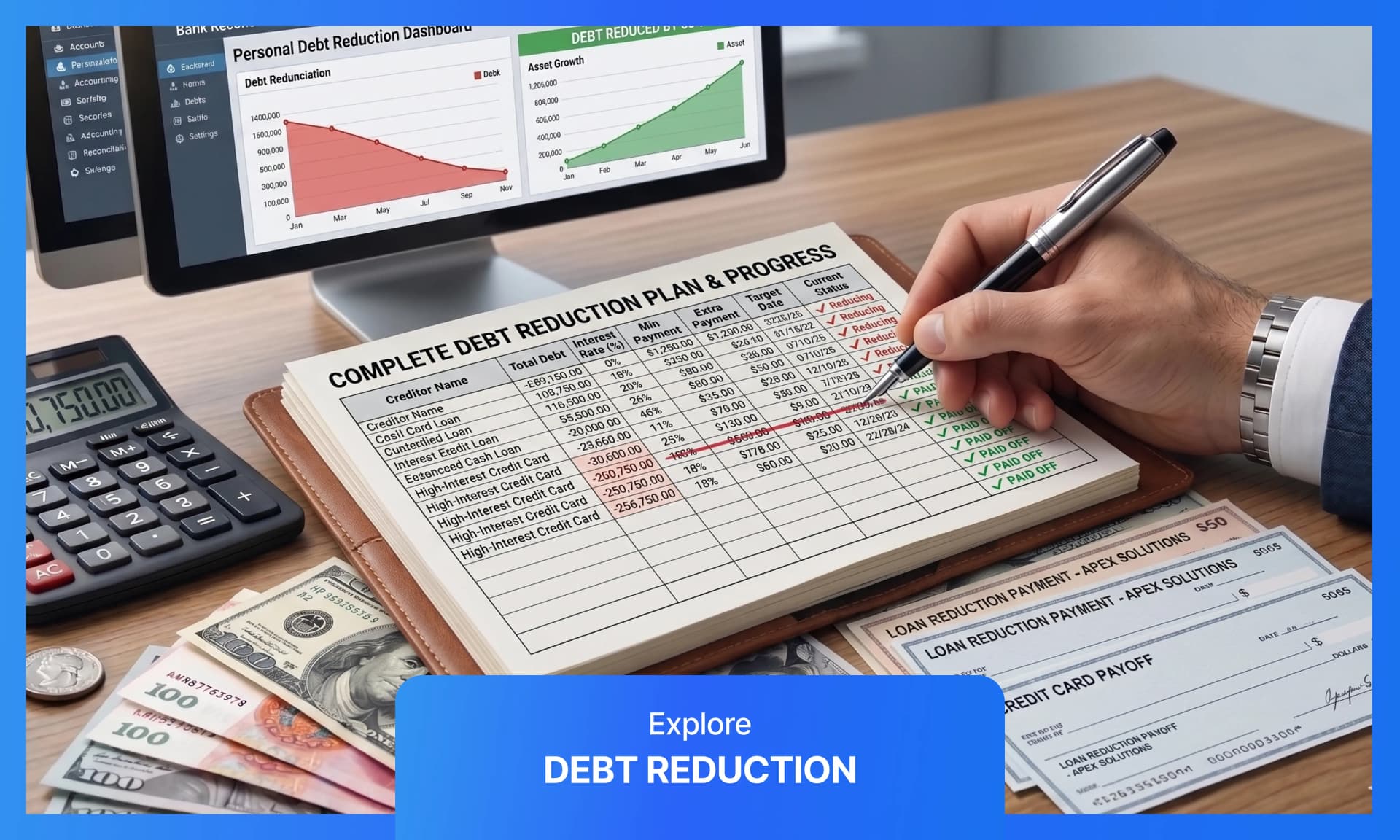
Many Canadians are looking for a financial reset. With the Bank of Canada's overnight rate holding at 2.25% through 2026, the rate volatility of previous years has finally cooled — but the cost-of-living hangover persists.
According to the Financial Consumer Agency of Canada, about 54% of Canadians are struggling to pay their bills, and the Office of the Superintendent of Bankruptcy reported that 4.2 out of every 1,000 adult Canadians filed for insolvency in 2024.
Debt is part of modern life, and it can spiral quickly when not handled with a clear plan. Whether you're managing credit cards, student loans, personal loans, or a mortgage, knowing how to reduce debt effectively — and, where possible, quickly — is one of the most financially meaningful things you can learn. What follows are proven strategies and practical steps that actually work.
Proven Debt Reduction Strategies
Not all debt reduction programs are created equal. Some prioritize speed, others minimize total interest paid — and the right choice depends on your income, your habits, and what keeps you motivated when the balances feel overwhelming.
| Feature | Debt Snowball | Debt Avalanche |
|---|---|---|
| Target | Smallest balance first | Highest interest rate first |
| Time to first payoff | Faster | Slower |
| Total interest paid | Higher | Lower |
| Best for | Motivation, behavior change | Minimizing cost, disciplined savers |
Debt Snowball
The debt snowball strategy focuses on momentum. You pay off your smallest debt first while making minimum payments on all others. Once that balance is gone, you roll that freed-up payment into the next smallest — and so on.
The appeal is psychological — seeing debts disappear early, even small ones, builds the motivation to keep going. For people who have tried and abandoned debt repayment plans before, the snowball often succeeds where more mathematically optimal methods fail.
Debt Avalanche
The debt avalanche targets the debt with the highest interest rate first while maintaining minimum payments on everything else. Once that balance is cleared, you direct the full payment toward the next highest-rate debt.
It takes longer to see the first debt eliminated, but the avalanche saves the most money in interest over the full repayment period. Mathematically, it's the gold standard for paying off debt faster (especially relevant if you're carrying high-interest credit card balances above 19%).
Debt Consolidation
A debt consolidation approach involves taking out a single loan to pay off multiple high-interest debts. The goal is to secure a lower interest rate, reduce your monthly obligation, and simplify tracking down to one payment. When it works, it works well.
However, there is a caveat. Consolidation only helps if you stop accumulating new debt afterward. Borrowers who consolidate and then rebuild credit card balances often end up with more total debt than before — not less.
50/30/20 Budget
The 50/30/20 framework divides your after-tax income into three clear categories:
- 50% for needs — rent, utilities, groceries, transportation
- 30% for wants — entertainment, dining out, discretionary spending
- 20% for savings and debt repayment
For anyone managing a debt reduction plan on a tighter income, this structure creates clear spending boundaries without requiring a line-by-line budget spreadsheet.
The 20% category is where debt repayment and any emergency savings compete for priority (and for most Canadians carrying high-interest debt, the debt should win until high-rate balances are cleared).
Balance Transfer
A balance transfer moves high-interest credit card debt to a card offering a promotional period at low or zero interest. During that window, every payment goes almost entirely toward principal rather than interest — which is how balances actually shrink.
Balance transfers come with two conditions worth understanding before you apply:
Most cards charge a 1-3% transfer fee upfront The promotional rate expires (often after 6-12 months).
Without a concrete payoff plan before that deadline, the balance reverts to the card's standard rate — sometimes higher than the account you transferred from. Used deliberately, a balance transfer is a powerful tool. Used loosely, it moves the debt without reducing it.
Practical Ways to Pay Off Debt Faster
Choosing the right strategy is only half the equation. Day-to-day financial habits — spending, income, and small tactical shifts — determine how fast the balance actually falls.
Monthly Payment Increase
Even an extra $20 or $50 a month removes months from your repayment timeline. The math is asymmetric in your favour…because interest compounds on the remaining balance, reducing that balance faster cuts interest costs non-linearly.
Automating a small round-up — directing every transaction to contribute a few extra dollars toward your balance — is the lowest-friction way to build this habit without thinking about it.
Expense Audit
Conduct a thorough audit of your digital subscriptions and recurring fees.
Most people discover 3-5 services they forgot they subscribed to or rarely use (it adds up faster than expected, especially when every platform runs on annual auto-renewal).
Small lifestyle adjustments — cooking more meals at home, being selective about subscriptions, reducing impulse purchases — compound quietly into meaningful cash flow when redirected toward debt.
Financial Windfalls
Tax refunds, work bonuses, and unexpected cash gifts feel like money that didn't exist before — which makes them psychologically easy to spend on wants rather than needs.
Applying them directly to debt is the fastest single accelerator available to most Canadians. A $500 tax refund applied to a 19.99% credit card balance saves more in interest than almost any other financial decision you'll make that week.
Additional Income
The gig economy in 2026 offers more entry points than at any previous point — from delivery services to AI-assisted microtask platforms to traditional freelancing.
Finding even 5-10 extra hours per week of side income, and dedicating all of it to debt repayment, creates a dedicated cash flow stream that doesn't compete with your regular budget. The psychological advantage is separation — gig income earmarked for debt never mingles with money you'd otherwise spend.
New Debt Avoidance
Reducing debt becomes significantly harder when new debt continues to accumulate.
Removing your credit card information from autofill on shopping sites, switching to a debit card for discretionary purchases, and freezing cards that carry high balances are all friction-adding tactics that slow impulsive borrowing.
Moreover, every month you avoid new high-interest debt is a month the avalanche or snowball method can actually gain ground. Without this discipline, both methods stall.
Every Dollar Saved Is a Dollar for Debt
One often-overlooked lever in a debt reduction plan is the cost of financial services themselves — particularly for Canadians who send money abroad to family while simultaneously trying to pay down debt.
A single international wire transfer from a Canadian bank can carry $15-$25 in fees. Over 12 months of monthly transfers, that's $180-$300 that could have gone directly toward a credit card balance.
RemitBee is how over 200,000 Canadians keep more of their money working — whether that's for their family abroad or their financial goals at home.
- Zero fees on transfers over $500 CAD
- 100% money back guarantee on all transfers
- Funding via Interac e-Transfer, EFT, or bill payment
- Competitive exchange rates with no hidden markups
- Most transfers arrive within minutes to hours, not days
Cutting transfer fees doesn't replace a debt reduction plan — but it removes a quiet monthly drain that too many Canadians absorb without questioning. Start your first transfer with RemitBee and redirect those savings where they do more good.