You pay your credit card bill every month, watching the balance inch down, but most of your payment disappears into interest charges. It's exhausting watching money vanish while your debt barely budges, especially when you're also trying to send support home.
The U.S. Securities and Exchange Commission puts it bluntly: "There is no investment strategy anywhere that pays off as well as, or with less risk than, paying off high-interest debt."
But what if there was a way to stop feeding the interest monster and actually make progress? In this guide, you'll find:
- How the avalanche method targets expensive debt first
- Why does it save more money than other approaches
- The motivation challenges you might face
- Whether this strategy fits your situation
Let’s help you understand how to structure payments to minimize what you pay overall.
What is the debt avalanche method?
The debt avalanche method (sometimes called the debt stacking method) is a repayment strategy that prioritizes debts based purely on their interest rates. You're not thinking about how much you owe on each account. You're thinking about which debt costs you the most money to carry.
Why interest rates matter more than balances
A credit card charging 24% APR costs you far more per dollar borrowed than a car loan at 6%. By targeting the priciest debt first, you reduce the total amount of interest that accumulates while you're paying everything off.
The context matters more now than ever. Average credit card APRs hit 21% in 2025, multi-decade highs according to Federal Reserve data. In the U.K., rates reached 35.7% in spring 2025. Every dollar spent on interest is a dollar that can't go toward your family overseas, your emergency fund, or your future.
How does the debt avalanche method work?
The mechanics are straightforward, but they require discipline and a clear system. You'll need to know exactly what you owe and what each debt is costing you.
Step 1: List your debts from highest to lowest interest rate
Pull together every debt you have:
- Car loans
- Credit cards
- Student loans
- Personal loans
Write down the balance, minimum payment, and APR for each one. Then sort them from the highest interest rate at the top to the lowest at the bottom.
The balance doesn't matter in this ranking. A $2,000 credit card at 22% APR goes above a $15,000 car loan at 7% APR.
If two debts have the same interest rate, put the smaller balance first (this gives you a quicker win without sacrificing mathematical efficiency).
Step 2: Pay minimum payments on all debts
Every debt on your list needs its minimum payment, every month, on time. Missing a minimum payment triggers late fees, potential APR increases, and credit score damage. Research shows that minimum payment disclosures actually anchor people to pay less than they otherwise would.
The solution is to set your default to statement-in-full or "minimum plus fixed extra" on your highest-APR account, and hide that minimum number in your own tracker. Minimums keep all your accounts in good standing. The real progress happens with what you do beyond them.
Step 3: Direct all extra payments to the highest interest debt
Once you've covered every minimum payment, look at what's left in your budget. Maybe it's $100. Maybe it's $500. Whatever that number is, it goes entirely to the debt at the top of your list.
Finding extra money
You'll need to review your budget to find this extra cash:
- Reduce dining out
- Cut subscriptions you're not using
- Negotiate lower bills (internet, phone)
- Pick up extra shifts if your schedule allows
This extra payment combined with the minimum you're already paying on that top debt accelerates how quickly you eliminate it. More money goes toward reducing the actual balance instead of just covering interest charges.
Payment allocation rules
If you're paying more than the minimum on a single credit card, Consumer Financial Protection Bureau regulations require issuers to apply the excess to the highest-APR balance on that card (like cash-advance sub-balances). Across different cards, though, the onus is on you to target the highest APR.
Step 4: Roll over payments when debts are paid off
When you finally clear that first high-interest debt, don't redirect that freed-up money back into your regular spending. Take the entire amount you were paying (minimum plus extra) and add it to the minimum payment of the debt with the next-highest interest rate.
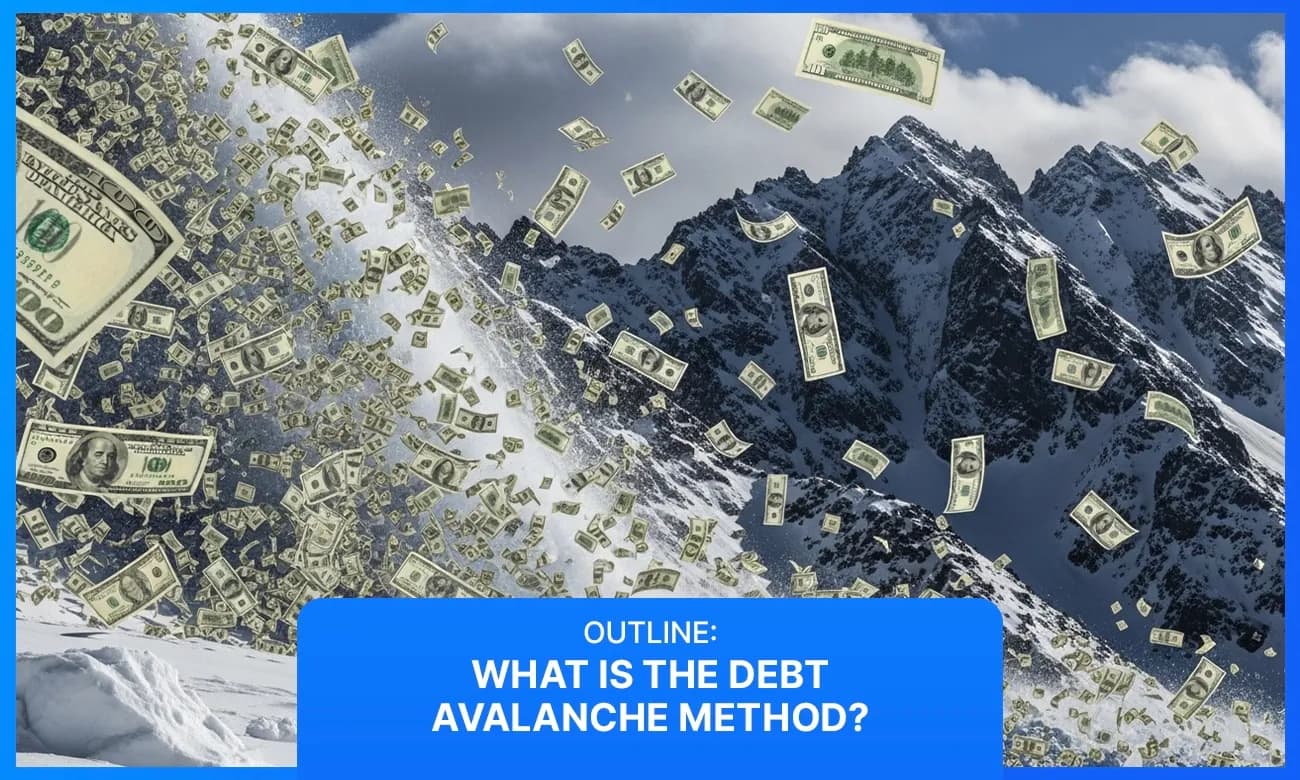
Your second debt gets paid off faster than your first. Your third debt gets paid off even faster than your second. The momentum builds like an avalanche rolling downhill (hence the name). You continue this process until every debt is gone.
Also read: What is debt snowball
Why does the debt avalanche method save you money?
The appeal of the avalanche method is simple you'll pay less money overall compared to any other repayment sequence.
Interest is calculated as a percentage of your remaining balance. When you carry a balance on a 20% APR credit card, you're paying roughly $20 per year for every $100 you owe. By eliminating high-rate debts first, you reduce the amount of interest that compounds month after month. You're cutting off the most expensive charges at the source.
Economic modeling confirms that, holding cash flow constant, prioritizing the highest APR first minimizes total interest paid and often reduces total time to debt-free status. For example, consider two $5,000 balances. One is a credit card balance with a 24% APR and an annual interest of around $1200, while the other is a personal loan with 10% APR and around $500 annual interest.
Now, paying off the 24% debt first stops that $1,200 annual charge. If you had paid off the 10% debt first, you'd continue bleeding $1,200 per year on the high-rate debt while you worked on it. Over the course of your repayment journey, this strategy saves you hundreds or thousands of dollars.
Also, people tend to linearize compounding (what researchers call "exponential growth bias"), underestimating how interest snowballs on high-APR debt. This bias is widespread and linked to worse financial choices. Interventions that show compounding explicitly like charts projecting interest avoided under avalanche versus equal payments, improve decisions.
What are the common mistakes people make with the debt avalanche?
Understanding what doesn't work helps you avoid wasting money and time.
The balance-matching trap
Research using linked-account data shows many borrowers split payments in proportion to each card's balance instead of targeting the highest APR. This balance-matching heuristic persists even when stakes are large, leaving money on the table. A $300 payment split across three cards based on their balances will always cost more than $300 payment directed at your highest-rate debt.
Ignoring promotional rates
0% balance transfers can supercharge the avalanche if you move your highest-APR balance, then attack it. But carrying any balance usually kills the grace period on new purchases. Intro rates can end early if you miss a payment. Plan to stop purchases on the transfer card and autopay well above the minimum.
What are the drawbacks of the debt avalanche method?
The avalanche method is mathematically optimal, but math isn't the only thing that matters when you're trying to change your financial life.
Slow initial progress can discourage you
If your highest-interest debt also has a large principal balance, it could take months (or even a year or more) to fully eliminate it. During that time, you're watching one big number slowly decrease while all your other debts just sit there at their minimum payment levels. That lack of visible progress can be demoralizing.
The behavior problem
Some financial experts argue that debt repayment is 80% behavior and only 20% math. When motivation disappears, the mathematically superior strategy becomes worthless if you can't stick to it. Research on repayment concentration shows people infer progress from the proportion of the balance reduced. You can keep avalanche ordering, but visualize the percentage paid on your current highest-APR account to create that progress feeling.
Requires patience and an analytical mindset
The avalanche method works best for people who are disciplined, patient, and motivated by numbers. If seeing interest savings in a spreadsheet keeps you going, this strategy is perfect. If you need regular emotional wins to stay committed, you might struggle. You also need enough cash flow to make meaningful extra payments (not just barely scraping by with minimums).
How can you stay motivated with Avalanche?
Keeping yourself engaged requires designing your own progress markers.
Track interest dollars avoided.
Create a dashboard showing "interest dollars avoided" month-to-date. This drives motivation without changing the math. Calculate what you would have paid in interest under a different approach, then highlight the growing savings gap.
Temporal landmarks trigger measurable spikes in goal pursuit. Start or reset your avalanche sprint on:
- New fiscal quarter
- First of the month
- Your birthday
- January 1st
If your highest-interest debt is large, celebrate every $1,000 paid down. Create smaller wins within the longer journey.
Is the debt avalanche method right for you?
Choosing a debt repayment strategy is personal. The avalanche method isn't universally superior despite being mathematically optimal.
You're a good candidate if you're analytical, patient, and motivated by saving money. People with stable income and adequate cash flow tend to succeed because they can consistently make extra payments without financial strain. Avalanche works best for those who:
- Have analytical personalities
- Are motivated by math/savings
- Keep an adequate cash flow
- Have the patience for a slow start
The alternative approach, the debt snowball method (targeting the smallest balances first), provides quick wins that keep you engaged, even though it costs more in interest over time. So, if you're struggling financially and need to see debts disappear to maintain hope, the snowball's behavioral benefits might outweigh the avalanche's mathematical edge.
There's a sweet spot — if your highest-interest debt happens to also be your smallest balance, you get both the interest savings of avalanche and the motivational boost of snowball simultaneously.
The right method is the one that matches your personality and financial situation. If discipline and cost-savings drive you, go avalanche. If you need regular encouragement and visible progress, consider alternatives. Either way, having a plan beats making minimum payments forever.
Clear costs, smarter choices with RemitBee
When you're managing debt payoff while supporting family overseas, every dollar matters — you need to know exactly where your money goes and what it costs you.
RemitBee brings that same transparency to your international transfers, offering:
- Zero fees on transfers over $500 CAD
- 100% money-back guarantee on all remittances
- FINTRAC regulated and fully compliant with Canadian law
- Real-time rate alerts so you can time transfers strategically
- Clear exchange rate margins (0.3-0.5% depending on corridor)
- Multiple payment options (EFT, Interac e-Transfer, bill payment, debit)
See exactly how much your family receives before you send.
Frequently asked questions
Here are some commonly asked questions about the debt avalanche method:
Should I use the debt avalanche if I have low credit card balances?
If your credit card balances are small but carry high interest rates, the avalanche method still makes sense mathematically. You'll clear those high-rate debts quickly while saving on interest. If the balances are so small that you could pay them all off within a few months regardless of order, just pick one and execute consistently.
Can I switch from debt snowball to debt avalanche mid-way?
Absolutely. Many people start with a snowball to build momentum, then switch to avalanche once they've eliminated a few debts and gained financial breathing room. Switching doesn't reset your progress—just reorganize your remaining debts by interest rate and continue.
How do I stay motivated with the debt avalanche method?
Track your interest savings, not just balance reduction. Create a spreadsheet showing how much interest you're avoiding by targeting high-rate debt first. Celebrate milestone markers like "saved $500 in interest" or "reduced total debt by 25%." Some people set up visual trackers or accountability check-ins with a friend.
What if my highest interest debt is also my largest?
This is the toughest scenario for avalanche. You're mathematically making the right choice, but it'll take longer to see that first debt disappear. Consider breaking the journey into smaller milestones (like every $1,000 paid down) to create more frequent wins. If you find yourself losing motivation after several months, it's okay to switch strategies.
Should I pause remittances to pay off debt faster?
This depends on your family's needs and your own values. If remittances are essential for basic needs (housing, food, healthcare), pausing them isn't realistic. Instead, optimize transfer costs so more money reaches your family while you tackle debt. Look for fee-free thresholds and good exchange rates. If remittances are more flexible, you might temporarily reduce the amount while you clear high-interest debt, then increase them once you're in better financial shape.
Does the debt avalanche method work if I have irregular income?
Irregular income makes any debt strategy more challenging, but the avalanche can still work with modifications. Focus on always meeting minimum payments first (build a small buffer if possible). During high-income months, apply extra funds to your highest-rate debt. During low-income months, stick to minimums only. The key is maintaining the prioritization system even if the extra payment amounts vary month to month.
References
- Dai, H., Milkman, K. L., & Riis, J. (2014). The fresh start effect: Temporal landmarks motivate aspirational behavior. Management Science, 60(10), 2563-2582.
- Gathergood, J., Mahoney, N., & Stewart, N. (2019). How do individuals repay their debt? The balance-matching heuristic. American Economic Review, 109(3), 844-875.
- Hamilton, S. E. (2023). Two steps forward, one step back? Quantifying the pecuniary costs of debt repayment strategies. Southern Economic Journal, 89(3), 743-764.
- Kettle, K. L., Trudel, R., Blanchard, S. J., & Häubl, G. (2016). Repayment concentration and consumer motivation to get out of debt. Journal of Consumer Research, 43(3), 460-477.
- Stango, V., & Zinman, J. (2009). Exponential growth bias and household finance. The Journal of Finance, 64(6), 2807-2849.
- Stewart, N. (2009). The cost of anchoring on credit-card minimum repayments. Psychological Science, 20(1), 39-41.