
Uprooting a plant and replanting it in new soil is never simple. At first, it wilts, unsure if it can draw strength from unfamiliar ground. The sunlight feels different, the seasons shift in new rhythms, and even the rain carries a taste it has never known. Yet with time, the plant grows new roots, adapts, and often blossoms in ways it never imagined before.
For many immigrants, moving to Canada feels much the same. It’s not just about crossing borders, but about being transplanted into a culture with its own pace, customs, and unspoken rules. Suddenly, everyday life can feel like going back to square one.
But in those square-one moments lie the beginnings of resilience, humor, and growth. If you’re reading this, chances are you’re either preparing to move to Canada or you’ve already begun the journey of adapting, perhaps even fully rooted yourself in Canadian life. Wherever you are on that path, the stories that follow will resonate with stories of culture shock, of challenges that tested newcomers, of surprises that made them smile, and of lessons that helped them take root once again.
Context and Background
Statistics show that the number of non-permanent residents increased from 2,729,771 in January 2024 to 3,020,936 in January 2025 ; an increase of 291,165. In total, Canada welcomed 483,591 permanent immigrants in 2024, marking the highest number of immigrant arrivals since 1972.
Based on the 2021 Census, nearly one in four people in Canada (23%) are immigrants . As one of the world’s most diverse countries, Canada is often described as a cultural mosaic rather than a melting pot where different traditions coexist and enrich one another. For many newcomers, this means juggling three things at once: adapting to Canadian ways of living, engaging with the diversity of other cultures around them, and holding on to their own roots. This process can be both enriching and unsettling, which many describe as culture shock.
What’s Shocking in Culture Shock?
Canadian anthropologist Kalervo Oberg first articulated the concept of culture shock in his seminal 1960 paper, Culture Shock: Adjustment to New Cultural Environments Oberg, whose earlier doctoral dissertation, The Social Economy of the Tlingit Indians of Alaska (1934), examined how Indigenous communities navigated their social and economic systems, later expanded his focus to the broader human experience of entering foreign cultural environments.
Oberg defined culture shock as:
“Culture shock is precipitated by the anxiety that results from losing all our familiar signs and symbols of social intercourse. These cues, or signs, include the thousand and one ways in which we orient ourselves to the situations of daily life.” (Oberg, 1960)
Like an ailment, culture shock has its own symptoms, cause, and cure.
4 Stages of Culture Shock
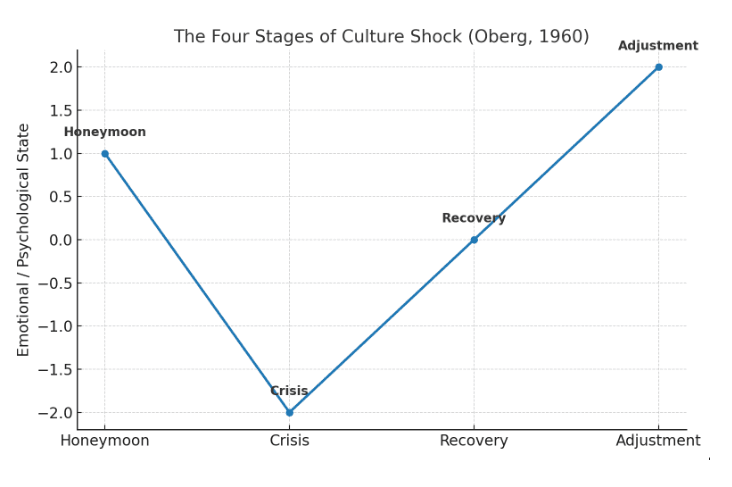
If there are five stages of grief, there are four stages of culture shock that Oberg identified. This framework is still used today to understand the immigrant journey:
- Honeymoon Stage – marked by excitement, fascination, and curiosity about the new culture.
- Crisis Stage – when differences become overwhelming, often leading to frustration, homesickness, or withdrawal.
- Recovery Stage – gradual adaptation as individuals learn the language, new cultural cues, and build coping strategies.
Adjustment Stage – when newcomers achieve a sense of balance, integrating aspects of the host culture with their own identity.
For many immigrants, this cycle does not follow a linear path. Instead, they may move back and forth between stages as they encounter new challenges and milestones, whether it’s navigating the workplace, raising children in a different education system, or simply adjusting to Canada’s winters.
Voices of Immigrants
Every immigrant story is a mosaic of small shocks, big adjustments, and eventual discoveries. The voices of newcomers across Canada reveal both the struggles and the unexpected joys of adapting to a new culture.
For this article, we have interviewed a handful of immigrants from Asia and Europe now residing in Ontario, British Columbia, Toronto, and Manitoba about their culture shocks when they first moved to Canada. Here are their stories:
Darshana, a teenager from India now living in Mississauga, remembers how overwhelming it was to be surrounded by people from so many countries all at once. Yet, she has grown to appreciate the independence Canada offers. Her advice to newcomers is practical: “Take small steps. Start by saying hi to one person, learning a few names, or joining one activity. Little by little, things will start to feel more familiar.”
For Mila, who moved from Ukraine, the surprise was Canada’s diversity: “Nobody will judge you for your look, clothes, or belief.” But her biggest struggle was loneliness. She reflects, “Everything starts from you — once you accept the situation, you will start to adapt.”
Bhanu from India points out a different kind of shock: “Weed being legal.” Winter, too, was a test: walking in snow and waiting for buses without a car. At work, he sometimes felt excluded when colleagues joked about TV shows he didn’t know. Still, his message is hopeful: “Stay open-minded, but never forget where you come from. Your roots and traditions give you strength.”
Micah, who arrived from the Philippines, compares her first Canadian winter to “stepping into another planet.” With frostbite scares and heavy hand-me-down jackets, she initially felt out of place. What made the difference was community: “Having friends who were the same culture made me feel not out of place… Canadians are understanding. Try to befriend people of different cultures — you’ll learn so much.”
Other Filipino immigrants shared lighter moments, like JM’s memory of tasting snow on his first winter day, or A.P.’s awkwardness wearing “big clunky winter boots” to class. But even these moments carry lessons. As A.P. advises, “Hang in there. Be kind to yourself and give yourself time to adjust. It gets easier.”
Across these stories, themes emerge: the cold of winter, the warmth of community, the confusion of social norms, and the resilience of holding onto one’s roots while learning a new way of life. Culture shock may be a universal experience, but the way each immigrant overcomes it makes every story unique — and worth telling.
An Expert’s Insight
To deepen our understanding of culture shock, we spoke with Dr. Harald Bauder, Professor of Geography & Environmental Studies, Graduate Program in Immigration and Settlement Studies at Toronto Metropolitan University, and Extraordinary Professor at the University of the Western Cape. His research focuses on immigration, settlement, and belonging.
When asked about the most common culture shocks newcomers face in Canada, Dr. Bauder pointed to two key factors:
“The cold weather and dressing for it; there is also the non-recognition of foreign credentials, but I’m not sure if you’d consider that ‘cultural.’”
He explained that while the weather is something most people eventually adapt to, even though it can have temporary impacts on mental health. The issue of foreign credential recognition carries heavier, long-term consequences, such as “depression when not finding jobs in their field; [they might] need to go back to school or experience de-skilling.”
His insight highlights how culture shock goes beyond surface-level surprises (like winter or slang) and can intersect with systemic challenges, shaping immigrants’ well-being, career trajectory, and sense of belonging in Canada.
Looking Into the Bigger Picture
Canada is often celebrated for its diversity, but the journey from newcomer to integrated resident reveals deeper systemic challenges that go beyond the initial culture shocks of food, language, or weather. One of the most pressing issues is employment. Despite arriving with strong qualifications, many immigrants face disproportionately high unemployment. In 2024, for example, the unemployment rate among recent immigrants was 11%, nearly double the 5.6% rate of Canadian-born workers.
Even for those who find jobs, underemployment is common. Research shows that only 44% of immigrants who arrived within the last ten years work in positions that match their education, compared to 64% of similarly aged Canadian-born workers. In fact, more than a quarter of immigrants,26.7%, were considered overqualified for their roles in 2021, more than twice the rate of Canadian-born workers. This mismatch not only wastes human capital but also erodes confidence and professional identity.
The psychological toll of this is significant. Studies from the University of Alberta reveal that 81% of skilled immigrants who are overqualified and stuck in precarious work report mental health struggles. These range from anxiety and depression to a deep sense of lost identity. Psychologists note that this kind of underemployment doesn’t just stall careers, it undermines belonging, integration, and overall life satisfaction.
Economically, the impact is just as profound. When highly skilled newcomers are unable to contribute fully, Canada loses out on productivity and growth. Reports highlight that once immigrants do secure jobs aligned with their skills, their economic contributions increase sharply, benefiting not only their families but also the broader society.
Taken together, these realities show that culture shock in Canada is not just about adjusting to the snow, the food, or the social norms. It also reflects systemic gaps, especially in the labor market, that prevent newcomers from thriving. Proper integration, therefore, requires addressing these underlying barriers alongside celebrating cultural diversity.
Conclusion
Moving to Canada often feels like being uprooted and planted into unfamiliar soil. At first, the cold bites, the food tastes different, and the rules of social life are puzzling. For many immigrants, culture shock is the first test of resilience. Yet behind the awkward stories and funny confessions lie much deeper realities: credential barriers, underemployment, and struggles with belonging that shape the immigrant journey.
But culture shock does not last forever. Over time, newcomers adapt, grow, and even flourish. What once felt foreign often becomes second nature, and many immigrants carry the unique strength of navigating two (or more) worlds at once. Their resilience doesn’t just reshape their own lives; it enriches Canada’s cultural fabric, pushing the country toward becoming not just a land of diversity but a land of genuine inclusion.
If you are reading this, chances are you’re either preparing for your own move to Canada or you’ve already begun the process of building a life here. Wherever you are on that journey, know this: culture shock is not a setback but a stage. It’s the bridge between who you were and who you’re becoming. And while the transition may not be simple, you are far from alone.