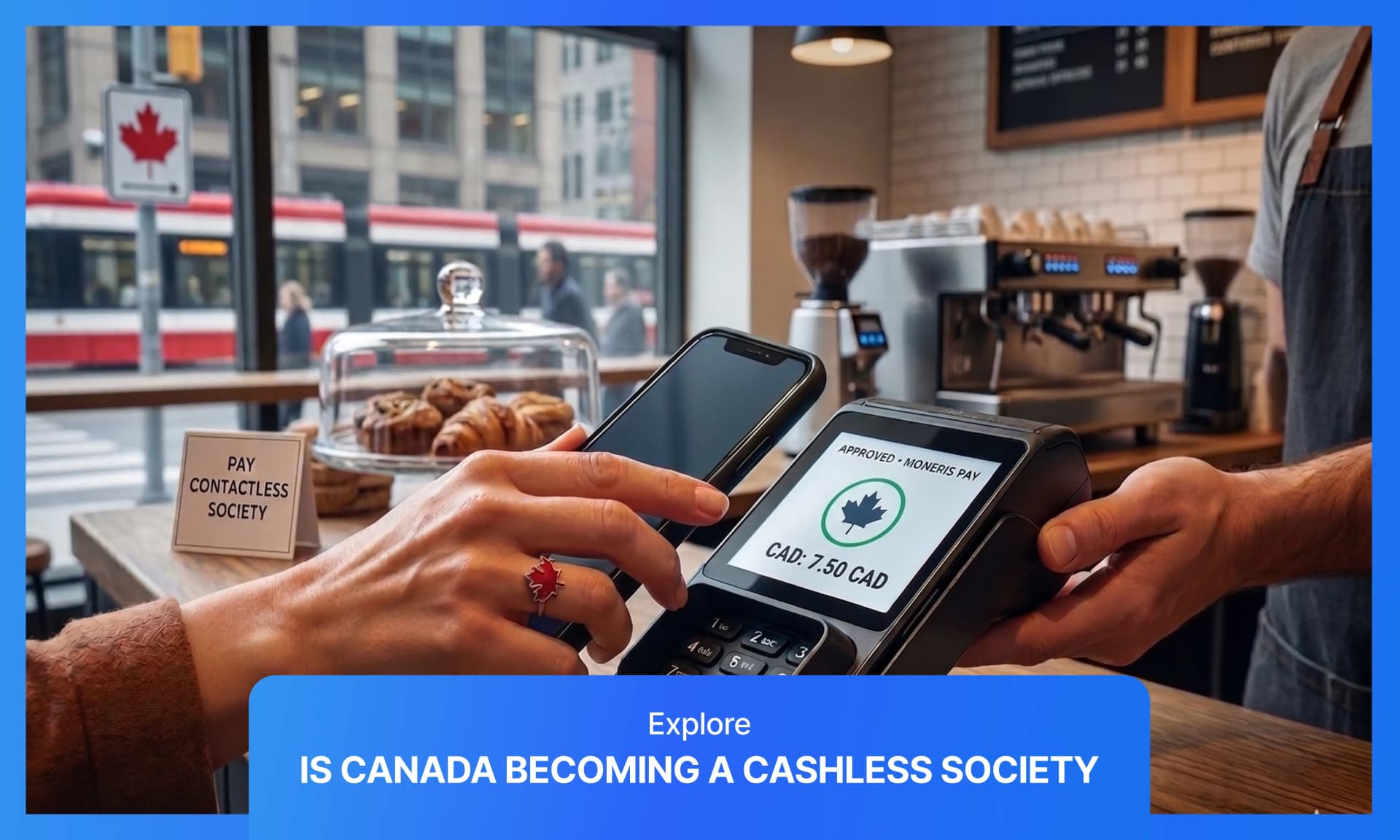
Canada is moving toward digital payments, but the data tells a more complicated story than headlines suggest. Cash still accounts for 21% of point-of-sale transactions, 79% of Canadians have no plans to stop using it, and 96% of small and medium-sized businesses still accept it.
The Bank of Canada tells us bluntly that Canada is far from being a cashless society. Let us dig in deep and explore the answer to this question with reliable data points, covering:
- Risks a cashless transition would create
- Who gets left behind when cash disappears
- Why cash persists despite contactless dominance
- Barriers keeping Canada from going fully cashless
- Current cash usage trends versus digital payment growth
What do the numbers say about cash in Canada?
The Bank of Canada's 2024 Methods-of-Payment Survey provides the clearest picture of how Canadians pay for things.
Cash use has stabilized — not collapsed — holding steady at 21% of purchase volume and 11% of purchase value, the same as 2023. Credit cards dominate with 46% of volume and 56% of value, while debit cards account for 23% of volume.
| Payment method | 2024 volume share | 2024 value share |
|---|---|---|
| Credit card | 46% | 56% |
| Debit card | 23% | 22% |
| Cash | 21% | 11% |
| Mobile payment | ~5% | — |
The real shift is happening in how people use cards, not whether they've abandoned cash. Almost two-thirds of in-person payments were contactless in 2024, and mobile payments climbed to nearly 5% of transactions (up from under 3% in 2022).
Contactless is displacing chip-and-PIN more than it's displacing cash — a distinction that matters when projecting where payments are headed.
The gap between volume share (21%) and value share (11%) reveals something important about cash's role. Canadians use cash primarily for small, everyday purchases — the coffee, the parking meter, the corner store run. The average cash transaction value sits around $26. For larger purchases, cards win.
Payments Canada reports that digital payments represented 86% of total payment volume and 77% of total payment value in 2024, with contactless accounting for 58% of transactions. That's a heavily digital market. But "heavily digital" isn't the same as cashless.
Why hasn't Canada gone cashless yet?
The answer splits into three categories — consumer preference, merchant reality, and infrastructure limitations.
Consumer preference
Most Canadians aren't trying to go cashless.
The Bank of Canada found that 79% have no plans to stop using cash, while only 8% said they might eventually, and 13% claimed they already had. Even among that 13%, slightly more than half still held some cash — likely as a backup for when digital fails.
Cash holdings actually increased in nominal terms, with mean cash on hand rising from $140 in 2023 to $156 in 2024. Adjusted for inflation, purchasing power stayed roughly flat. Canadians aren't emptying their wallets.
Merchant acceptance
The 2023 Merchant Acceptance Survey found that 96% of small and medium-sized businesses accepted cash, and 92% had no plans to stop. Merchants keep accepting cash because some customers still need it, and refusing it creates friction without a meaningful benefit for most businesses.
| Merchant acceptance | Percentage |
|---|---|
| Accept cash | 96% |
| No plans to go cashless | 92% |
| Accept debit/credit | 89% |
| Accept digital wallets | 49% |
Infrastructure gaps
Cash access remains reasonably good for most Canadians — 68% report easy access to ATMs and branches.
But that figure drops in rural areas, and branch closures hit outside urban centers harder. Between 2019 and 2022, the number of ATMs actually increased even as bank branches declined.
For the roughly 10% of Canadians who find cash access difficult (particularly in remote and Indigenous communities), a cashless system would create real problems.
What's driving Canada toward less cash?
Three forces push the country toward digital payments, even if full cashlessness remains unlikely.
Convenience wins
Contactless credit, contactless debit, digital wallets, and Interac e-Transfer have made non-cash options faster for both in-store and remote transactions.
Nearly half of Canadians used Interac e-Transfer in the past year, and about 20% used a digital wallet app. Once tap-and-go becomes a habit, carrying cash feels unnecessary — until the network goes down.
Online commerce growth
The online share of all purchases reached 23% in 2024, up 2 percentage points from 2023. Statistics Canada reports that 82% of internet users conducted online banking in 2022, up from 80% in 2018.
Among adults 65 and older, online banking use climbed from 62% to 70% — a demographic shift that matters for long-term payment trends.
Habit formation
Once contactless becomes routine, it's sticky. The practical need to withdraw cash fades when every transaction can happen with a tap. The pattern reinforces itself — less cash use leads to fewer ATM visits, leads to less familiarity with cash, and leads to less cash use.
What are the main barriers to going fully cashless?
Canada faces structural barriers that would make a truly cashless society difficult to achieve — and potentially harmful if forced.
Demographics
The unbanked and underbanked populations rely on cash because they lack alternatives.
About 3% of Canadians (roughly 1 million people) have no bank account, with higher rates among low-income, Indigenous, and immigrant populations. Another 15% are underbanked, using high-fee alternatives like payday loans while holding limited traditional accounts.
| Group | Status | Cash reliance |
|---|---|---|
| General population | 3% unbanked, 15% underbanked | 20% of transactions |
| Low-income (<$45K) | Higher unbanked risk | 30%+ of transactions |
| Seniors (55+) | Low unbanked rate | 26% of transactions |
Lower-income earners (under $45K annually) use cash in over 30% of transactions — far above the national 20% average. Older adults and those with disabilities often prefer cash's simplicity over digital interfaces. Strict cash-dependent users (under 5% of adults) face total exclusion without it.
Behavioral resistance
The 79% figure — Canadians with no plans to go cashless — reflects more than inertia. Cash offers perceived benefits that digital payments don't match:
- Privacy from transaction tracking
- Works without electricity, network connectivity, or battery life
- No transaction fees for the user (though merchants pay for card processing)
- Universal acceptance without technology requirements
- Tangible control over spending
Economic friction
For some users, the economics favor cash. Transaction fees and service costs hit low-volume users harder. Network effects require mass adoption for new payment methods to work — but dominant users lack incentives to switch, creating a chicken-and-egg problem for newer digital options.
What risks does a cashless society pose?
The Bank of Canada takes these risks seriously enough to study them as policy concerns, not just theoretical problems.
Financial exclusion
If cash were no longer widely accepted, the 3% unbanked population and portions of the 15% underbanked would face exclusion from basic commerce.
The Bank of Canada's digital dollar consultation states this directly — many Canadians could be excluded from the economy if cash disappeared from everyday transactions. That includes seniors, low-income households, newcomers, rural communities, and people with accessibility barriers.
System fragility
A payment system dependent entirely on cards, mobile devices, networks, and platform uptime becomes vulnerable to outages and cyberattacks.
Visa's 2018 European outage — 10 hours with no card payments across multiple countries — showed what happens when the backup disappears. The Bank of Canada's work on offline digital payments reflects direct concern about this fragility.
Cybersecurity exposure
Digital payment growth correlates with increased fraud, data breaches, and identity theft. Every card tap creates a data trail. Cash remains one of the few payment methods that doesn't require sharing credentials, creating accounts, or trusting network security.
Behavioral effects
Research (including MIT studies on credit card spending) shows that "painless" digital payments lead to higher spending than cash, where the physical act of handing over money creates psychological friction.
A fully cashless economy removes that natural spending brake — potentially worsening debt problems for populations already struggling with credit.
Is there a legal requirement to accept cash in Canada?
No. The Bank of Canada states plainly that no law requires anyone to accept cash as payment, even though bank notes are legal tender.
Legal tender status means cash can be used to settle debts, but it doesn't compel merchants to accept it for new transactions.
A cashless market could emerge sector by sector through business choice rather than policy. Some restaurants and retailers have already gone card-only. The question is whether that trend accelerates — and whether policymakers intervene to protect cash access.
The bottom line
Canada is becoming more digital, more contactless, and more mobile in its payment habits. It is not becoming cashless in any meaningful near-term sense.
The evidence supports this conclusion:
- Most Canadians report easy cash access
- 79% of Canadians have no plans to abandon cash
- 96% of SMBs accept cash, while 92% plan to keep doing so
- Cash accounts for 21% of purchase volume — too large to call marginal
- Digital payments grow quickly, but alongside cash rather than replacing it
The right framing isn't "cash versus digital." In Canada today, it's cash and digital — with digital growing faster but cash retaining a live and policy-relevant role.
The Bank of Canada continues treating cash as part of the public payments infrastructure rather than a legacy product fading into irrelevance.
For the foreseeable future, expect a cash-light economy rather than a cashless one. Digital convenience will keep winning converts, but cash will persist for small transactions, populations without digital access, privacy-conscious users, and anyone who's been stuck in a checkout line when the card reader goes down.
Send money internationally — with or without cash
Whether Canada trends cashless or not, one thing stays constant: sending money abroad should be fast, affordable, and transparent.
RemitBee helps over 200,000 Canadians transfer funds to 100+ countries without the hidden fees or inflated exchange rates banks typically charge.
- Zero fees on transfers over $500 CAD
- Bank-level encryption and FINTRAC regulation
- Exchange rates that consistently beat Canadian banks
- Works with Interac e-Transfer, debit, EFT, or bill payment
Start your first transfer with RemitBee.
References
- Bank of Canada. (2024). How do Canadians perceive access to cash? (Staff Analytical Note 2024-24).
- Bank of Canada. (2024). COVID-19 hasn't killed merchant acceptance of cash (Staff Discussion Paper 2024-2).
- Bank of Canada. (2025). 2024 Methods-of-Payment Survey report: Cash in an era of alternatives (Staff Discussion Paper 2025-12).
- Bank of Canada. (2023). A central bank digital currency for offline payments (Staff Analytical Note 2023-2).
- Bank of Canada. (2023). Digital Canadian Dollar public consultation report.
- Bank of Canada. (2020). Contingency planning for a central bank digital currency.
- Bank of Canada. (n.d.). About legal tenure.
- Bank of Canada. (n.d.). Methods-of-Payment Survey.
- Payments Canada. (2025). Canada reaches $12.2 trillion in payment transactions. Yahoo Finance.
- Statistics Canada. (2024, March 21). Trends in online banking and shopping.