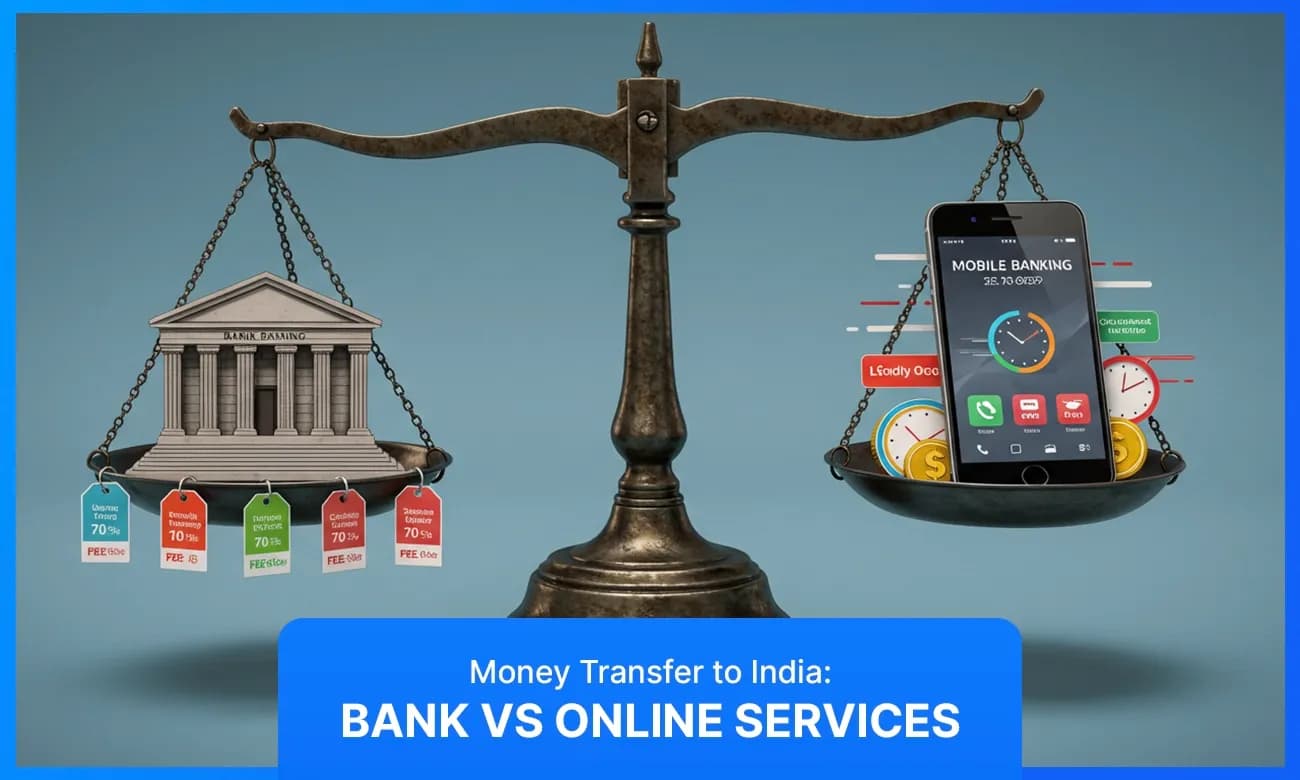
You're probably throwing money away every time you send funds to India, and you don't even realize it.
Canada's Indian diaspora sent billions home last year, but much of it disappeared into hidden fees, terrible exchange rates, and outdated transfer methods. If that sounds familiar, you're in the right place.
This guide reveals what the remittance industry doesn't want you to know. You'll discover:
- The legal limits and tax rules you need to know
- How to avoid hidden fees and terrible exchange rates
- Smarter ways to send money to India without getting ripped off
- Real tactics to maximize what your recipient gets every single time
- Mobile apps that consistently beat traditional banks on speed and cost
Let's uncover the smartest way to send money to India from right here in Canada.
Common reasons why people transfer money to India
Every transfer you make carries more than just currency. It carries care, commitment, and connection. For millions of Indian immigrants and NRIs in Canada, sending money is a lifeline.
Whether you're covering a family emergency, supporting a sibling's education, or building a future home in your hometown, your remittance has real impact.
Here's where most of your money goes:
1. Supporting family and household expenses
From groceries and rent to utility bills and caregiving, remittances help loved ones survive and thrive. Monthly transfers from Canada help bridge inflation gaps, medical costs, and day-to-day living expenses.
If you're sending money to your parents or siblings, you may also be using an NRE (Non-Resident External) or NRO (Non-Resident Ordinary) account to manage these funds efficiently.
2. Paying for education and tuition
Higher education in India can be expensive and competitive. Many Canadians send money to fund:
- Tuition fees
- Entrance coaching
- Hostel accommodation
- Study materials for their relatives
- For students, delays in receiving funds can mean missing deadlines or even enrollment loss.
3. Investing in real estate or property maintenance
Real estate remains a preferred investment for many Indian Canadians. From building your dream home in Kerala to managing a flat in Mumbai, there's always a need for funds. Construction payments, EMI dues, property taxes, maintenance costs all add up.
Using reliable remittance channels helps ensure your payments are traceable, fast, and compliant with Indian banking regulations.
4. Funding business or freelance services in India
If you run a side hustle, agency, or e-commerce store in Canada, chances are you've hired:
- Freelancers
- Developers
- Vendors from India
Remitting project payments through secure platforms with fair exchange rates ensures your team gets paid without delays or deductions.
5. Sending money for ceremonies, gifts, and festivals
Weddings, housewarmings, pujas, and festivals like Diwali, Raksha Bandhan, or Eid - every occasion in India is an opportunity to give. Whether it's 10,000 rupees for a cousin's birthday or helping fund a community function, money carries your presence even when you can't be there physically.
What are all the ways to send money to India from Canada?
There are plenty of ways to send money to India , but not all are created equal. Some methods are fast but expensive, others are cheap but frustratingly slow.
Choosing the wrong one could cost you time, money, and peace of mind.
Bank transfers via SWIFT or IFSC
Sending money through a Canadian bank (like RBC, TD, or Scotiabank) to an Indian bank account involves the SWIFT network. It's secure, but often slow and costly. Add in intermediary bank fees, and the amount that reaches your recipient can shrink by $15–$50. You'll also need your recipient's:
- IFSC code
- Account number
- Exact bank details
Mobile money transfer apps
Apps like RemitBee, Wise, Remitly, XE, and Panda Remit have changed the game. They offer:
- Low fees
- Real-time exchange rates
- Fast transfers (often within 24 hours or less)
Most are fully digital, letting you send money directly from your phone or laptop. Some even waive fees on transfers above a threshold.
Online transfer services
Web-based services like WorldRemit, Xoom, InstaReM, or ICICI Money2India operate similarly to apps, often with browser-only interfaces. They're useful if you prefer managing everything from a desktop but still want the flexibility of:
- Tracking
- Rate locking
- Scheduled payments
Cross-border UPI (Unified Payments Interface)
India's UPI is now integrated with platforms in:
- UAE
- Nepal
- France
- Mauritius
- Sri Lanka
- Singapore
It's expanding to North America soon. While not fully accessible in Canada yet, some apps now simulate UPI routing for faster settlements in India.
Wire transfers (in-branch or online banking)
Traditional wire transfers done at a Canadian bank branch or via online banking portals remain common for high-value or regulated business transfers. You'll need your recipient's:
- IFSC
- SWIFT/BIC
- Bank address
- Sometimes purpose codes for compliance
Expect 2–5 day delivery and higher fees (often $30+ per transaction).
International money orders (India Post)
India Post offers International Money Order (IMO) services, allowing you to send 1,000–50,000 INR per transaction. It's web-based and reliable, but limited to physical payouts at India Post locations. If the recipient doesn't have a bank account, this can be a fallback option.
Foreign cheques and demand drafts
Foreign Currency Cheques (FCCs) and Foreign Demand Drafts (FDDs) are physical instruments drawn in CAD, USD, or EUR. They're useful in very specific situations, such as:
- Business payments
- Legal settlements
- Official gifts
But they're incredibly slow and bureaucratic. Clearing takes 10–21 days, and banks often charge verification or courier fees.
Should you use mobile apps or banks?
Still using a traditional bank to send money to India? You could be throwing away hundreds of dollars a year in fees and bad exchange rates. Let me explain where mobile apps outperform banks and where they don't.
Fees and hidden charges
Banks typically charge $30–$50 per international wire, not including intermediary bank deductions in India.
What's worse, they rarely show you how much your recipient will get after conversion and fees. Apps, on the other hand, are refreshingly transparent. Platforms like RemitBee and Wise show the final payout upfront, often waiving fees over $500 CAD or offering flat low-cost structures.
Exchange rates
Banks use marked-up exchange rates (often 2–4% worse than the mid-market rate). That's like paying a hidden tax every time you send money.
Mobile apps generally offer mid-market or near-market exchange rates, with a smaller, declared margin. Wise even shows you the exact markup.
Speed of transfer
Bank wires can take 3 to 5 business days, depending on the intermediary bank network and holidays in either country. Apps like RemitBee, Remitly (Express), or Panda Remit can deliver in hours (or even minutes, depending on your payment method).
User experience and accessibility
Banking portals often feel like they were designed in 2005. Confusing menus, poor mobile UX, and limited after-hours support. Apps are built mobile-first. You can:
- Track the transaction in real time
- Send money while walking your dog
- Set up recurring transfers in seconds
Security and regulation
Don't assume banks are automatically more secure. Both banks and top-tier apps are regulated by FINTRAC (Canada), FCA (UK), and other authorities, and must follow KYC/AML rules. Apps like RemitBee use:
- 2FA
- Fraud monitoring
- Bank-level encryption
Just like your bank, but they often react faster and resolve issues more quickly due to leaner systems.
How do you choose the right money transfer service?
Choosing the wrong provider could mean delays, high fees, or even a failed transfer. But choosing the right one? It could save you hundreds and bring peace of mind.
Total cost: fees plus exchange rate margin
Low fees don't always mean better value. Some providers sneak in poor exchange rates that quietly eat up your money. Look for platforms that:
- Show exact fees and rates upfront
- Offer fee waivers above a certain threshold
- Use mid-market or transparent exchange rates
Compare both what you pay and what your recipient receives (that's the real cost).
Speed of delivery
Need to get funds there fast for a medical emergency or deadline? Then speed matters. Check for:
- Instant or same-day delivery options
- Whether holidays or weekends delay transfers
- Payment method impact (e-Transfer is faster than EFT)
Safety and regulation
Your money's security is non-negotiable. Choose services that are:
- Use encryption and 2FA
- Regulated by FINTRAC (Canada) or equivalent
- Offer digital receipts and FIRC/FIRS certificates for compliance
Ease of use and customer support
If the process to send money feels like solving a puzzle, it's the wrong platform. Look for:
- Real-time tracking of your transfer '
- 24/7 support via live chat or phone
- Intuitive mobile apps or desktop portals
- Clear instructions for both sender and recipient
- Promotions, first-time offers, and loyalty perks
Some platforms waive the first transfer fee or offer exclusive exchange rates for new users. Others give:
- Referral bonuses
- Cashback
Before settling, see what perks are available (they can add up, especially for frequent senders).
Which money transfer apps work best in 2025?
Not all apps are created equal. Some excel in speed, others in affordability, and a few offer the full package. When it comes to sending money to India from Canada, some apps rise above the rest depending on what matters most to you.
| App | Fees (CAD) | Exchange Rate Markup | Delivery Time | Standout Feature |
|---|---|---|---|---|
| RemitBee | Free over $500 CAD | Minimal (transparent) | Within 24 hours | Best for CAD to INR; fee-free over $500 |
| Remitly | $3.99 (waived 1st/1000+) | Moderate | 3–5 business days (Economy), minutes (Express) | Good first-time offers |
| Wise | ~1.7–1.8% of amount | None (mid-market rate) | 1–5 business days | Shows actual fee plus real-time tracking |
| XE Money Transfer | ~$3–Varies | Moderate | 1–4 days | Broad global coverage (100+ currencies) |
| Panda Remit | Low plus first-time perks | Competitive | 2 minutes to 1 day | Fastest for small transfers |
| Skrill | 5.50 EUR plus 3.99% markup | High | 1–3 days | Includes digital wallet plus crypto |
RemitBee offers the best value for Canadians with no fees over $500, great rates, and fast delivery. Wise stands out for transparency with mid-market rates plus digital FIRC. Remitly and Panda Remit shine with first-time promos, but fees rise after your initial transfers. Skrill and XE provide more payout options but at the cost of higher fees and weaker rates.
How do you use RemitBee to send money to India?
If you're in Canada and want the fastest, most cost-effective way to send money to India, RemitBee is built just for you.
With zero fees over $500, top-tier security, and instant delivery in many cases, getting started takes just a few minutes.
Step 1: Sign up for free
Create your account on the RemitBee website or mobile app. The signup process is quick, and your identity is verified for compliance and security (no shady backdoors, just clean, regulated transfers).
Step 2: Add recipient details
Enter your recipient's full name, address, and bank account details. RemitBee supports transfers to all major Indian banks
Step 3: Choose your payment method
Pick from flexible options based on your speed and fee preferences:
- Debit card
- Online bill payment
- Direct withdrawal (EFT)
- Interac e-Transfer (fastest)
Sending over $500 CAD? Most methods are fee-free, letting you send more without giving up a slice to banks.
Step 4: Lock in the exchange rate and send
Before confirming, you'll see the exact amount your recipient will receive, based on a live rate. No fine print.
Once you confirm, RemitBee initiates the transfer (most recipients get the money within 24 hours, often in just a few hours).
Step 5: Track in real-time
You'll get instant updates via the app and email. From "processing" to "delivered," everything is visible. If there's a delay, customer support is just a live chat away (no ticket numbers, no phone wait times).
Are there limits to sending or receiving money in India?
You might be wondering:
- Can I send as much money as I want?
- Or will your recipient in India hit a legal cap?
While most personal transfers are unrestricted, there are important rules depending on the route and purpose of the transaction.
Rupee Drawing Arrangement (RDA)
The RDA is the most commonly used channel for personal remittances into India. It allows unlimited inward remittances for personal transfers, use for family support, gifts, education, or medical expenses, trade-related payments capped at 15 lakh rupees (INR 1,500,000)
Money Transfer Service Scheme (MTSS)
MTSS is used for sending small personal remittances, especially from money transfer agents. It's stricter with max $2,500 USD per transaction, max 30 transactions per calendar year per recipient , no use for business, investment, or charitable contributions, use this if your recipient doesn't have a bank account or prefers cash pickup.
Online Payment Gateway Service Provider (OPGSP) Model
This model applies to online business and export payments, like e-commerce or freelance income. It has max $10,000 USD per transaction, only available for business-related transactions, regulated by RBI via Authorized Dealer (AD) banks, income tax rules on remittance
While inward personal remittances are taxed in India, there are exceptions:
- Gifts over 50,000 rupees (if not from close relatives) are taxable
- Money received as salary, service income, or consulting fees is taxed
- Inheritance and repatriated savings are not taxed, but interest earned on them is
Always document your transaction's purpose clearly and request a FIRC or FIRS from the receiving bank in India to stay compliant.
How is inward remittance taxed in India?
Just because you're sending money from abroad doesn't mean the taxman won't come knocking.
The good news is that most personal remittances are not taxable in India, but there are important exceptions. Understanding them can help you avoid:
- Audits
- Delays
- Penalties
What's not taxed
If you're sending money for personal reasons, there's usually no tax, but it must fit within specific categories:
- Gifts from close relatives (spouse, parents, siblings)
- Education, medical, or family support remittances
- Repatriation of your own savings from Canada
- Inheritance or money received under a will
Even large amounts are non-taxable if their source and intent are documented properly.
What is taxed
There are a few cases where money received in India is treated as taxable income:
- Gifts over 50,000 rupees from non-relatives
- Interest earned from remitted funds deposited in Indian accounts
- Income earned abroad but not declared under NRI/OCI tax status
- Money received for services rendered (salary, consulting, freelancing)
In these situations, the money must be declared under the recipient's income tax return and taxed according to their slab.
Why FIRC/FIRS matters
To validate that your remittance is taxable, your recipient should request:
- FIRC (Foreign Inward Remittance Certificate) for investments, exports, and high-value inward flows
- FIRS (Foreign Inward Remittance Statement) for personal transfers like gifts or family support
These act as proof of source and purpose, and are useful when:
- Filing taxes
- Responding to tax authorities
- Applying for property registration
- Smart tips to stay tax-free
- Always declare the purpose of your transfer clearly
- Keep a copy of your remittance receipt and rate confirmation
- Clarify the relationship if it's a gift to avoid income classification
- Use a platform like RemitBee which provides clear digital records
- Avoid routing large business payments through personal channels
What are the best tips to maximize every dollar you send?
Sending money to India is more than just clicking "send." Small tweaks in how, when, and why you transfer can have a big impact. Whether you're supporting family, covering tuition, or investing in your future back home, here's how to make sure every loonie lands with impact.
Time your transfers wisely
Exchange rates can shift multiple times a day, and even small swings can cost you hundreds on large transfers track the CAD–INR trend to send when rates spike , use providers (like RemitBee) that let you lock in rates, avoid weekends or holidays when rates are less favorable
Send over $500 CAD when possible
Why? Because most platforms, including RemitBee, waive transfer fees above $500 CAD. Maximize value by:
- Achieving faster delivery
- Bundling small transfers into one
- Getting better rates and fewer deductions
- Simplifying tracking and accounting on both ends
Use the right payment method
Your choice of payment method impacts both speed and cost:
- EFTs are slower but ideal for large, regular transfers
- Credit/debit cards are fast but may incur extra fees
- Interac e-Transfer is fast and often free
- Always double-check processing times before selecting.
- Confirm recipient details carefully
The number one reason for failed or delayed transfers? Incorrect recipient info:
- Double-check IFSC code and branch address
- Ensure the bank account name matches the ID
- Save trusted recipients for faster future transactions
- Mistakes can trigger delays or even bounce the money back.
Get documentation for large transfers
If you're sending large sums for property, education, or investment, make sure to:
- Mention the correct purpose code during transfer setup
- Save digital receipts and exchange rate confirmations
- Request a FIRC or FIRS from the receiving bank
Also Read: Documentations required for International Monay transfer
These steps ensure smooth compliance during tax filing or legal processes in India.
What mistakes should you avoid when sending money to India?
Even with the best apps, a few missteps can cost you money, time, or legal trouble. Here's what many people overlook when transferring funds and how to keep your remittances error-free.
Using banks without comparing rates
Many still default to their local bank, assuming it's the safest route. But banks often add a 2–4% markup to exchange rates and charge hefty wire fees. You could be shortchanging your recipient without realizing it. Comparing digital platforms like RemitBee can reveal better rates and eliminate unnecessary fees.
Sending small amounts frequently
Frequent transfers under $500 CAD may seem convenient, but they often rack up fees and give you weaker rates. Instead, consolidating transfers into one larger amount helps you dodge fees entirely and achieves better value.
Read more: Mistakes to avoid while transferring money to India
Entering incomplete recipient info
A mistyped account number, wrong IFSC code, or mismatched name can cause delays (or worse, failed transfers). Taking a few extra seconds to verify details and saving trusted recipients in your app ensures accuracy and speed.
Not declaring the right purpose
Transfers without a clear reason can create compliance flags, especially with larger amounts. Declaring the correct purpose (such as education, family support, or investments) ensures transparency and helps the recipient avoid tax issues down the road.
Ignoring processing time differences
Not all payment methods are equal. Some users expect instant delivery but choose slower options like EFT. Knowing the delivery time before sending can help you avoid missed rent payments, school fees, or emergencies back home.
How should you handle sending money during Indian festivals?
For the Indian diaspora in Canada, sending money home during occasions like Diwali, Eid, Raksha Bandhan, and Christmas is more than a transaction. It's love, loyalty, and tradition wrapped in rupees.
But with everyone else doing the same thing, your timing and method matter.
Expect higher volumes and possible delays
Festivals bring spikes in remittance traffic, especially in the week before the actual date. These surges can create:
- Longer processing times
- Slower bank clearances in India
- Occasional app glitches or customer service backlogs
To avoid stress, send a few days early and stick with digital-first services that have 24/7 customer support.
Mobile apps are festival game-changers
During busy periods, mobile apps outperform banks and in-person agents in both speed and flexibility. They offer:
- Transfers even on weekends and holidays
- No need to line up at physical remittance locations
- The ability to schedule in advance or send instantly
- Push notifications that let you track your transfer in real time
With everything happening on your phone, there's zero friction (even if you're multitasking between work and celebration prep).
Watch for festival promotions
Many providers offer limited-time perks during major festivals:
- Bonus exchange rate offers (like extra rupees per CAD)
- Referral rewards or cashback on specific days
- Fee-free transfers for first-timers
RemitBee often runs Diwali and holiday promos, so keep an eye on your email or app notifications around festive dates.
Why should you stop losing money on transfers?
Every time you send money to India through a bank or high-fee service, you're handing over a chunk of your hard-earned cash and getting nothing in return. That ends today.
RemitBee is the smarter, faster, and more affordable way to send money from Canada to India.
With zero transfer fees over $500 CAD, top exchange rates, and instant delivery options, it's built to serve the Indian diaspora (people like you who value speed, transparency, and impact).
Frequently asked questions
Here are some frequently asked questions on this topic:
What is the safest way to send money to India from Canada for a property purchase?
When buying property in India, use a regulated service that provides FIRC documentation, like Wise or RemitBee. These platforms ensure the remittance is legally recognized and tax-compliant. Always declare the transfer purpose as "property investment" and keep all receipts for future property registration and tax filing in India.
Can I send money to India from Canada using a credit card?
Yes, several platforms allow transfers via credit card, including Remitly, Skrill, and RemitBee. However, credit card transfers usually come with higher fees and interest rates, and are best used for urgent, small transfers rather than regular remittances.
Are there mobile apps that allow instant money transfers to India?
Yes, apps like Panda Remit, RemitBee, and Remitly (Express service) offer instant to same-day delivery for many Indian bank accounts. Just ensure your recipient's bank supports instant settlement and that you choose a fast payment method like Interac e-Transfer or debit card.
Can I send money to India from Canada without a bank account?
Yes, you can use cash-to-bank or card-to-bank services from platforms like RemitBee (via debit), Skrill, or even Western Union. But you still need to verify your identity and use a valid funding source (usually a debit card, credit card, or e-Transfer).
What happens if I send money to the wrong bank account in India?
If you mistype a recipient's details, the transaction may fail or get credited to the wrong person. Contact the remittance service immediately. Some services like RemitBee allow swift corrections if the money hasn't been delivered yet. Always double-check recipient information before confirming your transfer.