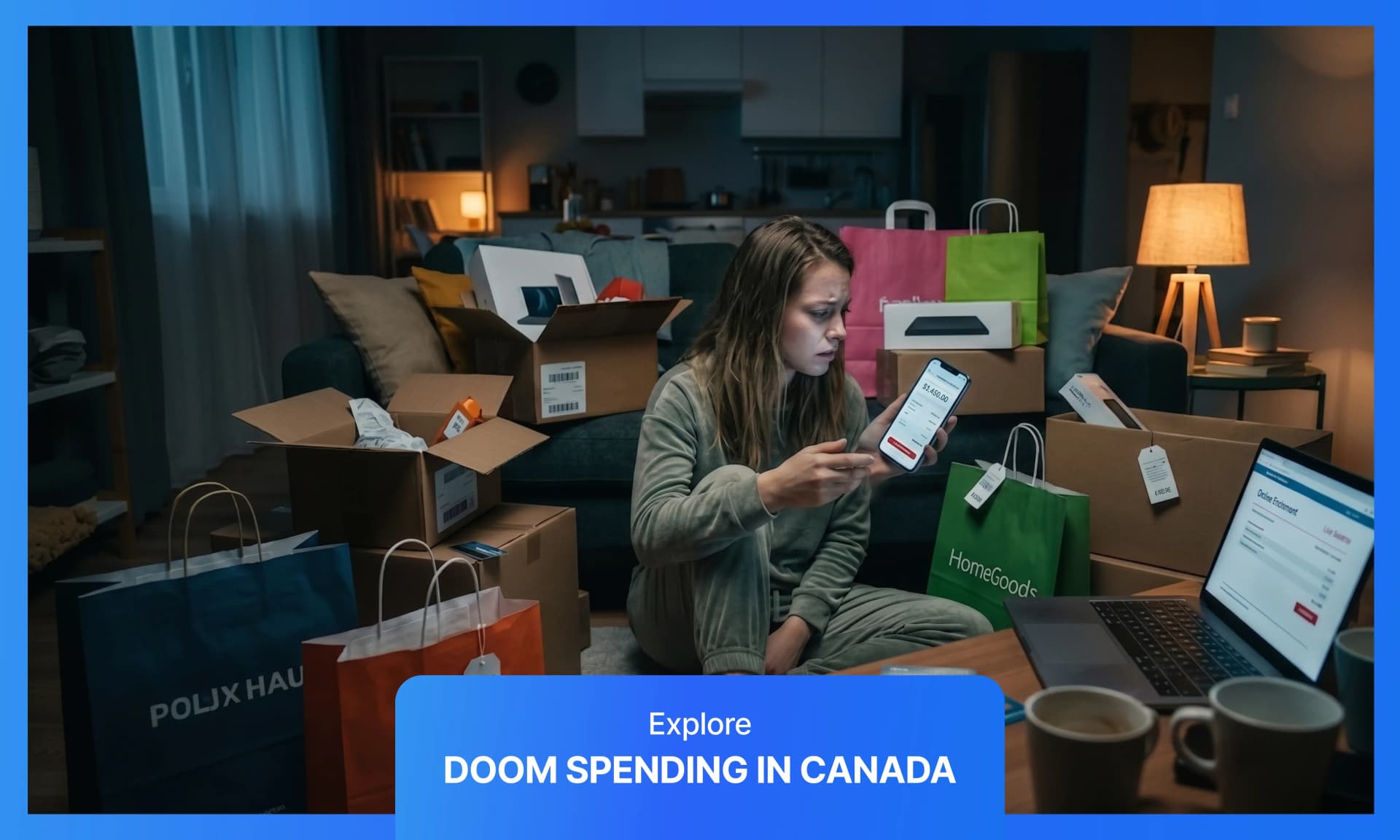
Doom spending is the habit of buying non-essential items despite — or because of — financial anxiety and a growing belief that long-term goals like homeownership are out of reach.
Nearly half of all Canadians say rising prices have severely affected daily expenses (Statistics Canada), and 42% name money as their single greatest stressor (FP Canada).
While the term gained traction in the U.S. through social media in 2023, the underlying behavior is measurable across Canadian households, credit reports, and BNPL adoption data.
The research below covers:
- Credit card delinquency and rising household debt
- BNPL as the payment infrastructure for emotional spending
- Housing unaffordability and the "why bother saving?" mindset
- Added pressure on newcomers with family obligations abroad
- Financial stress levels across Canadian households
- Why Gen Z and Millennials are the most exposed
- Behavioral research on the stress-spending loop
How Stressed Are Canadian Households Right Now?
Financial pressure in Canada is not a recent development, but the numbers from the past two years show it is hitting harder and spreading wider. Several independent surveys paint a consistent picture across income levels, age groups, and regions.
| Finding | Source | Year |
|---|---|---|
| 45% of Canadians say rising prices greatly affect daily expenses (up from 33% two years prior) | Statistics Canada | 2024 |
| 42% of Canadians name money as their greatest stressor | FP Canada | 2025 |
| 55% feel anxious about personal finances; 42% could cover basic expenses for less than one month if income stopped | United Way Centraide Canada | 2025 |
| 41% of Canadians are $200 or less away from financial insolvency each month | MNP Consumer Debt Index | 2026 |
| 71% expect the cost of living to worsen in 2026; 59% expect the economy overall to deteriorate | MNP / Ipsos | 2026 |
Physical Symptoms
The United Way report found that 41% of respondents experienced physical stress symptoms tied to money — headaches, sleeplessness, tension. FP Canada noted that stress runs higher among Canadians under 55 and households earning below $50,000, confirming that age and income both sharpen the problem.
Avoidance Behavior
MNP's data reveals a troubling pattern in how Canadians respond to stress. Only 11% have sought advice from a financial professional, while 15% avoid discussing finances altogether.
Another 17% are using credit to cover basic necessities — not discretionary purchases, but groceries and bills. Grant Bazian, president of MNP LTD, described the pattern well — even small improvements in the overall debt picture do not resolve the fragility underneath.
Psychological Trap
What makes Canada's case unusual is the combination of sustained cost-of-living pressure and a housing market that has locked out a large share of younger adults.
When saving toward a traditional milestone feels futile, spending on smaller, immediate rewards starts to feel rational. The doom spending loop begins here.
Why Are Young Canadians at the Center of This?
Young Canadians face a sharper version of the same financial pressure, amplified by social comparison and the constant visibility of other people's spending on social media. TD's 2025 Gen Z survey produced some of the clearest numbers on this phenomenon.
| TD Gen Z Survey Finding | % |
|---|---|
| Feel compelled to maintain a successful image on social media | 53% |
| Believe they are falling behind peers financially | 65% |
| Cite the cost of living as the biggest barrier to financial goals | 47% |
| Worry that one financial misstep could set them back | 73% |
Image Performance
When 53% of Gen Z feel compelled to look successful online, and 65% feel they are falling behind, the gap between projected image and lived reality widens with every scroll.
The Maclean's feature "The Doom Spenders" (October 2025) profiled young Canadians caught in this exact cycle — facing uncertain futures while turning to installment-based consumption.
Housing Despair
Statistics Canada reported that 56% of Canadians aged 15 to 34 were very concerned about housing affordability, sitting 18 percentage points above the national average.
For a 27-year-old in Toronto who concludes that homeownership requires a household income they won't reach for another decade, the emotional calculus shifts.
The $300 dinner, the spontaneous weekend trip, the jacket purchased on BNPL — all begin to feel less like indulgences and more like the only financial decisions where they have any agency.
Short-Game Spending
The long game has been priced out. The short game is what's left. When unreachable goals dominate a person's financial horizon, present-focused spending fills the void — and that spending is not irrational from the consumer's perspective. It is a response to a system that offers no visible reward for patience.
How Is Credit Stress Showing Up in the Data?
If doom spending were only a cultural observation, it could be dismissed as a social media narrative. However, Canadian credit data confirms that spending under pressure is producing real, measurable damage — especially among younger consumers.
Card Delinquency
Equifax Canada's Q1 2025 Market Pulse report found that the highest credit card delinquency rate (90+ days past due) belonged to consumers under 26.
| Credit Metric (Under 26) | Rate | Trend |
|---|---|---|
| Credit card 90+ day delinquency | 5.38% | ↑ 21.7% YoY |
| Auto loan delinquency | 1.95% | ↑ 30% YoY |
Household Debt
TransUnion Canada reported that by Q4 2025, total Canadian household debt reached $2.6 trillion, up 4.3% year-over-year, while the number of credit-active Canadians grew only 1.2%. Existing consumers are borrowing more — not a wave of new borrowers entering the market.
Millennial Burden
A separate TransUnion study from January 2026 put the Millennial picture in sharp focus.
Millennials now account for 38% of Canada's total outstanding debt (approximately $988 billion). Among consumers planning new credit applications within the next year:
- 47% planned to apply for a new credit card
- 23% planned to increase limits on existing cards
Increasing a credit limit is rarely a sign of financial strength here. It is a pressure valve — a way to buy time when monthly expenses already exceed income.
Flight Response
The MNP Consumer Debt Index adds a behavioral layer. According to MNP / Ipsos, 32% of Canadians are in "flight" mode:
- 15% avoid financial conversations entirely
- 12% refuse to think about obligations
- 17% use credit to cover necessities
What Role Does Buy Now, Pay Later Play?
BNPL has become the payment infrastructure of doom spending. It does not create financial anxiety, but it removes the friction between impulse and purchase — and for a consumer already under emotional pressure, that frictionless gap is where the damage compounds.
Adoption Patterns
TransUnion Canada's BNPL white paper found that Millennials and Gen Z contributed to nearly 80% of "Pay in 4" volumes and close to 70% of "Pay Monthly" volumes.
The stated reasons are convenience and budgeting, but the pattern underneath tells a different story — consumers drawn to BNPL because they can't afford the purchase outright.
Market Growth
Canada's BNPL market is on a steep trajectory. According to ResearchAndMarkets, the sector is projected to reach US$7.50 billion by 2025 and grow to US$11.32 billion by 2030.
| BNPL Metric | Value |
|---|---|
| Canadian market size (2025) | US$7.50 billion |
| Projected market size (2030) | US$11.32 billion |
| Growth rate (2025–2030 CAGR) | 8.6% |
| Gen Z + Millennial share of Pay in 4 | ~80% |
| Gen Z + Millennial share of Pay Monthly | ~70% |
Late Payments
Motley Fool Money's 2025 study found that 29% of BNPL users have made at least one late payment, with Gen Z at 39% and Millennials at 35%.
An H&R Block survey confirmed that Canadian Millennials and Gen Z are less likely than older generations to have disposable income, with many living paycheque to paycheque.
Invisible Debt Trap
The practical mechanism works like this: a stressed consumer sees a $200 purchase. Paying $200 upfront triggers loss aversion. Paying "$50 today and three more payments" triggers almost nothing.
Multiply that across a dozen purchases per quarter, and the consumer carries hundreds in fragmented obligations without a single consolidated view of what they owe. Nearly one in five BNPL users has lost track of their upcoming payments entirely, according to Motley Fool.
For anyone tracking payment trends in Canada, BNPL adoption among financially stressed young consumers is a leading indicator of where credit problems will surface next.
Does Housing Unaffordability Fuel the "Why Bother Saving?" Mindset?
Housing is the most important background variable behind doom spending in Canada. It explains why financial behavior among young Canadians has shifted from conservative saving to present-focused spending — and why that shift is more pronounced here than in many peer countries.
Price-to-Income Gap
The OECD's 2025 Canada economic survey found that Canadian real house prices have outpaced real disposable income growth by approximately 60% since the Global Financial Crisis. Nominal rents grew 6.3% in 2023 and 7.9% in 2024, exceeding earnings growth in both years.
| Housing Metric | Source | Value |
|---|---|---|
| Real house price vs. disposable income since GFC | OECD (2025) | ~60% gap |
| Nominal rent growth, 2023 | OECD (2025) | 6.3% |
| Nominal rent growth, 2024 | OECD (2025) | 7.9% |
| Aged 15–34, concerned about housing | Statistics Canada (2024) | 56% |
| All Canadians concerned about housing/rent | Statistics Canada (2024) | 38% (up from 30%) |
Psychological Impact
When a 30-year-old renting in Vancouver calculates that saving 20% of their income for a decade still won't produce a viable down payment, the logic of long-term planning collapses. A new phone delivers utility today. A savings account that covers one month's rent in five years delivers nothing.
Newcomer Burden
The OECD also reported that landed immigrants are more likely than Canadian-born residents to live in housing that costs more than 30% of income, with the gap widening for newer immigrants in the Toronto area.
For newcomers already sending money home, the double weight of expensive Canadian housing and cross-border remittance obligations leaves almost no room for savings.
How Does Doom Spending Affect Newcomers Differently?
Newcomers face a distinct and intensified version of the same financial pressure. They absorb Canadian cost-of-living increases from day one, often without established credit, a local support network, or eligibility for programs that longer-term residents access.
Financial Barriers
Securian Canada's 2025 research found that 54% of newcomers cite financial stress as their primary well-being challenge, while 26% report social isolation. Interac's 2024 survey widened the picture further.
| Indicator | Newcomers | General Population |
|---|---|---|
| At least one financial barrier | 85% | 58% |
| Financial stress as a primary well-being challenge | 54% | — |
| Social isolation reported | 26% | — |
The 27-percentage-point gap in financial barriers reflects credential recognition delays, limited employment options, higher housing cost burdens, and the ongoing expense of maintaining connections abroad.
Remittance Squeeze
For newcomers who regularly send money home, the doom spending dynamic contains an added layer. Most will cut their own discretionary spending before reducing transfers to family — skipping meals, delaying appointments, and still sending the same amount every month through a money transfer service.
Credit Fragility
For newcomers building credit in Canada, the risk is not just overspending. A delinquency on a thin credit file carries more weight than the same delinquency on a file with 10 years of history. The social pressure to "fit in" adds a spending vector that credit cards and BNPL make dangerously easy to activate.
What Drives the Behavioral Loop Behind Doom Spending?
Doom spending is not simply poor budgeting. Research across multiple countries now supports a model where financial anxiety, social media exposure, identity pressure, and frictionless payment tools combine into a self-reinforcing cycle.
Stress-Spending Link
Intuit Credit Karma's 2024 U.S. survey found that 27% of Americans doom spend to cope with stress, climbing to 37% among Gen Z and 39% among Millennials. The most telling finding — 53% of Gen Z said receiving bad news online drives them to stress spend.
Social Media Trigger
A 2025 peer-reviewed study in the Journal of Economics, Finance and Management Studies examined doom spending among Indonesian university students aged 17 to 25.
Social media interaction had a strong, statistically significant relationship with doom spending (path coefficient of 0.650, p = 0.000), while financial literacy alone did not have a significant direct effect.
Knowing better does not reliably prevent the behavior when social comparison is constant.
Digital Impulse Research
Additional studies fill in the mechanism:
- A 2025 Acta Psychologica study found that time pressure, social influence, and emotional arousal predict online impulse buying
- A 2025 MDPI study confirmed that emotional, identity-driven, and lifestyle-related factors shape impulsive buying in digital environments
The Full Loop
Synthesized across these studies, the doom spending cycle follows a consistent sequence:
| Stage | What Happens | Accelerant |
|---|---|---|
| Trigger | Financial anxiety or negative news | Rent increase, peer milestone |
| Amplification | Social media widens the gap | Algorithmic feeds prioritize aspiration |
| Emotional Response | Stress, frustration, helplessness | Scroll fatigue |
| Spending Impulse | Purchase framed as self-care | "I deserve this" narrative |
| Friction Removal | BNPL or stored card completes it in seconds | No cooling-off period |
| Temporary Relief | Brief dopamine hit | Unboxing, social sharing |
| Guilt Return | Financial position unchanged or worsened | Next bill, next scroll |
The loop restarts at Stage 1. For Canadians specifically, the loop has an extra structural ingredient — a housing market that has made the traditional financial milestone unreachable for a growing share of the population.
What Can Canadians Do to Interrupt the Cycle?
Breaking the doom spending cycle is not about willpower. The Indonesian study specifically found that financial literacy had no statistically significant direct effect on reducing doom spending when social media interaction was present. The intervention has to target the mechanism, not just the knowledge gap.
Set Spending Boundaries
- Keep a dedicated account for discretionary purchases with a hard monthly cap
- When the account hits zero, that is the signal — not the credit limit
- Separate wants from needs at the account level, not mentally
Conduct Regular BNPL Audits
- List every active installment plan quarterly
- Track fragmented obligations across all providers
- Most users underestimate real exposure by a wide margin
Reduce Social Media Exposure
- The 0.650 path coefficient is not a small effect
- Removing the trigger works better than resisting it
- Mute shopping-adjacent content during high-stress months
Use Transfer-First Budgeting
- Treat the monthly remittance as a fixed expense, like rent
- The remaining pool is what's available for everything else
- Knowing that number prevents the guilt spiral
Find Lower-Cost Transfer Options
- A better rate does not change behavior, but widens the margin
- High wire transfer fees and poor exchange rates silently reduce what arrives
- A wider margin is often the difference between a manageable month and a missed payment
The broader pattern is worth stating plainly. Doom spending thrives where long-term goals feel impossible, short-term rewards are one tap away, and social media keeps score in a game most people are losing.
The most effective counter is rebuilding some version of a reachable goal — however small — so that saving has a destination again.
Frequently Asked Questions
Is Doom Spending an Official Financial Term?
Doom spending is not an academic or regulatory classification. The term emerged from social media and personal finance commentary in 2023, referring to spending on non-essential items as a coping response to financial anxiety. Intuit Credit Karma's 2024 survey was among the first to formally measure it. No widely cited, Canada-specific primary study has yet measured doom spending by name across a representative Canadian sample.
How Is Doom Spending Different from Impulse Buying?
Impulse buying is a reaction to immediate desire (a sale, a product display). Doom spending adds an emotional trigger layer — the purchase is driven by anxiety, hopelessness, or identity pressure rather than simple want. A 2025 MDPI study confirmed that impulse buying in digital environments is shaped by emotional and identity-driven factors, which aligns with the doom spending model.
Are Newcomers to Canada More Likely to Doom Spend?
The data does not directly measure doom spending rates among newcomers, but structural exposure is higher. Interac found that 85% of newcomers face at least one financial barrier (versus 58% of the general population), and Securian Canada reported that 54% cite financial stress as their primary well-being challenge. Newcomers also carry the added obligation of supporting family overseas.
Does Financial Literacy Prevent Doom Spending?
Not on its own. The 2025 Journal of Economics, Finance and Management Studies study found that financial literacy did not have a significant direct effect when social media interaction was factored in. Effective prevention combines financial literacy with structural changes — spending caps, BNPL audits, and reduced exposure to comparison-driven content.
References
- Statistics Canada. "Nearly half of Canadians report that rising prices are greatly impacting their ability to meet day-to-day expenses." August 15, 2024.
- FP Canada. "2025 Financial Stress Index Results Deck." 2025.
- United Way Centraide Canada. "Financial stress leaving people vulnerable beyond their wallets." October 15, 2025.
- TD Bank Group. "More than Half of Gen Z Canadians Feel Pressured to 'Fake' Financial Stability." October 14, 2025.
- Maclean's. "The Doom Spenders." Courtney Shea. October 14, 2025.
- Equifax Canada. "Q1 2025 Market Pulse Quarterly Consumer Credit Trends." 2025.
- TransUnion Canada. "Q4 2025 Credit Industry Insights Report." February 2026.
- TransUnion Canada. "Canadians' Financial Outlook Divided as Inflation and Recession Fears Appear to Shape Behaviours." January 13, 2026.
- TransUnion Canada. "Next-Gen Lending Product: Buy Now, Pay Later." 2024.
- OECD. "OECD Economic Surveys: Canada 2025, Chapter 2: Improving Housing Affordability." May 2025.
- Securian Canada. "More than half of newcomers to Canada cite financial stress as their primary well-being challenge." June 18, 2025.
- Interac. "Interac survey reveals newcomers lose financial confidence after arrival in Canada." November 12, 2024.
- Intuit Credit Karma. "Economic concerns heighten as young Americans doom spend to cope with stress." October 31, 2024.
- Husnayetti, Novida, Junarti, and Yudiman. "Doom Spending Behaviour Among the Digital Generation: The Role of Financial Literacy and Social Media Interaction." Journal of Economics, Finance and Management Studies, June 2025.
- Ngo, T.T.A. "Key determinants of online impulse buying behavior: A study from TikTok Shop users in Vietnam." Acta Psychologica, 2025.
- Qi, Y. "'You Only Buy What You Love': Understanding Impulse Buying Among College Students Through Values, Emotion, and Digital Immersion." Journal of Theoretical and Applied Electronic Commerce Research, 2025.
- MNP LTD / Ipsos. "MNP Consumer Debt Index." January 12, 2026.
- ResearchAndMarkets. "Canada Buy Now Pay Later Business Report 2025." December 2025.
- Motley Fool Money. "2025 Buy Now, Pay Later Trends Study." 2025.