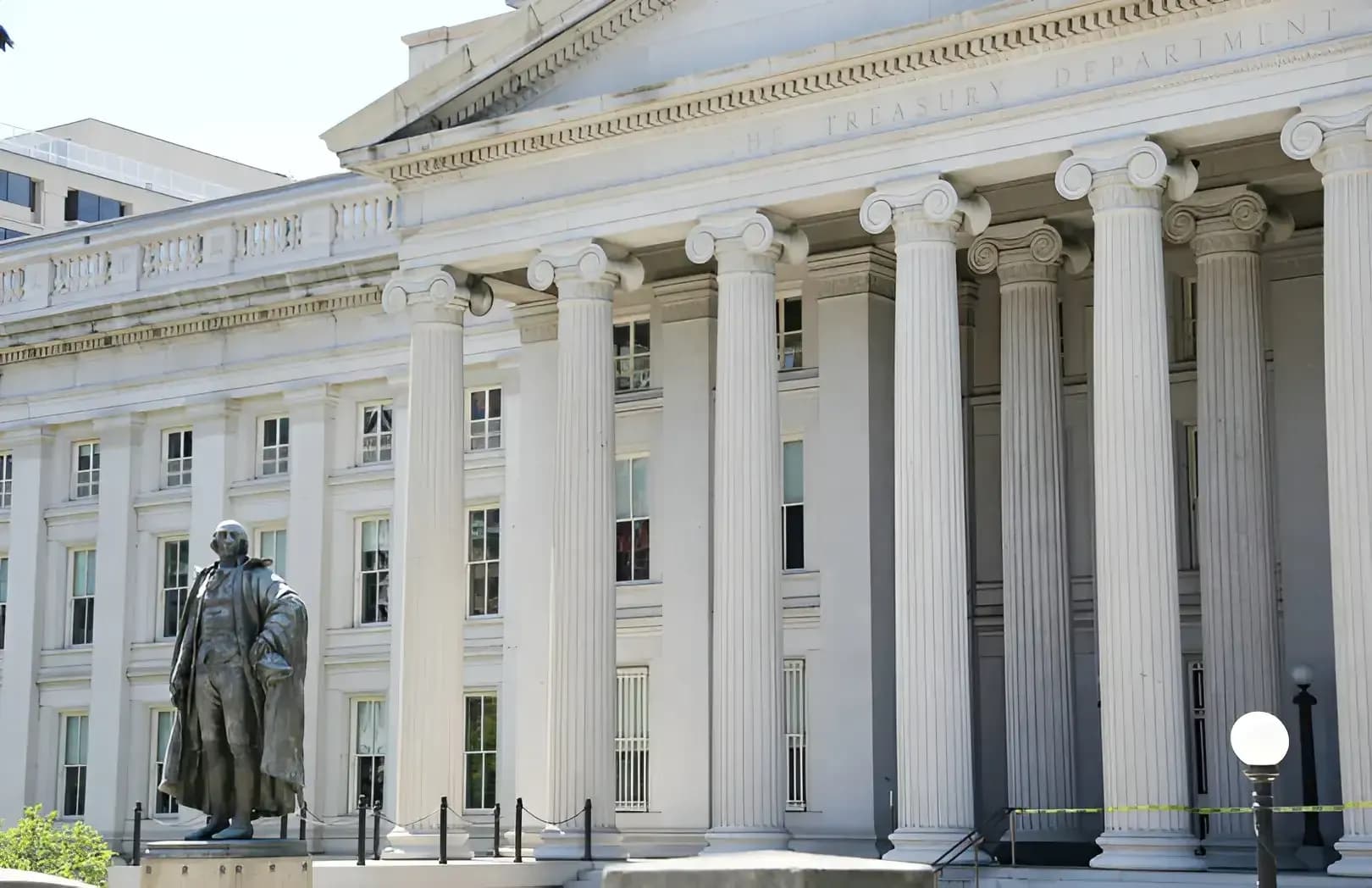
WASHINGTON — The U.S. Treasury's annual financial report shows the federal government's net position deteriorated by $2.07 trillion in fiscal year 2025, reaching a negative $41.72 trillion, as the Government Accountability Office again warned of an "unsustainable long-term fiscal path."
The consolidated financial statements for FY2025, released by the Treasury Department, show total assets of $6.06 trillion and total liabilities of $47.78 trillion as of September 30, 2025.
The report separately presents 75-year projected social insurance shortfalls totalling $88.4 trillion under stated assumptions. These are long-horizon actuarial projections under current law, not the same as booked balance-sheet liabilities due today.
A Fortune commentary by economist Steve H. Hanke and former Comptroller General David M. Walker described the situation as "insolvency."
However, Treasury did not use that term. The report explicitly notes that the government's balance sheet does not include the value of sovereign powers such as:
- Taxation
- Regulation of commerce
- Monetary policy
That’s a key reason many economists reject the application of private-firm insolvency standards to sovereign currency issuers.
What the report shows
The FY2025 Financial Report is a financial disclosure document, not a policy verdict. Treasury presents financial statements and explanatory discussion rather than legislative recommendations.
The Government Accountability Office again disclaimed an opinion on the consolidated statements, citing serious financial management problems at the Department of Defense, intragovernmental accounting issues, and weaknesses in the consolidation process. GAO has been unable to render an opinion on these statements for many consecutive years.
GAO stated directly that "the federal government continues to face an unsustainable long-term fiscal path."
The Congressional Budget Office projected in February 2026 that the federal deficit would rise from $1.9 trillion in FY2026 to $3.1 trillion in FY2036, with debt held by the public reaching 120 percent of GDP by 2036 — well above the previous record of 106 percent set in 1946.
Why the "insolvency" label is contested
Economists note that governments with sovereign currency authority operate differently from households or corporations.
Former Federal Reserve Chair Alan Greenspan made this point in congressional testimony: "There is nothing to prevent the government from creating as much money as it wants, and paying it to somebody."
The U.S. has not formally defaulted on Treasury principal and interest payments in the modern era. Current Treasury yields are roughly 3 to 5 percent depending on maturity, according to Treasury data, consistent with continued market demand — though yields also reflect inflation expectations, Federal Reserve policy, term premium, and geopolitical risk.
Moody's downgraded the U.S. credit rating in May 2025 from Aaa to Aa1, following earlier downgrades by S&P in 2011 and Fitch in 2023.
| Metric | FY2025 | FY2024 | Change |
|---|---|---|---|
| Total assets | $6.06T | $5.68T | +$0.38T |
| Total liabilities | $47.78T | $45.33T | +$2.45T |
| Net position | -$41.72T | -$39.65T | -$2.07T |
| 75-year social insurance gap | $88.4T | $78.3T | +$10.1T |
Source: U.S. Treasury FY2025 Financial Report
The 75-year social insurance estimate is based on current-law assumptions and can change materially if Congress adjusts taxes, benefits, eligibility, or healthcare cost parameters.
The largest drivers of the balance sheet deterioration were a $2 trillion increase in federal debt and interest payable (now $30.33 trillion) and a $438.8 billion increase in federal employee and veteran benefits payable.
What the Fortune commentary proposes
The authors of the Fortune commentary proposed two legislative solutions:
The Fiscal Commission Act (H.R. 3289) and an Article V Convention to propose a balanced budget constitutional amendment modeled on Switzerland's debt brake system.
Walker has long been associated with deficit reduction advocacy efforts that have pushed for Social Security and Medicare reforms.
How is this relevant to the Canadian economy
U.S. markets influence Canada's financial conditions.
The trade exposure is substantial — Global Affairs Canada says nearly $3.6 billion in goods and services crossed the border daily in 2024. Statistics Canada reported that 71.7 percent of Canadian merchandise exports went to the U.S. in 2025.
A Treasury market shock or sustained repricing of U.S. borrowing costs would likely spill over into Canadian borrowing costs, trade sentiment, and business investment.
The Bank of Canada noted on March 18 that the war in the Middle East has already increased volatility in global energy prices and financial markets.
Foreign holdings of U.S. Treasuries rose to $9.305 trillion in January 2026, Reuters reported. Japan held $1.225 trillion; the U.K. held $895.3 billion.


