Compare RemitBee with top money transfer services
Every money transfer provider claims to offer "the best rates" — but the real cost hides in exchange rate markups, not just fees.
Let us show exactly how RemitBee stacks up against major alternatives for Canadian senders.

How does RemitBee compare to other providers?
Provider | Transfer fee | Exchange rate | Speed | Best for |
|---|---|---|---|---|
RemitBee | $0 over $500 CAD; $2.99 under | 0.3% - 0.5% margin | Minutes to hours | Low total cost, Canada-based |
Wise | Varies by currency (often under 1%) | Mid-market (no markup) | 74% under 20 seconds | Transparency, multi-currency |
Western Union | Varies, promos may waive the first | Provider rate (WU profits from FX) | Minutes for cash pickup | Cash pickup, agent network |
PayPal / Xoom | $2.99 - $4.99 CAD; card adds 2.9% | 4% minimum (3% other cases) | Varies | Existing PayPal users |
MoneyGram | Varies by method/destination | Provider rate (MG profits from FX) | Minutes for cash | Cash pickup, mobile wallets |
OFX | CA$15 under CA$10K; free above | OFX margin (quote-specific) | 1-4 days | Large transfers |
XE | Low to no fees (varies) | Quote-specific | 1-4 days | 190+ countries coverage |
Transfer fees vs exchange rate markups
A "$0 fee" can still be expensive — Scotiabank and RBC both market low or $0 transfer fees for international transfer products, but both note that foreign exchange rates still apply.
A provider offering $0 fees with a 4% exchange markup costs more than one charging $5 with a 0.5% margin. Always calculate what your recipient receives.
That’s why you must know the following concepts to evaluate better:
A fixed charge regardless of amount. Sending $100 with a $5 fee costs 5%; sending $1,000 costs 0.5%. Flat fees hurt small transfers most.
Tied to the transfer amount. Wise charges variable percentages by currency, so costs scale proportionally with the amount.
The gap between the mid-market (interbank) rate and the provider rate. If the mid-market is 1.37 CAD/USD and a provider offers 1.33, that 0.04 difference is roughly a 3% hidden cost.
Transfer speed and payment methods
Delivery speed depends on two factors — funding speed (how fast the provider receives your money) and payout speed (how fast they deliver it).
Typically takes 1–2 business days to fund and is usually the cheapest method (but adds time).
Often funds within minutes and is widely supported by Canadian providers, including RemitBee.
Instant funding, but often higher fees than bank transfer — however, not as high as credit cards.
Fastest funding, but the highest cost — card issuers may treat transfers as cash advances and charge extra fees and interest.
Cash can be ready in minutes at eligible locations, but typically, relatively higher fees apply.
Traditional bank wire network. Often takes a few business days, while intermediary banks may deduct their own fees.
Transfers are generally instant or occur within seconds, making them faster than traditional bank transfers.
Safe and sound
Your money, your data, protected


Money transfer companies in Canada must register with FINTRAC as MSBs. RemitBee is registered and complies with Canadian AML requirements. Verify providers on FINTRAC's MSB registry.

Registered providers implement anti-money-laundering programs and identity-verification measures. Western Union, MoneyGram, and Xoom note transactions may be delayed for compliance purposes.

RemitBee uses SHA-256 RSA encryption. Xoom states that it uses 128-bit encryption with site-wide secure pages. Western Union confirms transfers are encrypted.
Best money transfer services in Canada
What factors are important when comparing providers?
Choosing the right provider depends on what you're optimizing for — cost, speed, convenience, or coverage. Not all factors matter equally for every sender.

RemitBee's $0 fee (for amounts over $500 CAD) plus a 0.3%–0.5% margin is transparent. Providers like Western Union and MoneyGram don't publish margins, compare the final recipient amount, not the advertised fee.

Cash pickup (Western Union, MoneyGram) arrives in minutes. Digital transfers (RemitBee, Wise) to bank accounts or mobile wallets typically complete within hours. Bank wires take 1–5 business days via SWIFT.

Not everyone has a bank account. Cash pickup serves unbanked recipients. Mobile wallets (GCash, bKash, Easypaisa) work where digital payments dominate. UPI transfers reach India instantly.

FINTRAC registration matters for Canadian senders. RemitBee, Wise, Western Union, MoneyGram, and major providers are registered Money Services Businesses. Verify any provider on FINTRAC's public MSB registry before sending.
RemitBee vs other money transfer services
Pricing varies by corridor, amount, funding method, and payout option. Each comparison page below provides a detailed analysis for that provider pair.
Money transfer vs bank wire transfers service
Bank | Outgoing International Wire | Incoming Wire |
|---|---|---|
TD | $50 to non-TD account | $17.50 |
RBC | Starting at $45 CAD | Free under $50, starting at $17 above |
CIBC | $30 (less than or equal to $10K); $50 ($10K–$50K); $80 (greater than $50K) | $15 |
Scotiabank | Varies by product/channel | $15 |
Cheapest way to send money from Canada
Fixed fees dominate at this level — a $5 fee on $100 is 5%. Look for providers with low flat fees and avoid credit card funding. For under $500 CAD, RemitBee charges $2.99 for EFT/e-Transfer.
Balance of fees and exchange rate matters equally. RemitBee offers $0 fees for amounts over $500 with a 0.3%–0.5% margin, while Wise offers a mid-market rate with a transparent percentage fee. Always calculate the final recipient amount from each provider.
Exchange rate margin dominates for amounts over $5,000 CAD. On a $10,000 transfer, a 0.5% vs 2% margin difference is $150. Get quotes from multiple providers at this level before you pick a money transfer service.
Popular transfer corridors from Canada
This is one of the most competitive corridors from Canada, which generally means strong exchange rates. It’s best to compare the total amount delivered in INR rather than focusing only on fees. UPI transfers are often more cost-effective and can arrive quickly, while traditional bank deposits usually settle within 24 hours.
Sending to GCash is especially popular and often more affordable than depositing directly into a bank account. Comparing providers based on the total PHP received gives the clearest picture of value. In most cases, both GCash and bank transfers are completed the same day.
The CAD→USD corridor is highly competitive, giving senders plenty of options. For smaller amounts, fees tend to have the biggest impact, whereas for larger transfers, the exchange rate margin matters more. Delivery to U.S. bank accounts is commonly same-day or next-day.
Mobile wallets such as Easypaisa and JazzCash are widely used and frequently cheaper than bank transfers. Wallet transfers can arrive within minutes or a few hours, while bank deposits typically take one to two business days.
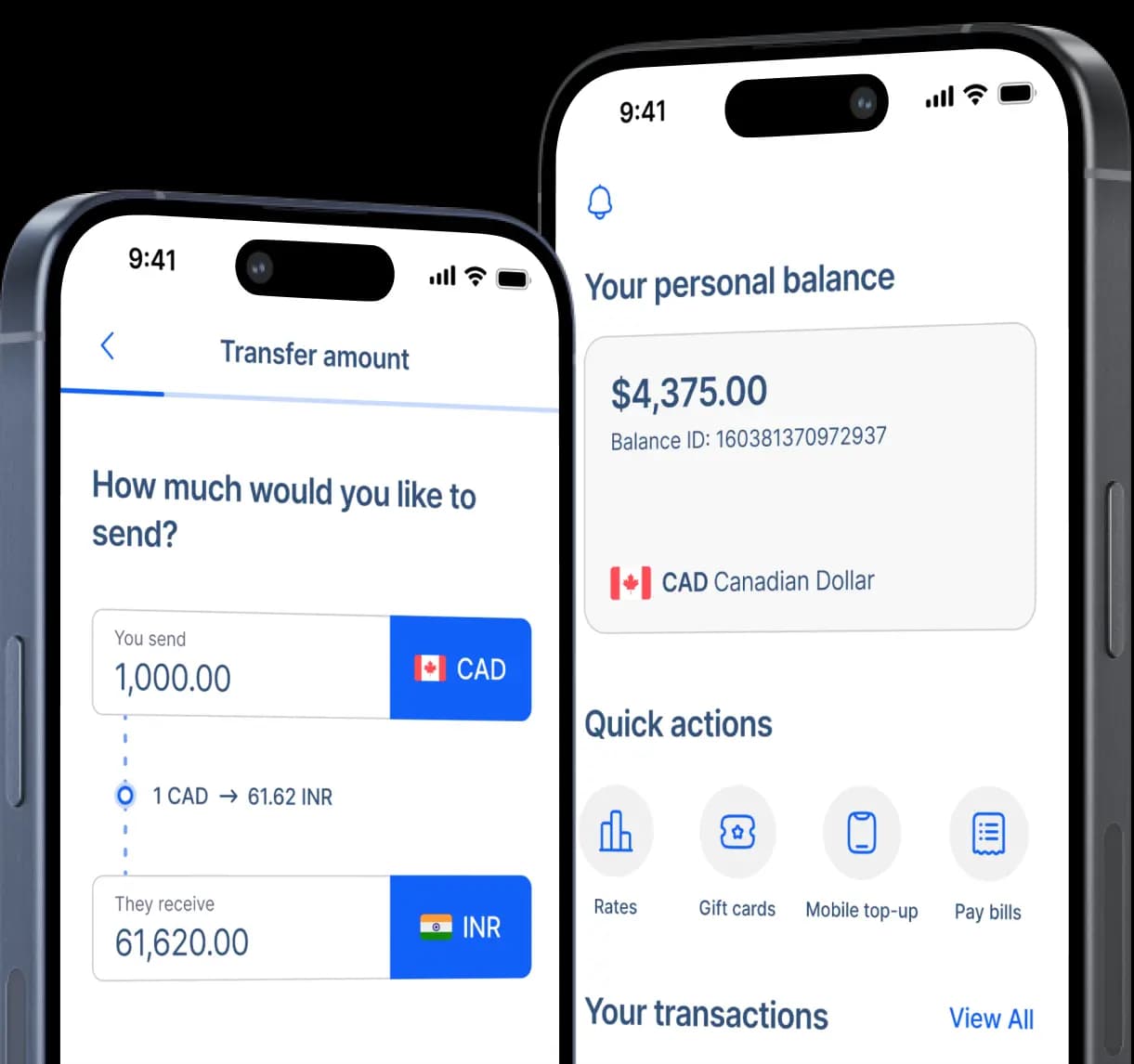
Take RemitBee With You
- Biometric login for quick access
- Transaction history at your fingertips
- Rate alerts for your preferred currencies
- Push notifications for every transfer update