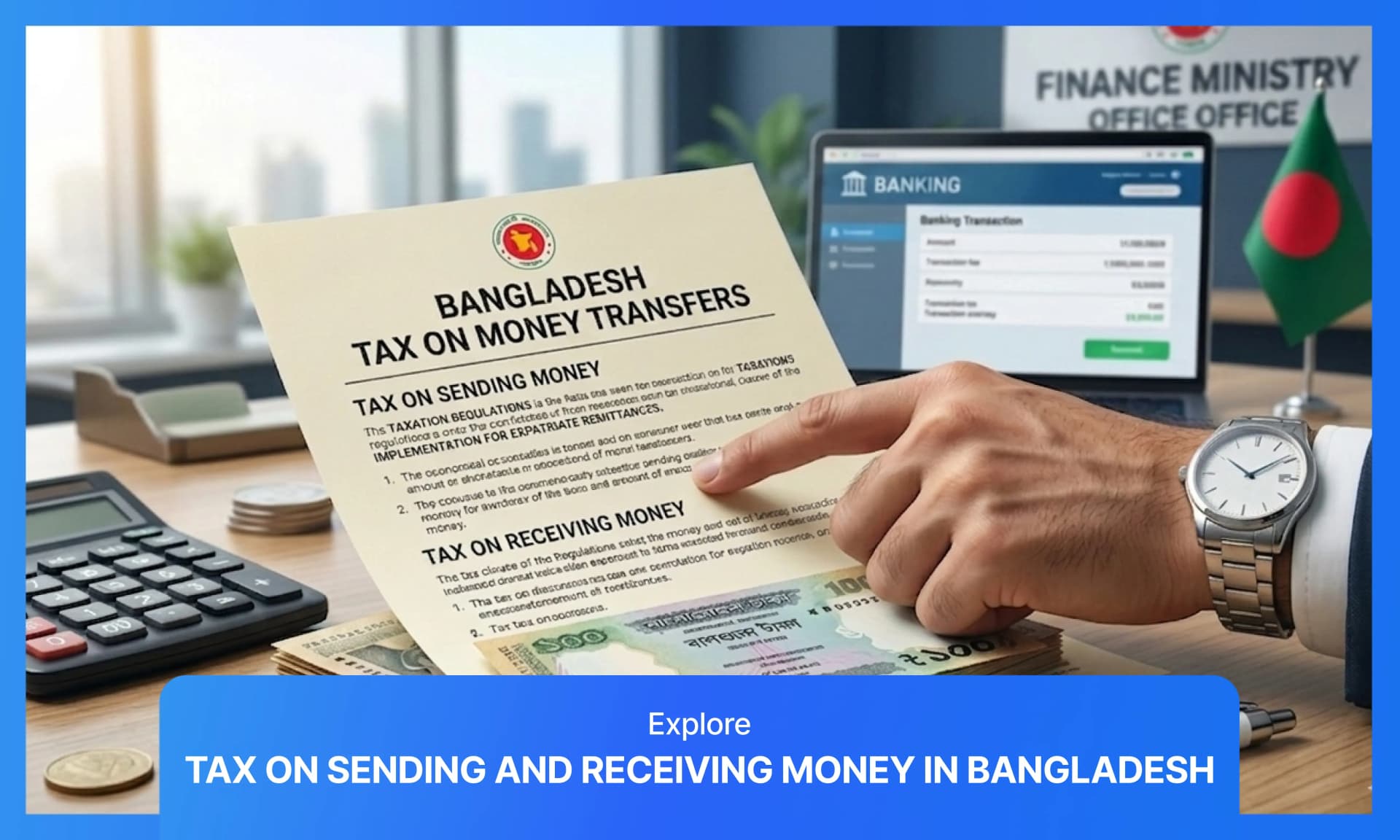
Neither Canada nor Bangladesh taxes the act of transferring money. No "remittance tax" exists on either side. Canada taxes income at the point of earning, not at the point of transfer, and Bangladesh actively rewards inbound remittances with a 2.5% government cash incentive on funds sent through official banking channels.
For Canadian immigrants sending money home to family in Bangladesh, the vast majority of transfers are tax-free on both ends because they are personal gifts or family support — not income.
The complications arise only when money is classified as income (salary, freelance payments, business revenue), when transfers are poorly documented, or when the recipient earns taxable foreign income.
What's Covered in This Guide
- How Canada treats outbound money transfers
- Why transfers are not taxed, but income is (on both sides)
- Banking controls, compliance requirements, and audit risks
- When receiving money in Bangladesh becomes taxable
- How the Canada-Bangladesh tax treaty prevents double taxation
- How Bangladesh treats inbound remittances (including the 2.5% incentive)
TLDR – Tax Treatment at a Glance
Here is the quick-reference breakdown before we get into the details.
| Scenario | Taxed in Canada? | Taxed in Bangladesh? |
|---|---|---|
| Salary earned in Canada, sent to parents in Bangladesh | Already taxed as income | Not taxed (treated as remittance/gift) + 2.5% incentive |
| Gift from savings to family | Not taxed | Not taxed (family support) |
| Transfer between your own accounts | Not taxed | Not taxed |
| Freelance income received by someone in Bangladesh | N/A (earned in Bangladesh) | Taxable as income (withholding may apply) |
| Business income labeled as "family support" | Taxable if undeclared | May be reclassified as taxable income |
What Are Canada's Tax Rules for Sending Money to Bangladesh?
Canada does not tax outbound transfers. No reporting form, no exit levy, no remittance surcharge. The CRA's only concern is whether the money was properly taxed before it left the country.
Income Taxation
Canadian residents are taxed on worldwide income. If you earn a salary, business income, or investment returns in Canada, that income is taxable regardless of where you send the proceeds.
Sending $2,000 per month to parents in Bangladesh does not create a new tax event — the income was already taxed through payroll deductions or your annual return.
Gift Treatment
Canada has no gift tax. Giving money to family members abroad does not trigger any tax for the sender or the recipient.
Monthly support payments, lump-sum transfers for a medical emergency, or help with a sibling's education — all non-taxable, provided the funds come from after-tax income.
The risk appears when the CRA questions whether a transfer is genuinely a gift:
- Regular payments to someone who provides services may be reclassified as employment or contractor income
- Business profits channeled through personal accounts as "family support" can trigger reassessment
- Offshore income that was never declared becomes taxable the moment CRA discovers it
Reporting and Compliance
Transfers are not reported directly to the CRA, but they are monitored. FINTRAC requires financial institutions to report transactions of CAD $10,000 or more (and any pattern that appears structured to avoid the threshold).
The reporting is automatic and does not create a tax obligation — but it creates a trail that CRA can access during an audit. Banks may also request documentation before processing large transfers:
- Source of funds
- Purpose of the transfer
- Relationship between sender and recipient
How Does Bangladesh Treat Inbound Remittances?
Bangladesh is one of the world's largest remittance-receiving countries — inflows exceeded $21 billion in the 2024 fiscal year and grew roughly 20% year-on-year through early 2026.
The government's policy is clear: remittances sent through official channels are not taxed, and recipients are actively rewarded for using formal banking systems.
Tax-Free Status
Remittances from expatriates to family members in Bangladesh are not subject to income tax. The policy is designed to maximize foreign exchange reserves and discourage informal transfer systems (like hundi). Family support payments, savings transfers, and financial assistance for education or healthcare all fall under this exemption.
The 2.5% Cash Incentive
Rather than taxing remittances, Bangladesh pays recipients a bonus. The government provides a 2.5% cash incentive on remittances sent through official banking channels.
If $1,000 is sent, the recipient receives approximately $1,025 in BDT. The incentive is credited automatically for transfers under BDT 500,000; larger amounts require documentation (a copy of the sender's passport and proof of employment).
The incentive program launched in July 2019 (initially at 2%) and was increased to 2.5% in January 2022. It remains active as of 2026.
No Restrictions on Inflows
Bangladesh allows the free inflow of foreign funds, with no caps on remittances — making it one of the more open systems globally for inbound transfers.
When Does Receiving Money Become Taxable in Bangladesh?
Remittances and family gifts are tax-free, but income is not. The classification of the money determines everything.
Foreign Income
If money received in Bangladesh constitutes income (e.g., salary from a foreign employer, freelance payments, consulting fees, business distributions, or investment returns), it is included in the recipient's total taxable income. Bangladesh's individual income tax system for the 2025-26 assessment year uses progressive rates:
- Non-resident individuals who are not Bangladeshi citizens are taxed at a flat 30%
- The first BDT 350,000 is tax-free
- The tax-free threshold is higher for women, seniors aged 65 and above, and persons with disabilities
Freelancers and Digital Workers
Bangladesh has tightened rules around online income.
Payments from foreign clients for services (freelancing, consulting, commissions) may be subject to withholding tax at source — typically around 10% — before funds are credited to the recipient.
The growing digital economy has pushed authorities to formalize these income streams, and labeling freelance payments as "remittances" to avoid tax carries audit risk.
Gifts from Non-Immediate Family
Money received from parents, children, or spouses is generally treated the same as remittances (not taxed). Transfers from siblings, friends, or other non-immediate relatives are an evolving area — recent policy discussions suggest these may be classified as capital income and become taxable. The distinction is still developing, but it signals increased scrutiny on the classification of gifts.
Bangladesh Income Tax Rates (2025-26 Assessment Year)
| Income Slab (BDT) | Tax Rate |
|---|---|
| First 350,000 | 0% |
| Next 100,000 | 5% |
| Next 400,000 | 10% |
| Next 500,000 | 15% |
| Next 500,000 | 20% |
| Next 2,000,000 | 25% |
| Above 3,850,000 | 30% |
What Banking Controls Apply on Both Sides?
Even when a transfer is tax-free, it is not invisible.
Canada Side
Financial institutions report transactions of CAD $10,000 or more to FINTRAC as part of anti-money-laundering compliance. Banks may request source-of-funds documentation for large or unusual transfers. The reporting does not trigger tax — it creates a compliance record.
Bangladesh Side
Banks must credit remittance funds promptly and notify recipients upon receipt. For large or unusual transfers, the receiving bank may request:
- Explanation of the transfer's purpose
- Proof of the relationship between the sender and recipient
- Employment documentation (for transfers qualifying for the 2.5% incentive above BDT 500,000)
Using informal channels (hundi) eliminates the 2.5% incentive, increases legal risk, and removes the paper trail that protects both sender and recipient during a tax review.
How Does the Canada-Bangladesh Tax Treaty Prevent Double Taxation?
The Canada-Bangladesh Income Tax Convention was signed on February 15, 1982, and entered into force on January 18, 1985. The treaty allocates taxing rights for different types of income and provides relief through foreign tax credits.
In practice:
- If you pay income tax in Canada on employment earnings, Bangladesh allows a credit for the Canadian tax paid (and vice versa) — so the same income is not taxed at the full rate by both countries
- The treaty reduces withholding tax rates on certain cross-border payments
- The treaty applies to income, not to gifts or family support transfers
For most immigrant families, the treaty is not directly relevant because the transfers are gifts. The treaty becomes important only when the recipient earns foreign income, holds cross-border investments, or receives payments that qualify as taxable income in both jurisdictions.
Send Money to Bangladesh — And Your Family Gets a Bonus
For Canadian immigrants supporting family in Bangladesh, the tax picture is straightforward: genuine remittances from after-tax income are not taxed in either country, and your family receives an extra 2.5% from the Bangladeshi government.
- Zero fees on transfers over $500 CAD
- Best exchange rates that consistently beat banks
- FINTRAC-regulated and fully compliant with Canadian law
- Send money to Bangladesh with real-time tracking and transparent pricing
Frequently Asked Questions
Does Bangladesh Tax Remittances from Canada?
No. Bangladesh does not tax remittances sent by expatriates through official banking channels. Family support payments, savings transfers, and financial assistance for education or healthcare are all exempt from income tax. Recipients also receive a 2.5% cash incentive from the government on qualifying transfers. The policy is designed to maximize foreign exchange inflows and discourage informal transfer systems like hundi.
Does Canada Charge Tax for Sending Money to Bangladesh?
No. Canada has no remittance tax, no exit levy, and no surcharge on outbound transfers. The CRA's concern is whether the money was properly declared and taxed at the point of earning. If the funds came from declared employment or business income, sending them abroad creates no new tax obligation. Gifts to family members are also not taxable in Canada (there is no gift tax).
What Is the 2.5% Bangladesh Remittance Incentive?
The Bangladesh government pays recipients a 2.5% cash bonus on remittances sent through official channels. The incentive is credited automatically for transfers under BDT 500,000. For larger amounts, the recipient must provide the sender's passport copy and proof of employment. The program launched in July 2019 at 2%, was increased to 2.5% in January 2022, and remains active as of 2026.
Can Freelance Income Be Sent as a "Remittance" to Avoid Tax?
No. If money received in Bangladesh represents payment for services (freelancing, consulting, commissions), it is classified as income and taxed under Bangladesh's progressive income tax system. Withholding tax of approximately 10% may apply at source. Labeling freelance payments as family support to avoid tax carries audit risk and can lead to reclassification, penalties, and back taxes.
Is There a Canada-Bangladesh Tax Treaty?
Yes. The Canada-Bangladesh Income Tax Convention was signed on February 15, 1982, and entered into force on January 18, 1985. The treaty allocates taxing rights on income types such as employment, business profits, dividends, and interest. It provides foreign tax credits so that the same income is not taxed twice in both countries. The treaty applies only to income, not to gifts or family support transfers.
What Triggers a FINTRAC Report in Canada?
Financial institutions report transactions of CAD $10,000 or more to FINTRAC, as well as transactions that appear structured to avoid that threshold. The report is automatic and does not create a tax liability. FINTRAC's role is anti-money-laundering compliance, not tax collection. The record can be accessed by CRA during an investigation, but routine family remittances do not trigger tax consequences.