In 2026, Canada's labor market has entered uncharted territory. RBC Economics estimates that the country's "breakeven" employment — the monthly pace of job creation needed to keep unemployment steady — has fallen to approximately -10,000 jobs per month.
During the 2023–2024 surge, breakeven sat closer to 60,000 jobs monthly. The collapse signals a fundamental shift in how Canada's workforce functions.
Key dynamics shaping the 2026 labor market:
- Agentic AI is automating traditional entry-level roles
- Licensed, in-person occupations now offer the most stability
- International graduates face shrinking pathways to permanent residency
- Baby Boomer retirements are accelerating faster than new workers are entering
- Breakeven employment has turned negative (fewer jobs needed to maintain current unemployment)
- For newcomers, graduates, and job seekers, understanding these forces is essential to navigating what comes next.
Why is unemployment falling while jobs disappear?
Two converging demographic forces are reshaping Canada's labor supply — and creating counterintuitive employment signals.
Immigration slowdown
Federal caps on temporary residents and international students have sharply slowed the rapid labor force expansion seen in 2023. With fewer new entrants competing for positions, the economy needs fewer jobs to keep unemployment stable.
Aging workforce
Record numbers of Baby Boomers are exiting the workforce. RBC estimates the Canadian workforce could outright shrink in the year ahead, driven by retirements outpacing new labor force entrants.
The result: unemployment can actually fall even when the economy loses jobs. The January 2026 Labour Force Survey illustrates the paradox perfectly — unemployment dropped to 6.5% despite the economy shedding 25,000 positions.
The number of unemployed fell by 94,000 alongside a decline in labor force participation, creating a denominator effect where fewer job seekers — not more hiring — drove the improved headline rate.
The employment rate dipped to 60.8%, signaling a shrinking workforce rather than a thriving one. For those outside the labor market (immigrants seeking their first Canadian role, new graduates hunting for experience), the headline unemployment figure masks a genuine hiring drought.
What does Indeed's 2026 report reveal about hiring?
Indeed's 2026 Canadian Jobs & Hiring Trends Report confirmed that the "low-hire-low-fire" dynamic persisted through 2025.
While layoffs remained subdued compared to pre-pandemic levels, hiring slowed even further — creating a labor market where movement has ground to a halt.
The consequences are measurable:
- Only 0.4% of Canadian workers changed jobs in November 2025
- 26% of Canadians aged 15–24 have never held a job (up from 21% three years earlier)
- 3.4% of prime-age workers (25–54) are unemployed for over six months despite wanting work (up from 2.5% in late 2022)
Job switching has collapsed. New entrants struggle to break in. And those already employed are staying put — whether by choice or necessity.
How are Boomer retirements reshaping industries?
Canada is now at peak demographic impact. RBC data shows 5.2 million Boomers have already retired, with the most intense wave of exits occurring between 2024 and 2030 as remaining Boomers reach age 65.
Uneven exits
Retirement churn hits some sectors harder than others. RBC identifies industries with unusually high concentrations of older workers:
- Agriculture
- Wholesale trade
- Non-durable goods manufacturing
- Building and other support services
RBC finds older-worker shares exceed 25% in 9 of 21 industries, reaching around 40% in fishing and agriculture. In these sectors, physical labor and specialized licensing roles are vacating while desk jobs sought by new graduates remain frozen.
Persistent shortages
Meanwhile, health care, social services, and warehousing have maintained above-average vacancy rates even as overall Canadian vacancies cooled from their 2022 peak.
The Indeed report notes the job vacancy rate fell from 3.1% (Q3 2024) to 2.8% (Q3 2025) — yet certain sectors remain stubbornly understaffed.
A succession gap is emerging: physically demanding or licensed roles are vacating faster than desk jobs, creating mismatches between where openings exist and where graduates want to work.
Is Agentic AI eliminating "starter" jobs?
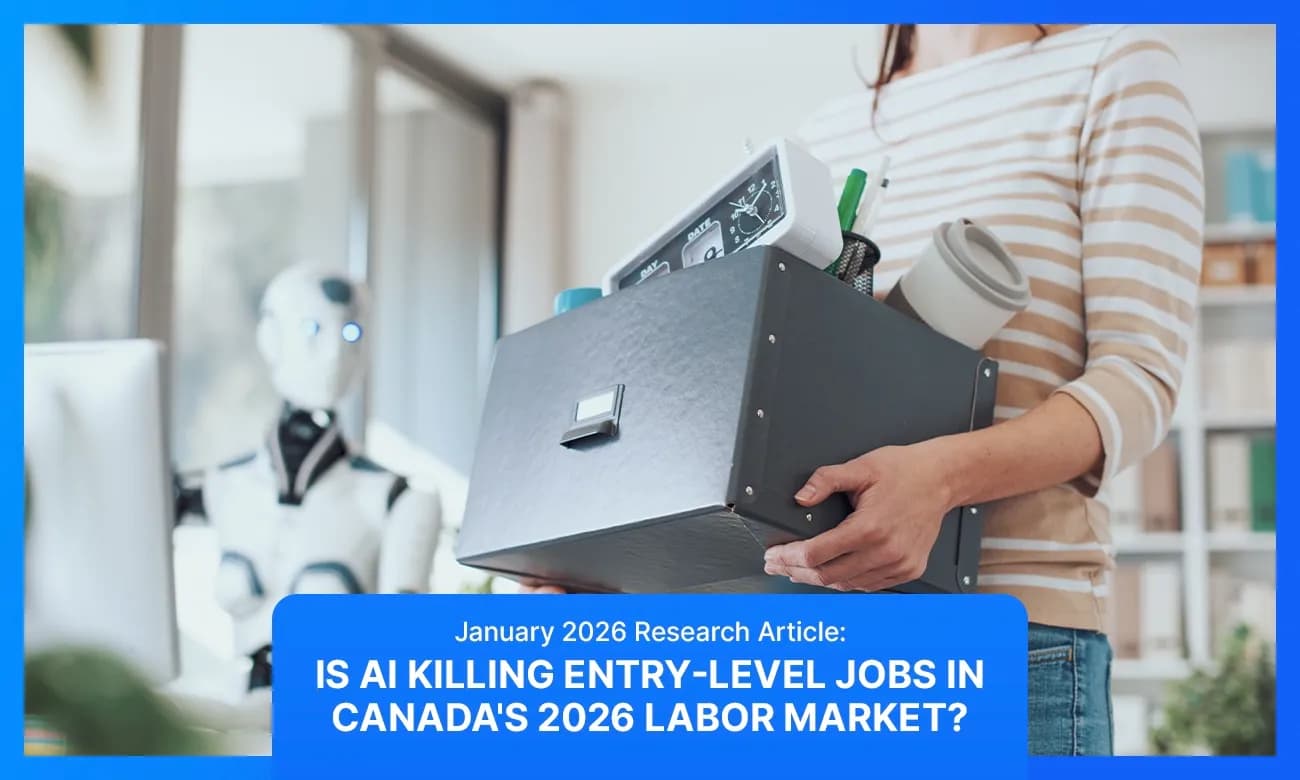
In 2026, traditional entry-level roles that once allowed graduates and immigrants to gain crucial Canadian experience are being automated by Agentic AI.
What was once grunt work — data entry, scheduling, basic reporting — served as a training ground where fresh graduates learned industry nuances and prepared for professional careers.
Vanishing rungs
Agentic AI automates low-stakes tasks, removing the learning milestones that previously moved interns from year zero to year two on the corporate ladder.
As a result, employers increasingly demand two to three years of experience for "entry-level" positions — because the tasks used to train someone no longer require a human.
The Indeed report cautions that it remains "difficult to pinpoint AI's broader effects" on the labor market. However, the direction is clear: fewer junior roles exist, and competition for those remaining has intensified.
Expert perspectives
Aimee Li, co-director of Encode Canada, argues that replacing interns with AI deprives companies of fresh ideas. "At the end of the day, AI is just a very sophisticated regression model that uses past data to predict the most likely outcome," Li explained. "It is unable to progress further than what we have already."
Simon Blanchette, a management lecturer at Concordia University and McGill University, notes that many companies use AI primarily for cost-cutting. Small businesses deploy it to scale without spending big; large corporations use it to stay lean.
Survey findings
In a social media poll by RemitBee, over 50% of Canadians surveyed said entry-level tech roles are the hardest to find in Canada over the last two years.
Entry-level office roles followed at over 30%, with skilled trades at 15%. Interestingly, no one voted for healthcare and care roles — a sector that remains chronically understaffed.
Why are international graduates struggling to obtain PR?
For many international students, the disappearance of traditional starter jobs isn't merely a career setback — it's become a structural barrier to permanent residency (PR). As AI automates entry-level positions, the pathway from a Post-Graduation Work Permit (PGWP) to PR grows narrower.
The hours problem
To qualify for PR under the Canadian Experience Class (CEC), candidates must accumulate at least one year (1,560 hours) of paid skilled work in Canada within three years of applying.
The work must fall under NOC TEER 0, 1, 2, or 3 — categories that historically included many entry-level administrative and technical roles.
Critical limitations apply:
- Work gained while studying does not count toward CEC requirements (even if paid)
- Only post-graduation skilled employment qualifies
- Hours must be completed before the PGWP expires
As AI handles routine tasks and reduces junior roles in offices and tech support teams, international graduates find fewer opportunities to earn the skilled hours required for PR.
Running out of time
A PGWP can range from 8 months to 3 years, depending on program length and other factors. Without access to TEER-eligible paid positions, many students cannot complete the one-year skilled experience requirement before their permits expire.
The paradox is painful: international students spend significant money and time on Canadian credentials, earn a PGWP that allows them to work, but cannot find the right work needed for PR.
Some measures of labor underutilization have edged up as highly educated graduates take jobs unrelated to their field — and immigration eligibility.
In the same RemitBee survey, over 65% of immigrants and international students identified lack of Canadian experience as their biggest job-search barrier. Unrecognized credentials and limited professional networks each received over 15% of votes.
Which jobs offer stability in 2026?
The decline in demand for traditional entry-level office work is shifting the value of credentials in Canada's labor market.
Employers increasingly prioritize candidates with immediately deployable, occupation-specific skills — pressuring immigrants and students to upskill quickly or risk being locked out of PR-eligible employment.
Credentials as signals
Industry-specific qualifications are becoming minimum expectations in shortage sectors:
- Skilled trades diplomas
- Healthcare support certificates
- Compliance-related certifications
- Early childhood education credentials
These qualifications shorten employer training time and reduce onboarding costs, making candidates more attractive in a breakeven employment environment.
In-person services
In-person services such as social assistance, childcare, and ambulatory health services continue growing in demand (though pay varies widely by role and province). While AI can perform knowledge work, physical presence cannot be replicated by programs and apps.
Licensing as protection
Regulated professions such as nursing, electrical work, plumbing, financial compliance, and childcare are generally harder to automate quickly due to regulation, safety constraints, and hands-on requirements.
Licensed occupations offer stability and align with Canada's immigration category-based priorities — including healthcare, trades, and education.
For international students and newcomers, the strategic shift has moved from attaining generalist degrees to securing specific licenses. Regulated professions such as nursing, Red Seal trades, and early childhood education offer a "regulatory moat" that AI cannot cross — and a more direct path to PR.
What does the breakeven economy mean for job seekers?
Canada's labor market in 2026 is a tale of two economies. Agentic AI is hollowing out starter roles that once served as training grounds for professionals.
By automating entry-level tasks, AI has made the first few rungs of the career ladder harder to reach — leaving graduates without the experience employers now demand.
Meanwhile, the Boomer Bottleneck creates shortages in physical, licensed, and care-based work. For those willing to pivot toward sectors AI cannot touch, the current labor shortage represents genuine opportunity.
Canada is not running out of work — it's running out of entry-level desk work. The breakeven economy of 2026 demands a new kind of worker: one who combines technical fluency with "human-only" licensed skills.
Whether that means pursuing a healthcare certificate, a skilled trade, or an in-person service credential, the path forward requires adapting to a labor market that no longer offers easy on-ramps.
Frequently asked questions
Here are some frequently asked questions on this topic:
What is breakeven employment?
Breakeven employment is the pace of job creation (jobs per month) needed to keep the unemployment rate from rising. When breakeven turns negative (as it has in 2026), the economy can lose jobs without unemployment increasing — because fewer workers are entering the labor force.
Why did unemployment fall in January 2026 despite job losses?
The number of unemployed dropped by 94,000 alongside a decline in labor force participation. With fewer people actively seeking work, the unemployment rate fell even though employment itself declined by 25,000 positions.
How does AI affect entry-level jobs?
AI (particularly Agentic AI) automates low-stakes tasks that previously served as training ground for junior employees. Fewer entry-level roles exist as a result, and employers increasingly demand prior experience for positions that once required none.
Can international students still qualify for PR through work experience?
Yes, but it's harder. The Canadian Experience Class requires 1,560 hours of skilled work (NOC TEER 0–3) within three years. With fewer entry-level roles available, accumulating those hours before a PGWP expires has become more challenging.