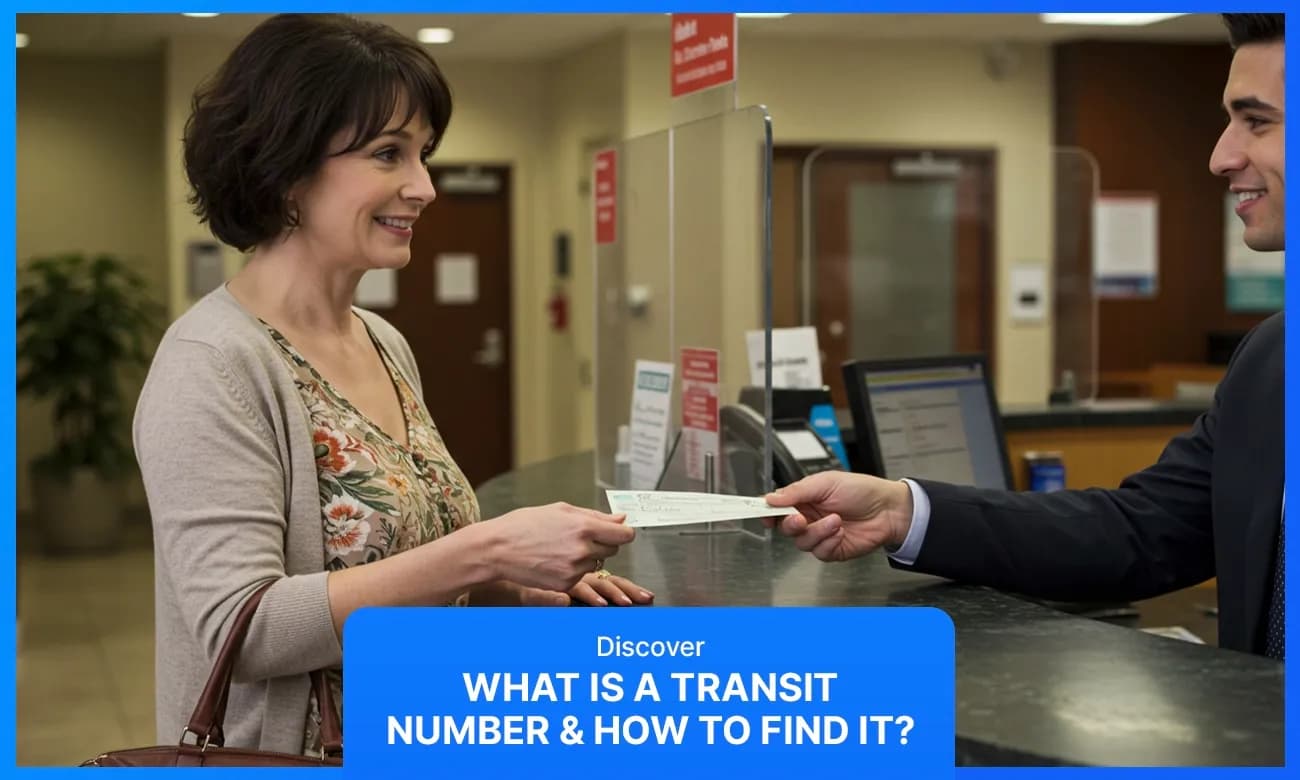
What is a Transit Number?
A transit number is a five-digit numeric code that identifies the specific branch where you opened your account. It’s an important part of the larger routing number used for financial transactions.
Imagine Friday evening arrives, and you check your bank account expecting your bi-weekly paycheck. Instead, you find an empty balance and a voicemail from HR about "banking information issues."
Why? One digit sent your $3,200 salary bouncing around the Canadian banking system while your mortgage payment looms Monday morning.
That’s how important the transit number is. If you get your transit number wrong once, your money can disappear into banking silos while late fees pile up.
We’ve prepped a guide that will help you:
- Avoid costly wire transfer delays with proper banking details
- Find your transit number instantly (even without ordering checks)
- Understand why these five digits protect your paydays and bill payments
What exactly is a transit number?
Your transit number pinpoints the exact branch where you first opened your account.
The five-digit code teams up with your three-digit institution number and personal account number to create a routing number the complete address that guides every electronic payment straight to your account.
On a Canadian check, you’ll see this pattern:
Transit: 12345 | Institution: 010 | Account: 1234567890
- The first five digits = your branch location
- The next three digits = your bank (010 = CIBC)
- The rest = your unique account number
Every Canadian financial institution follows this exact sequence, allowing transfers to process automatically in seconds.
Why does your transit number control your financial life?
Your transit number is critical in three common situations.
Direct deposit
Payroll systems require:
- 5-digit transit number
- Personal account number
- 3-digit institution number
Missing one detail causes bounced deposits and CRA penalties for employers.
Automatic payment
Autopay setups rely on your complete banking information. Common issues include:
- Rejected payments with late fees
- Service interruptions
- Awkward restoration calls
International transfers
Banks route funds domestically first using your transit number, then send them abroad. Errors cause:
- Failed transfers with full fees charged
- Double costs for corrections
- Wire fees of $15–50 per transaction
Transit numbers remain constant unless you switch branches.
How can I find my transit number?
You can access it quickly through several sources.
Check paper or digital checks
- Transit number appears between the check number and institution number
- Look for 5-digit sequences like 01011 or 70321
Mobile banking apps
- RBC app: downloadable void checks
- TD EasyWeb: transit in account details
- BMO and others: show full banking info clearly
Monthly bank statements
- Look in the header section for "Institution" and "Transit" numbers
Direct branch contact
- Staff can confirm instantly
- Branches provide printed direct deposit slips
What makes up a Canadian routing number?
A Canadian routing number combines three parts.
Transit vs institution numbers
- Transit (5 digits) = branch location
- Institution (3 digits) = bank
Example: 01011-010-1234567
- 01011 = CIBC branch
- 010 = CIBC bank
Think of the institution number as the city, and the transit number as the street address.
Your unique account number
- Typically 7–12 digits
- Identifies your specific account
- Needed along with transit and institution numbers for transfers
Banks process transfers automatically, so one wrong digit causes rejection and fees.
Also read: Difference between routing number and transit number
How do you use transit numbers for international transfers?
Connect your Canadian bank account
- Remittance services like RemitBee use EFT to verify your transit, institution, and account numbers
- Setup takes under two minutes for most Canadian banks
Double-check banking details
Always review your routing information before sending money.
Send and track transfers
- RemitBee offers zero fees on transfers over $500 CAD
- EFT funding avoids $15–50 bank wire charges
What are the biggest transit number mistakes?
Swapping adjacent digits
- Typing 70231 instead of 70321 sends money to the wrong branch
- Fixing mistakes means extra fees and delays
Mixing up institution and transit codes
- Entering codes in the wrong fields causes CRA penalties and service suspensions
Using internal branch codes
- Deposit slips sometimes show internal codes instead of public transit numbers
- Causes manual processing delays of up to 10 days
Always use:
- Official statements
- Banking app void cheque
- Personal cheques
Which institution numbers belong to major Canadian banks?
- Scotiabank: 002
- Tangerine Bank: 614
- Simplii Financial: 010
- TD Canada Trust: 004
- Bank of Montreal (BMO): 001
- Royal Bank of Canada (RBC): 003
- Canadian Imperial Bank of Commerce (CIBC): 010
Is sharing your transit number safe?
- Transit numbers alone carry minimal risk since they only identify a branch
- Full details (transit + institution + account) must be protected
Share only with:
- Employers for payroll
- Verified service providers for autopay
- Trusted financial institutions
Avoid sharing full banking details through insecure channels like text or social media.
Send money to your loved ones from Canada
RemitBee makes sending money abroad simple and affordable.
- 100% money-back guarantee
- Fast transfers with competitive exchange rates
- Zero fees on transfers over $500 CAD
- Real-time tracking for peace of mind
Download RemitBee today.
Frequently asked questions
Where can I find my bank's transit number?
Check the bottom of any personal cheque, your bank’s mobile app, statements, or by calling customer service.
What's the difference between a transit number and an account number?
Transit = branch identifier (5 digits). Account = personal identifier (7–12 digits). Both are needed.
How do I use a transit number for direct deposit?
Provide transit, institution, and account numbers together. Employers usually require a void cheque.
Is a transit number required for international transfers?
Yes, along with institution and account numbers.
Do I need a transit number for online bill payments?
Yes, most systems require it when setting up automatic payments.
How do I find my transit number online?
Log into your bank’s portal or app, or download a void cheque.
What is the purpose of a bank transit code?
It identifies your branch so payments reach the right location.
What is the structure of Canadian bank transit numbers?
Transit (5 digits), Institution (3 digits), Account (7–12 digits).
What happens if you enter the wrong transit number?
Payments get delayed, rejected, and fees apply. International wires may double the cost.
Is it safe to share my bank transit number?
Yes, the transit number alone is safe. Protect full details by sharing only with trusted parties.
How do I get a transit number if I don't have checks?
Use your bank’s app for digital void checks, visit a branch, or check your statements.