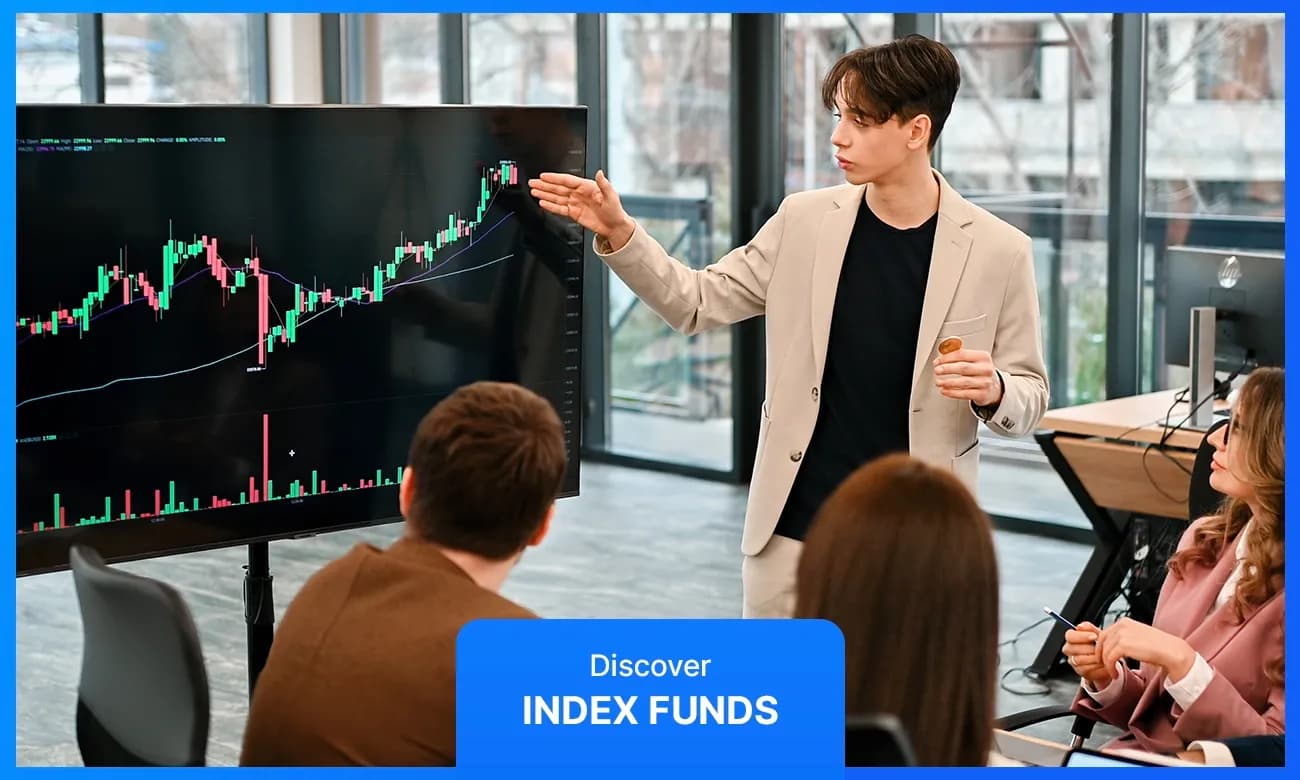
An index fund is a mutual fund or exchange-traded fund (ETF) designed to match the performance of a financial market index like the S&P 500.
Rather than picking individual stocks, index funds let you "buy the market" through passive investing — capturing broad economic returns with minimal effort and significantly lower fees than actively managed funds.
Index funds matter because they:
- Reduce human decision-making errors
- Offer greater tax efficiency than active funds
- Charge expense ratios as low as 0.00% to 0.10%
- Provide instant diversification across hundreds or thousands of stocks
- Allow investors with $100 to own the same diversified exposure as institutional portfolios
This guide covers how index funds work, the different types available, their benefits and risks, the best funds to consider in 2026, and how to start investing.
How Do Index Funds Work?
Instead of active stock picking, index funds employ a passive strategy that replicates a specific market benchmark. The fund trades primarily when the underlying index changes composition — though it also handles cash flows, dividends, and corporate actions.
Lower trading activity results in reduced transaction costs, greater tax efficiency, and significantly lower fees.
Tracking Methods
Funds generally use two approaches to mirror an index:
- Full replication — the fund buys every security in the index in matching proportions
- Sampling — for massive indexes with thousands of small companies, the fund buys a representative sample to reduce transaction costs while still tracking the index's movement
Expense Ratios
The expense ratio represents annual fund operating expenses as a percentage of assets. Because index funds require less active management, costs run dramatically lower than actively managed alternatives.
| Fund Type | Typical Expense Ratio |
|---|---|
| Active equity funds | ~0.64% (industry average) |
| Index funds | 0.00% to 0.10% |
| FXAIX (Fidelity 500) | 0.015% |
Over 30 years, even a 0.50% difference in fees can cost tens of thousands of dollars in lost compounding — fees matter more than most investors realize.
What Types of Index Funds Exist?
Different index funds track different market segments. You can choose funds covering entire markets or focus on specific niches, depending on your financial goals.
Broad Market Funds
Broad market index funds capture the majority of an investable market rather than a single slice, providing low-cost exposure to entire asset classes.
- Total stock market — funds like Vanguard Total Stock Market ETF (VTI) hold 3,527 stocks across large-, mid-, and small-cap companies
- Broad bond market — funds like Vanguard Total Bond Market ETF (BND) provide exposure to taxable, investment-grade U.S. bonds
Market Cap Funds
Funds are invested based on company size, categorized by total market value:
- Large-cap — companies with market caps generally above $10 billion (S&P 500 funds like FXAIX)
- Mid-cap — companies in the middle range of valuation
- Small-cap — smaller, higher-growth companies (iShares Russell 2000 ETF)
Equal-Weight Funds
Most indexes are market-cap weighted, meaning giant companies dominate performance. Equal-weight index funds give every company the same portfolio percentage at each rebalancing, reducing concentration in a few mega-cap stocks and allowing smaller companies to contribute more to returns.
Sector Funds
If you have a specific outlook on an industry, sector funds let you express that view without picking individual stocks:
- Energy
- Financials
- Healthcare
- Information Technology
- Communication Services
International and ESG Funds
- International — gain exposure to Europe, Asia-Pacific, or emerging markets (Vanguard FTSE Emerging Markets ETF)
- ESG — prioritize environmental, social, and governance factors, often excluding tobacco, firearms, or fossil fuel companies
Fixed Income Funds
Not all index funds hold stocks. Fixed-income index funds track bond indexes, offering a lower-volatility way to earn interest income — particularly valuable during retirement for capital preservation.
What Are the Benefits of Index Fund Investing?
The popularity of index funds stems from mathematical and structural advantages that make actively managed funds difficult to beat over long periods.
Instant Diversification
A single index fund provides broad market exposure. If one company in a 500-stock index goes bankrupt, the impact represents only a fraction of your total investment. One purchase gives you stakes in every major sector — technology, healthcare, energy, consumer goods, and more.
Low Expense Ratios
Fees quietly erode investment returns. Because index funds follow a passive strategy, they don't require expensive research teams or frequent trading. Some funds (like Fidelity's ZERO lineup) charge literally 0% in management fees.
Tax Efficiency
Index funds generate fewer taxable events than actively managed alternatives:
- Low turnover — selling stocks only when the index changes triggers fewer capital gains
- ETF structure — most index ETFs use in-kind redemptions that reduce capital gains distributions until investors sell their own shares
Long-Term Performance
While active managers occasionally beat the market for a year or two, very few sustain outperformance over decades. By being the market rather than trying to beat it, index investors historically outperform the majority of professional fund managers after fees.
Accessibility
Index funds eliminate analysis paralysis. You don't need to read balance sheets or predict tech trends. A "set-it-and-forget-it" approach complements dollar-cost averaging, making index funds the most accessible entry point for new investors.
What Are the Risks of Index Fund Investing?
Index funds carry specific vulnerabilities every investor should understand — from broad market movements to structural features of the funds themselves.
Market Risk
The most significant limitation is the lack of defensive flexibility. Because the fund mirrors the market, it stays fully invested during downturns:
- No downside protection during crashes
- In a bull market, you rise with the index; in a bear market, you sink with it
- Active managers might shift to cash during recessions — index funds cannot
Concentration Risk
Many popular indexes (S&P 500, Nasdaq-100) are market-cap weighted, meaning the largest companies exert disproportionate influence on performance. A handful of technology giants currently account for a substantial share of the S&P 500. Even owning 500 stocks, if those top companies struggle, the portfolio suffers regardless of how other holdings perform.
Tracking Error
Tracking error measures variability between the fund's returns and the index it follows. While usually minor, causes include:
- Transaction costs from buying and selling
- Cash drag from holding reserves for investor withdrawals
- Sampling approaches that don't perfectly replicate every holding
No Alpha Potential
Index funds aim for market-average returns by design. You won't beat the market with an index fund (though some slightly outperform due to securities lending revenue). The fund holds every stock in the index — including declining companies.
Index Front-Running
When a new company gets added to a major index, traders often buy beforehand, pushing prices higher. Index funds then purchase at elevated prices. Research suggests turnover costs for mechanical indexing run in the range of tens of basis points annually.
Which Index Funds Should You Consider in 2026?
Choosing the right index fund involves evaluating three factors: expense ratio, tracking accuracy, and liquidity.
S&P 500 Funds
These track the 500 largest U.S. companies — the bedrock of most retirement accounts.
| Fund | Expense Ratio | Type |
|---|---|---|
| Fidelity 500 Index (FXAIX) | 0.015% | Mutual fund |
| Vanguard S&P 500 ETF (VOO) | 0.03% | ETF |
| iShares Core S&P 500 ETF (IVV) | 0.03% | ETF |
Total Market Funds
For exposure to the entire U.S. economy, including small and mid-sized companies:
| Fund | Holdings | Expense Ratio |
|---|---|---|
| Vanguard Total Stock Market ETF (VTI) | 3,527 stocks | 0.03% |
| Schwab U.S. Broad Market ETF (SCHB) | ~2,400 stocks | 0.03% |
Zero-Fee and Equal-Weight Options
Competition has driven a "race to zero" in fund fees:
- Fidelity ZERO Large Cap Index (FNILX) — 0.00% expense ratio, tracks a proprietary index closely mirroring the S&P 500
- Invesco S&P 500 Equal Weight ETF (RSP) — 0.20% expense ratio, gives each company equal weighting to reduce Big Tech concentration
International Funds
To hedge against U.S. market slowdowns:
| Fund | Focus | Expense Ratio |
|---|---|---|
| Vanguard Total International Stock ETF (VXUS) | Developed + emerging markets | 0.05% |
| Vanguard Russell 2000 ETF (VTWO) | U.S. small-caps | 0.07% |
How Do You Start Investing in Index Funds?
Getting started requires three steps: choosing a brokerage, selecting your fund, and implementing a consistent strategy.
Choose a Brokerage
Your brokerage serves as the hub for buying and selling funds. Industry veterans recommend major platforms for their scale, low costs, and reliability:
- Fidelity — known for a zero-fee fund lineup and a strong interface
- Vanguard — pioneer of index investing, owned by its own funds (and thus investors)
- Charles Schwab — offers a broad selection with no minimums on many products
Select Your Fund
For most beginners, a broad market index fund provides immediate diversification:
- S&P 500 exposure → VOO or FXAIX
- Total market exposure → VTI or VTSAX
Check the expense ratio (aim under 0.10%) and minimum investment. Mutual funds sometimes require $1,000–$3,000 to start, while ETFs can be purchased for the price of a single share.
Implement Dollar-Cost Averaging
The biggest mistake new investors make is trying to time the market. Dollar-cost averaging means investing a fixed amount at regular intervals regardless of market conditions.
- When prices drop, your fixed amount buys more shares
- When prices rise, it buys fewer shares
The approach reduces timing risk and removes emotional stress from volatility. Most brokerages allow automatic investing — link your bank account and schedule recurring purchases to remove behavioral risk entirely.
How Do Index Funds Compare to Active Funds?
The fundamental difference lies in objectives. Active managers use research and forecasts to beat the market. Index managers seek to match the market.
| Feature | Index Funds | Active Funds |
|---|---|---|
| Goal | Match index return | Beat index return |
| Strategy | Automated tracking | Human stock picking |
| Cost | 0.01%–0.10% | 0.50%–1.50%+ |
| Tax efficiency | Higher (low turnover) | Lower (frequent trading) |
| Manager discretion | Minimal | Significant |
Active management isn't obsolete — it can work in inefficient markets where information is scarce:
- Small-cap international stocks where local expertise finds overlooked opportunities
- High-yield bonds, where credit analysts assess default risk
- Tax-loss harvesting strategies in separately managed accounts
However, after fees, the majority of active funds underperform their benchmark indexes over longer time horizons according to SPIVA research.
Frequently Asked Questions
Are Index Funds Good for Beginners?
Yes. Index funds eliminate the need for stock analysis, provide instant diversification, and work well with a simple buy-and-hold strategy. Starting with a broad market fund like VTI or VOO gives immediate exposure to hundreds of companies.
How Much Money Do I Need to Start?
ETFs require only enough to buy one share (often $100–$500). Many mutual funds have minimums of $1,000–$3,000, though some brokerages offer $0 minimums on proprietary funds.
Can I Lose Money in Index Funds?
Yes. Index funds follow market movements — when markets decline, so does your investment. However, historically, broad market indexes have recovered from downturns and produced positive long-term returns.
What's the Difference Between an Index Fund and an ETF?
An index fund is a category that includes both mutual funds and ETFs. ETFs trade throughout the day like stocks, while mutual funds trade once daily at market close. Both can track the same index with similar expense ratios.