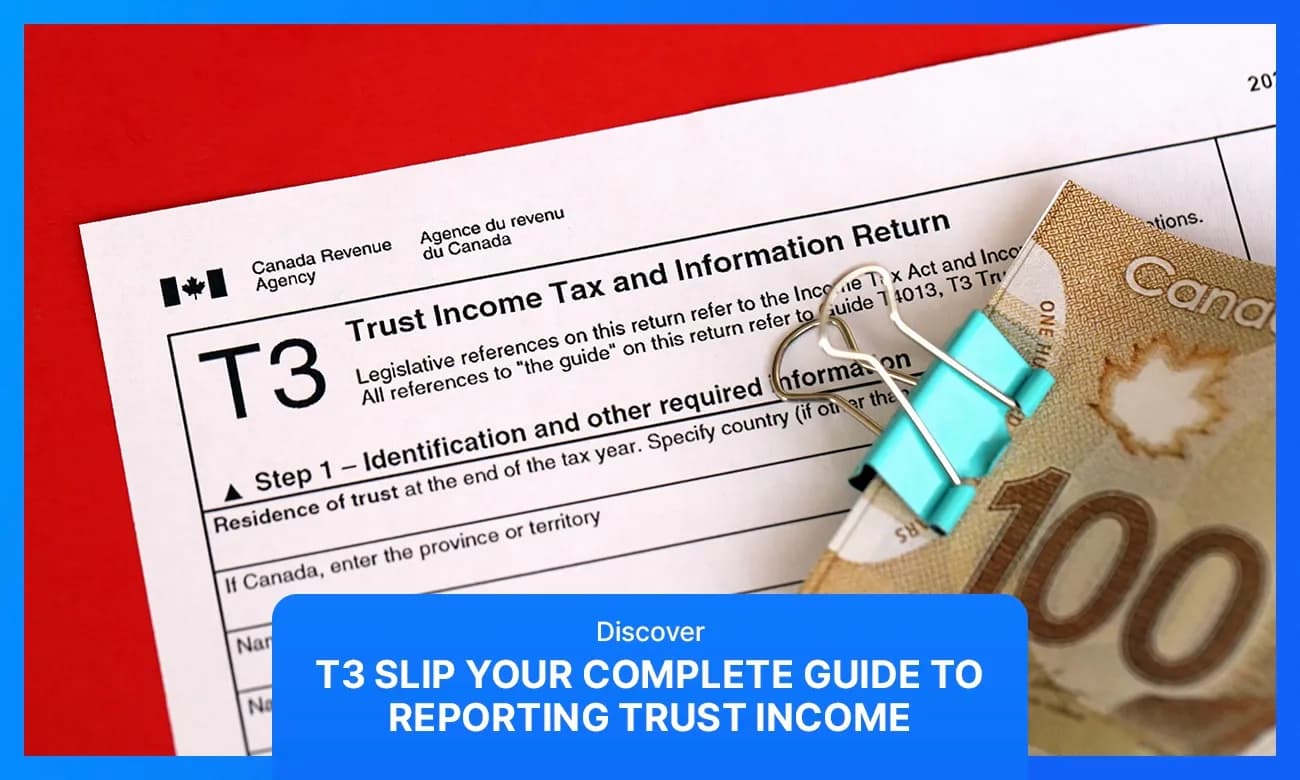
A T3 slip — officially the Statement of Trust Income Allocations and Designations — reports income you've received as a trust beneficiary.
You'll likely encounter one if you hold mutual funds or ETFs in a non-registered account, or if you're the beneficiary of an estate or family trust.
Key facts about T3 slips:
- Only applies to non-registered accounts
- Arrives later than most tax slips (90 days after trust year-end)
- Some amounts (like return of capital) aren't immediately taxable
- Reports capital gains, dividends, interest, and return of capital from trusts
- Issued by mutual fund trusts, ETFs (structured as trusts), estates, and personal trusts
Understanding your T3 helps you file accurately and avoid CRA reassessments from missing income.
What is a T3 slip, and how does it work?
The T3 slip is a tax document issued by a trust to its beneficiaries. The income shown can include interest, dividends, capital gains, and other amounts earned by the trust and allocated to you during the year.
How trusts work
Trusts often function as a "conduit" — flowing income through to beneficiaries rather than paying tax at the trust level.
When income is allocated to you, you're responsible for reporting it on your return. However, trusts don't always avoid tax.
If income is retained rather than distributed, or in certain other situations, the trust itself may owe tax. The rules depend on whether income is allocated, retained, or designated.
For most mutual fund investors, the practical effect is straightforward: the trust allocates taxable amounts to you, reports them on a T3, and you include those amounts on your return.
How does a T3 differ from a T5?
The structure of your investment determines which slip you receive. Many investors confuse the two, but the distinction matters for accurate reporting.
| Slip | Primary Use | Common Sources |
|---|---|---|
| T3 | Income from trusts | Mutual fund trusts, ETFs (trust structure), estates, REITs |
| T5 | Interest and dividends from corporations | Banks, GICs, corporate-structure funds, stock dividends |
Many mutual funds and ETFs are structured as trusts and issue T3 slips. However, some funds are structured as corporations and issue T5 slips instead. If you invest through multiple platforms, you may receive both slip types in the same tax year.
Who receives a T3 slip?
T3 slips go to beneficiaries who received allocated income from a trust. Common situations include:
- Estates where you're a beneficiary and the estate earned income before distribution
- Mutual funds or ETFs held in non-registered (taxable) accounts
- Family or personal trusts where you're named as beneficiary
- Income trusts such as Real Estate Investment Trusts (REITs)
You won't receive a T3 for investments held in an RRSP, TFSA, or FHSA — those accounts are tax-sheltered, and income earned inside them doesn't trigger slips.
When do T3 slips arrive?
T3 slips arrive later than most other tax documents. The CRA deadlineis 90 days after the trust's tax year-end — not a fixed calendar date. For trusts with a December 31 year-end (most mutual funds), slips are typically due by late March.
| Deadline Type | 2025 Tax Year Timing |
|---|---|
| Trust Issuer Deadline | 90 days after trust year-end (often late March 2026) |
| Personal Filing Deadline | April 30, 2026 |
| Self-Employed Filing Deadline | June 15, 2026 (taxes owing still due April 30) |
Many Canadians wait until April to file, specifically because T3 slips arrive later. Filing too early can mean missing trust income allocations — leading to CRA reassessments, interest charges, or the need to amend your return.
What do the boxes on your T3 mean?
T3 slips contain several numbered boxes reporting different income types. Understanding which boxes matter (and where they go on your return) prevents errors.
| Box | Description | Tax Treatment |
|---|---|---|
| 21 | Capital gains | 50% taxable under the standard inclusion rate |
| 23 | Actual non-eligible dividends | Actual cash amount (use Box 32 for taxable amount) |
| 26 | Other income | Interest and non-dividend income — fully taxable |
| 32 | Taxable non-eligible dividends | Grossed-up amount to report on your return |
| 39 | Non-eligible dividend tax credit | Claim on Line 40425 to reduce tax |
| 42 | Return on capital (ROC) | Not immediately taxable — lowers your ACB |
| 49 | Actual eligible dividends | Actual cash amount (use Box 50 for taxable amount) |
| 50 | Taxable eligible dividends | Grossed-up amount to report on your return |
| 51 | Eligible dividend tax credit | Claim on Line 40425 to reduce tax |
Return of capital
Box 42 requires special attention. Return of capital isn't taxable in the year you receive it, but it reduces your Adjusted Cost Base (ACB).
When you eventually sell the investment, your capital gain will be higher because your ACB is lower. Keep records of all ROC amounts — you'll need them to calculate gains accurately at disposition.
Dividend tax credits
Boxes 39 and 51 contain your dividend tax credit amounts. These offset the "gross-up" applied to Canadian dividends, ensuring you aren't taxed twice on corporate profits. Report these credits on Line 40425 of your return.
How do you report a T3 on your tax return?
Reporting your T3 is straightforward with tax software. Most certified programs support CRA's "Auto-fill my return" feature, which pulls your slips directly into your return.
Steps to follow:
- Match boxes on your slip to the corresponding fields in your software
- Verify the imported amounts against your physical or digital slip
- If you live in Quebec, you'll also receive an RL-16 slip for provincial reporting
- Track Box 42 (return of capital) separately — it affects future capital gains calculations
Always double-check your CRA My Account in late March to see if slips have been uploaded digitally. Slips appear there once the issuer files with the CRA.
What's changing with trust reporting?
The CRA has implemented enhanced reporting requirements for certain trusts, including bare trusts.
A bare trust exists when you hold legal title for someone else — such as a parent co-signing a mortgage for an adult child.
Under the updated rules, bare trusts will be required to file a T3 return and Schedule 15 (even if no income was earned) starting with taxation years ending on or after December 31, 2026.
If you're a trustee in such an arrangement, consult a tax professional about your filing obligations going forward.
File your taxes with confidence
The T3 slip is a vital piece of the Canadian tax puzzle.
While it arrives later than other forms, the slip ensures you're only taxed on your fair share of a trust's earnings. Always check CRA My Account in late March to see if your slips have been uploaded digitally.
RemitBee has partnered with CloudTax, allowing you to file your Canadian taxes for free directly in the RemitBee app. Sign up now and access additional services, including money transfers, currency exchange, and eSIM.
Frequently asked questions
Here are some commonly asked questions about the T3 slip:
Do I need a T3 for my RRSP or TFSA?
No. Income earned inside registered accounts is tax-sheltered. You won't receive a T3 for mutual fund allocations within those accounts.
Why did I get a T3 instead of a T5?
The fund's legal structure determines the slip type. Trusts issue T3 slips; corporations issue T5 slips. Many (but not all) mutual funds and ETFs are structured as trusts.
What if my T3 arrives after I've already filed?
You'll need to amend your return to include the missing income. Filing before all slips arrive is a common cause of CRA reassessments. Waiting until early April reduces this risk.
Is the return of capital (Box 42) free money?
Not exactly. ROC isn't taxed immediately, but it lowers your ACB. When you sell, your capital gain will be larger. Track all ROC amounts carefully — they affect your eventual tax bill.