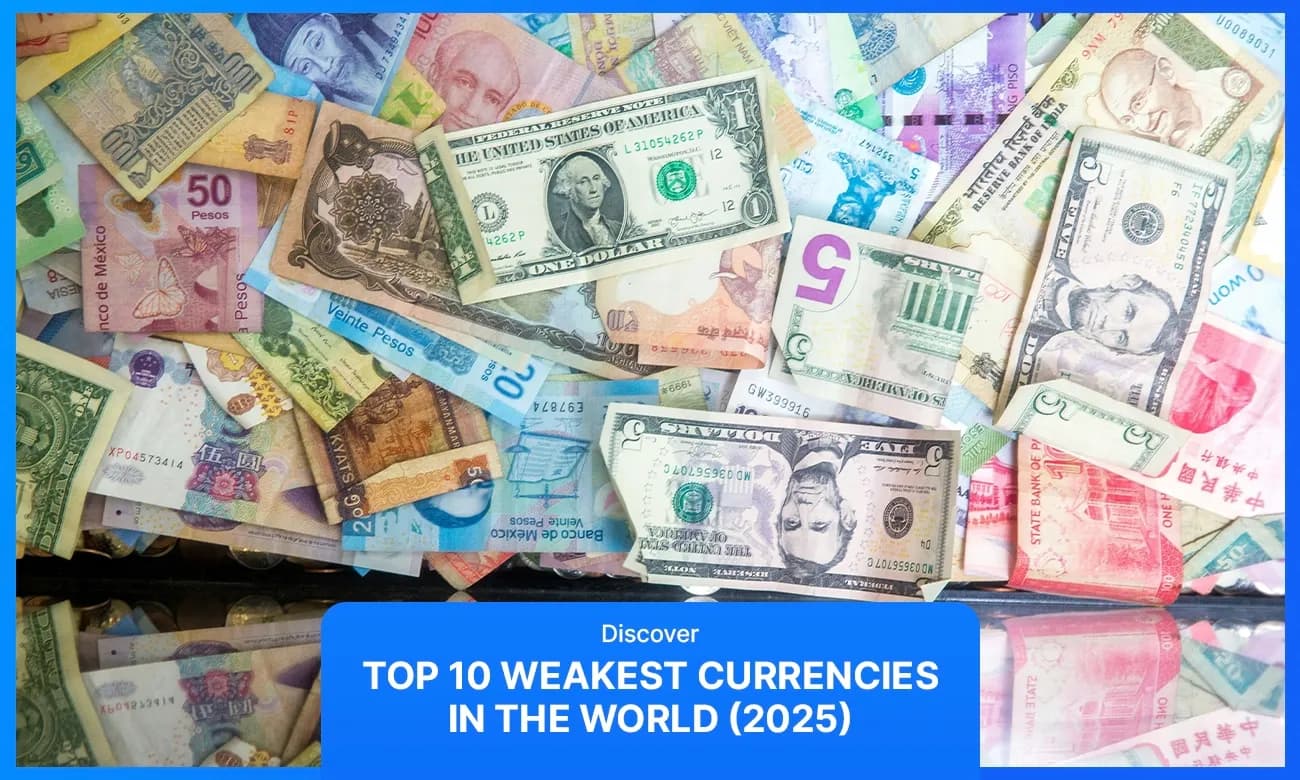
Not all currencies are equal. Some are strong, while others are weak. Being a weak currency means having low buying power compared to other currencies. On the other hand, the strongest currencies can buy more goods and services.
What is Currency Devaluation?
Currency devalues when a nation’s central bank deliberately lowers its value. When a currency is devalued, buying a unit of foreign currency or goods priced in foreign currency requires more local currency. A weak currency becomes less attractive, especially to foreign investors, and the country’s exports become cheaper.
Currency devaluation is not always a bad thing. In some cases, countries choose to devalue their currency to boost their economy by increasing exports and decreasing imports. Another advantage is helping address trade imbalances.
What is Currency Depreciation?
If currency devaluation is a deliberate strategy, currency depreciation is a natural occurrence due to market forces that weaken a currency. Usually, when a currency depreciates, it is not controlled by the government or central bank. Shifts in economic conditions and market sentiment are reflected in the currency’s strength.
Currency Wars: Top 10 Weakest Currencies in the World in 2025
| Rank | Currency | Country | 1 Unit = USD Equivalent | 1 USD = X Local Currency |
|---|---|---|---|---|
| 1 | Lebanese Pound (LBP) | Lebanon | 0.000011 USD | 90,074 LBP |
| 2 | Iranian Rial (IRR) | Iran | 0.000024 USD | 497,000 IRR |
| 3 | Vietnamese Dong (VND) | Vietnam | 0.000039 USD | 25,500 VND |
| 4 | Laotian Kip (LAK) | Laos | 0.000047 USD | 21,500 LAK |
| 5 | Sierra Leonean Leone (SLL) | Sierra Leone | 0.000048 USD | 21,000 SLL |
| 6 | Indonesian Rupiah (IDR) | Indonesia | 0.000063 USD | 15,800 IDR |
| 7 | Uzbekistani Som (UZS) | Uzbekistan | 0.00008 USD | 12,500 UZS |
| 8 | Guinean Franc (GNF) | Guinea | 0.000115 USD | 8,650 GNF |
| 9 | Paraguayan Guarani (PYG) | Paraguay | 0.000139 USD | 7,200 PYG |
| 10 | Malagasy Ariary (MGA) | Madagascar | 0.000217 USD | 4,600 MGA |
1. Lebanese Pound (LBP)
The Lebanese pound (LBP) has significantly depreciated in recent years due to severe economic problems, political instability, and declining foreign reserves in Lebanon. Adding to the weakness of the LBP is the collapse and corruption of the banking sector, which negatively affected people's trust in the currency. The exchange rate stands at 1 LBP, which is equal to 0.000011 USD.
Stabilizing Lebanon’s economy continues to be challenging due to the lack of political consensus and structural reforms.
2. Iranian Rial (IRR)
The Iranian rial (IRR) is second on the list of the weakest currencies in the world. One IRR is equal to 0.000024 USD.
One reason behind IRR’s weakness is Iran’s economic sanctions, which have limited the country's ability to engage in international trade. Other factors include high inflation, political instability, and the lack of diversification of the economy.
3. Vietnamese Dong (VND)
The Vietnamese Dong’s exchange rate equals 1 VND to 0.000039 USD. Vietnam's restrictions on foreign exports have made the dong the third weakest currency in the world as of 2025. Vietnam's Central Bank has devalued its dong to boost exports in recent years.
4. Laotian Kip (LAK)
High inflation, slow economic growth, and growing foreign debt made 1 Laotian kip (LAK) equal 0.000047 USD. The depreciation of LAK against USD and on the parallel market has increased the cost of imports, exacerbating inflationary pressures within Laos.
5. Sierra Leonean Leone (SLL)
As of 2025, the Sierra Leonean leone (SLL) is another weak currency worldwide. The exchange rate is 1 SLL, which is equivalent to 0.000048 USD.
Sierra Leone has a long history of corruption and other scandals. It has also been a casualty of a terrible civil war and health crises, such as the Ebola virus outbreak between 2014 and 2016. Factors such as high inflation rates, trade imbalances, and limited foreign currency have resulted in SLL's continuous decline.
6. Indonesian Rupiah (IDR)
In the last seven years, the Indonesian rupiah (IDR) has not improved. The currency's continuous decline and foreign exchange reserves decline is due to the central bank's failure to safeguard it. High inflation and the threat of recession are some of the reasons why the IDR continues to weaken despite Indonesia being one of the largest countries in Southeast Asia by GDP. 1 IDR is equal to 0.000063 USD.
7. Uzbekistani Som (USZ)
The Uzbekistani Som (USZ) has continued to struggle in recent years due to Uzbekistan’s high unemployment, high inflation, low economic growth, and corruption issues. 1 USZ is equal to 0.00008 USD.
UZS was devalued due to Uzbekistan’s currency reforms. Prior to these reforms, USZ was heavily controlled, resulting in a large gap between the official and black-market rates.
8. Guinean Franc (GNF)
The Guinean franc (GNF) is the eighth-weakest currency in the world as of 2025. One GNF is equal to 0.000115 USD.
Guinea's economy is driven by a rich reserve of minerals, gold, diamonds, and high-grade iron ore. It also has one of the largest reserves of bauxite. However, the country’s political instability has continued to stall its economic growth, along with the Ebola virus outbreak in 2014 and 2015.
9. Paraguayan Guarani (PYG)
1 Paraguayan Guarani (PYG) is equal to 0.000139 USD. The currency continues to weaken due to the country’s persistent issues with inflation, employment, corruption, and counterfeit currency.
10. Malagasy Ariary (MGA)
The Malagasy ariary (MGA) grabbed the 10th spot as the weakest currency in the world as of 2025. 1 MGA is equal to 0.000217 USD.
In 2009, MGA witnessed a significant drop in value due to natural disasters, political instability, and the global financial crisis. The currency continued to decline due to high inflation and the unwillingness of foreign investors to invest in Madagascar.
Impact of Weak Currencies
If you are a citizen of one of the countries with the weakest currencies in the world, you may be wondering how you and your country are affected.
When a currency weakens, the cost of importing goods rises because more local currency is needed to buy foreign products. This increase in import prices leads to higher costs for businesses and consumers, potentially leading to inflation.
On the positive side, when local currency depreciates, the cost of products and services offered in that currency becomes cheaper for foreign buyers, making them more attractive to foreign buyers. However, If a country whose weak currency heavily relies on imported goods, there could be trade imbalances since the cost of imports increases as their exports rise.