Saskatchewan Income Tax Calculator 2026
See what remains after taxes and payroll deductions in Saskatchewan. Enter an annual salary or hourly wage to estimate federal income tax, Saskatchewan income tax, CPP, EI and take-home pay using current 2026 rules. Add RRSP contributions, bonus income or self-employed status when they apply.
Free, no sign-up required
Salary & hourly income
Federal + Saskatchewan tax
2026 rates verified
- Gross income
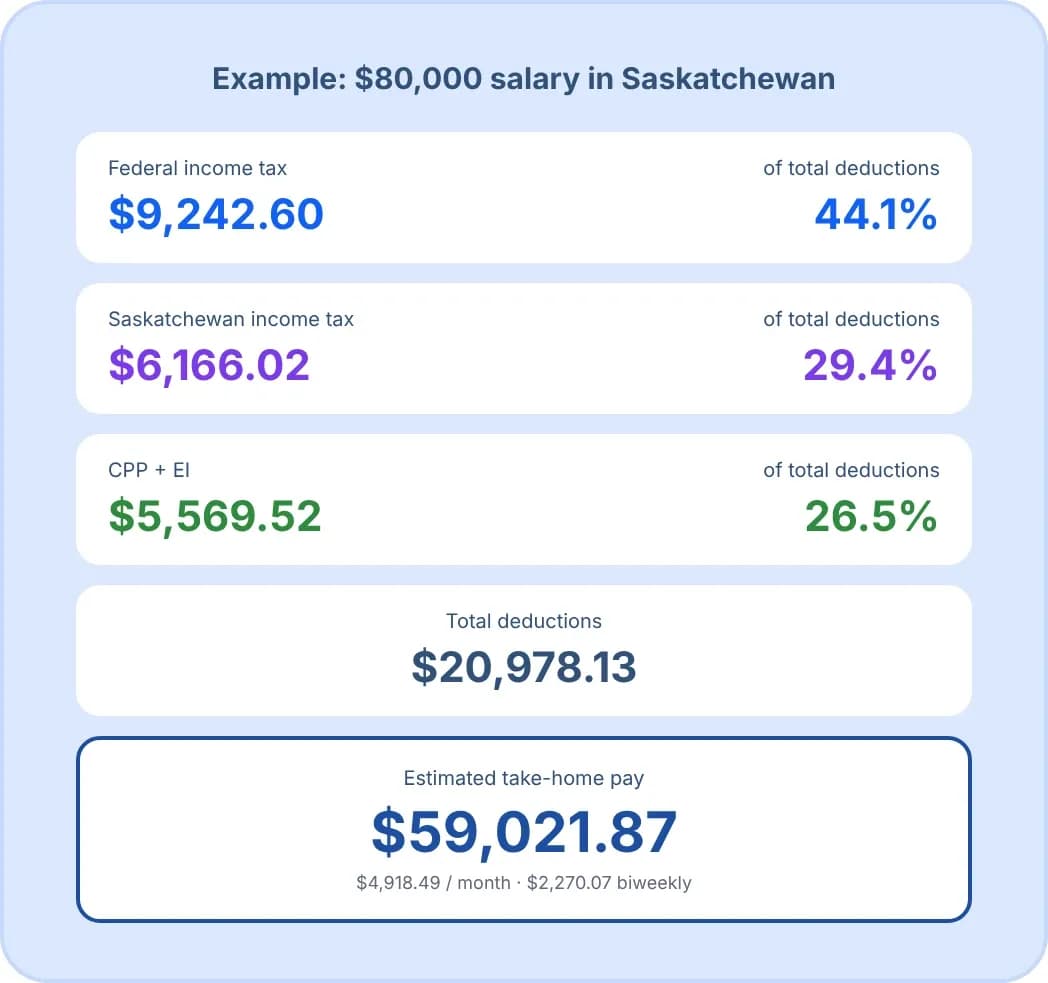
- $80,000
- Federal income tax
- −$9,243
- Saskatchewan provincial tax
- −$6,166
- CPP contribution
- −$4,446
- EI premium
- −$1,123
- Total deductions
- −$20,978
- Effective tax rate
- 26.2%
- Net take-home (annual)
- $59,022
For informational purposes only. Estimate assumes employment income, standard 2026 personal amounts, no RRSP contribution, no bonus income and no additional personal credits or deductions. Refundable benefits are not included. Actual payroll withholding and final tax payable can differ.


SASKATCHEWAN INCOME TAX RATES 2026
Federal tax. Saskatchewan tax. Then your take-home pay.
Taxable income | Federal rate | Tax on bracket |
|---|---|---|
$0 to $58,523 | 14% | Up to $8,193 |
$58,523.01 to $117,045 | 20.5% | Up to $11,997 |
$117,045.01 to $181,440 | 26% | Up to $16,743 |
$181,440.01 to $258,482 | 29% | Up to $22,342 |
Over $258,482 | 33% | — |
Taxable income | Saskatchewan rate | Tax on bracket |
|---|---|---|
$0 to $54,532 | 10.5% | Up to $5,726 |
$54,532.01 to $155,805 | 12.5% | Up to $12,659 |
Over $155,805 | 14.5% | — |
Five federal bracketsStarts at 14%
Top rate is 33%
Three provincial bracketsStarts at 10.5%
Top rate is 14.5%
CPP + EI
Payroll contributionsCPP applies to pensionable earnings
EI applies to insurable earningsBoth are capped annually.
How to calculate Saskatchewan income tax
Start with your annual salary or choose hourly mode and enter your wage and normal weekly hours. Include bonus income when it forms part of your expected earnings.
Saskatchewan is already selected. Choose your pay frequency, enter any deductible RRSP contribution and switch on self-employed mode if your CPP obligations are different from those of an employee.
The calculator separates federal tax, Saskatchewan tax, CPP and EI so you can see exactly how gross income turns into net pay.
View your result annually, monthly, biweekly or weekly. Change your income or deductions to compare job offers, plan RRSP contributions or build a more realistic budget.
QUICK REFERENCE
Saskatchewan take-home pay examples
Gross salary | Federal + Saskatchewan tax | CPP + EI | Est. take-home |
|---|---|---|---|
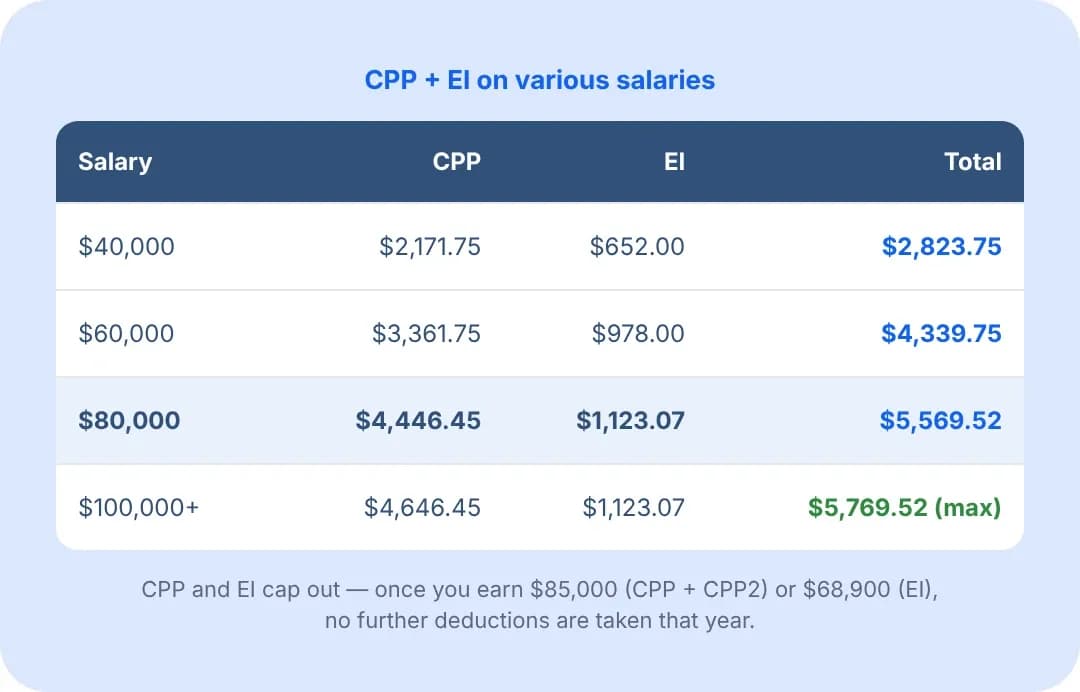
$40,000 | $4,454.76 | $2,823.75 | $32,721.49 |
$60,000 | $9,140.68 | $4,339.75 | $46,519.57 |
$80,000 | $15,408.61 | $5,569.52 | $59,021.87 |
$100,000 | $21,942.61 | $5,769.52 | $72,287.87 |
$150,000 | $40,193.15 | $5,769.52 | $104,037.33 |
Pay frequency | Gross pay | Est. deductions | Est. take-home |
|---|---|---|---|
Annual | $80,000.00 | $20,978.13 | $59,021.87 |
Monthly | $6,666.67 | $1,748.18 | $4,918.49 |
Biweekly | $3,076.92 | $806.85 | $2,270.07 |
Weekly | $1,538.46 | $403.43 | $1,135.04 |
What you need to know about Saskatchewan income tax

The 2026 amount is $20,381. At Saskatchewan’s 10.5% lowest rate, it generates a provincial non-refundable credit worth up to about $2,140 for someone with enough tax payable.
Saskatchewan doubled the tax-credit amount for qualifying volunteer firefighters, search and rescue volunteers and volunteer emergency medical first responders from $3,000 to $6,000.
2026 payroll deductions - what comes off your pay?
Maximum employee amount: $4,230.45
Maximum employee amount: $416.00
Maximum employee amount: $1,123.07
COMPARE PROVINCES
Canadian provincial income tax rates by province 2026
Province / Territory | Lowest rate | Highest basic rate | Number of brackets |
|---|---|---|---|
ABAlberta | 8% | 15% | 6 |
BCBritish Columbia | 5.6% | 20.5% | 7 |
MBManitoba | 10.8% | 17.4% | 3 |
NBNew Brunswick | 9.4% | 19.5% | 4 |
NLNewfoundland & Labrador | 8.7% | 21.8% | 8 |
NTNorthwest Territories | 5.9% | 14.05% | 4 |
NSNova Scotia | 8.79% | 21% | 5 |
NUNunavut | 4% | 11.5% | 4 |
ONOntario | 5.05% | 13.16% | 5 |
PEPrince Edward Island | 9.5% | 20% | 6 |
QCQuebec | 14% | 25.75% | 4 |
SKSaskatchewan ← You are here | 10.5% | 14.5% | 3 |
YTYukon | 6.4% | 15% | 5 |
Calculate income tax in another province: Ontario · Quebec · British Columbia · Alberta · Saskatchewan · Manitoba · Nova Scotia · New Brunswick · Newfoundland · PEI · NW Territories · Yukon · Nunavut