Saskatchewan Capital Gains Tax Calculator 2026
Turn the profit from an asset sale into a clearer estimate of what may actually be taxable. Enter the asset’s adjusted cost, selling price and your other annual income to estimate your capital gain, taxable portion, federal tax, Saskatchewan tax and after-tax proceeds using 2026 rules.
Saskatchewan preselected
Capital losses supported
Updated for 2026 rules
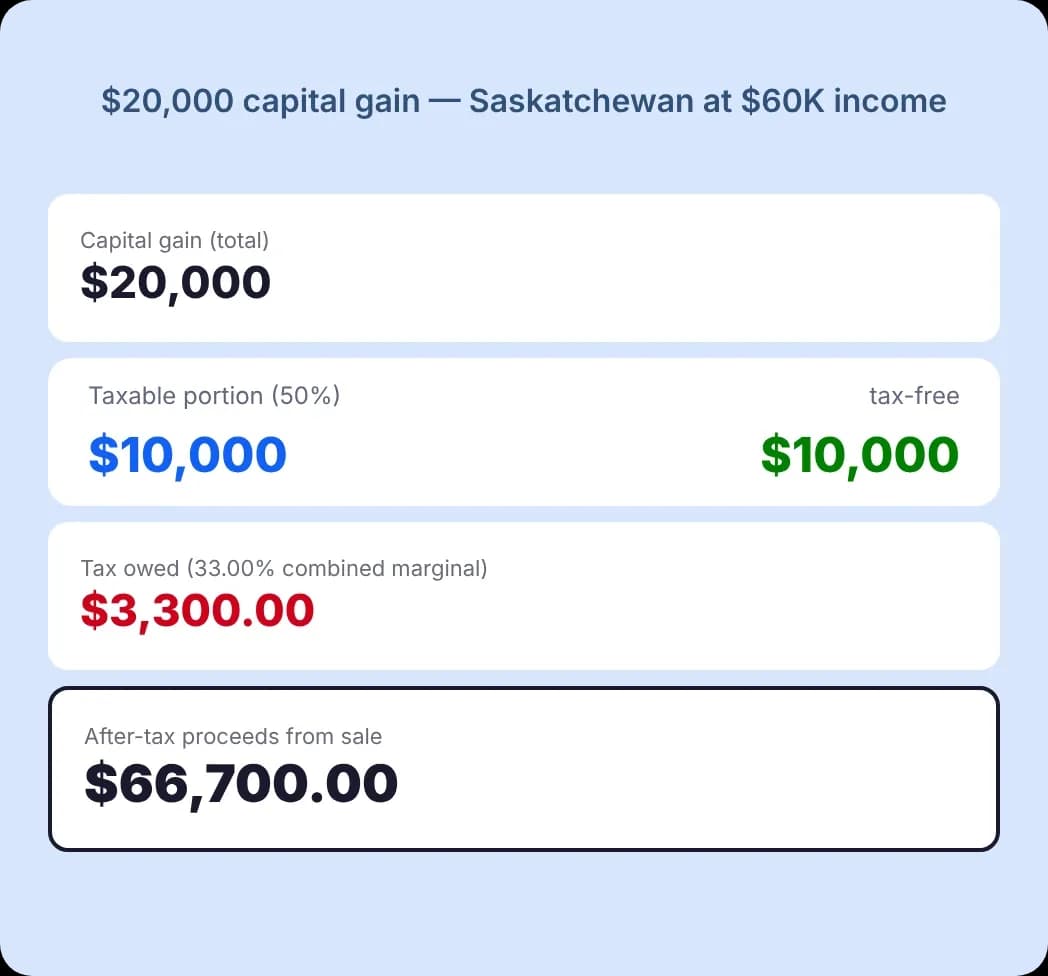
- Capital gain
- $20,000.00
- Taxable portion
- $10,000.00 (50%)
- Marginal rate applied
- 33%
- Estimated capital gains tax
- $3,300.00
- Effective tax rate on full gain
- 16.5%
- Estimated after-tax proceeds
- $66,700.00
Estimate assumes a Saskatchewan resident with $60,000 of other taxable income, a standard capital-property disposition in 2026, no selling expenses, no capital losses, no principal-residence exemption and no other capital-gains deductions. The final amount can change because of adjusted cost base, transaction expenses, available losses, asset classification and personal tax circumstances.


The 50% rule decides what becomes taxable — not how much tax you pay
A 50% capital-gains inclusion rate does not mean half of your profit goes to tax. It means half of a standard net capital gain becomes taxable income. Federal and Saskatchewan income-tax rates then apply to that taxable portion according to the brackets your total income reaches.
Half of a standard net gain is taxable
The other half is not included in income
Applied before marginal tax rates
Three provincial brackets
First threshold: $54,532
Top rate begins above $155,805
Five federal brackets
First threshold: $58,523
Taxable capital gains join other income
From sale proceeds to the actual capital gain
Capital gain = Proceeds of disposition − adjusted cost base − eligible selling expensesUsing the simple example:
$70,000 selling price − $50,000 adjusted cost base = $20,000 capital gainIf eligible selling expenses also applied, the final gain could be lower.
From capital gain to taxable capital gain
Taxable capital gain = Net capital gain × 50%Using the same example:
$20,000 × 50% = $10,000 taxable capital gainThat $10,000 is added to the taxpayer’s other taxable income. It is not taxed under a separate Saskatchewan capital-gains bracket.
QUICK REFERENCE
Saskatchewan and federal tax brackets applied to capital gains in 2026
Saskatchewan taxable income | Saskatchewan rate | Federal taxable income | Federal rate |
|---|---|---|---|
$0 to $54,532 | 10.5% | $0 to $58,523 | 14% |
$54,532.01 to $155,805 | 12.5% | $58,523.01 to $117,045 | 20.5% |
Over $155,805 | 14.5% | $117,045.01 to $181,440 | 26% |
— | — | $181,440.01 to $258,482 | 29% |
— | — | Over $258,482 | 33% |
How an asset sale becomes a Saskatchewan capital-gains estimate
Enter the adjusted cost base and selling price. For a straightforward investment, ACB may be close to what you originally paid, but commissions, fees and other allowable adjustments can change it.
Your taxable capital gain is added to your other taxable income. The calculator needs that income to determine which Saskatchewan and federal brackets the gain actually passes through.
Enter unused capital losses when they can be applied against the gain. An available loss can reduce the net capital gain before the taxable portion is calculated.
Review the full gain, taxable portion, marginal rate, estimated tax attributable to the gain, effective capital-gains rate and after-tax proceeds.
QUICK REFERENCE
See how income changes tax on the same Saskatchewan gain
Other taxable income | Taxable capital gain | Approx. tax on gain | Effective rate on full gain |
|---|---|---|---|
$40,000 | $10,000 | $2,450.00 | 12.25% |
$60,000 | $10,000 | $3,300.00 | 16.50% |
$100,000 | $10,000 | $3,300.00 | 16.50% |
$150,000 | $10,000 | $3,933.90 | 19.67% |
$200,000 | $10,000 | $4,350.00 | 21.75% |
Saskatchewan’s first tax threshold arrives before the federal one

A taxable gain can enter Saskatchewan’s second bracket before it reaches the second federal bracket.
If the gain crosses a bracket threshold, each portion should be calculated at the rate that applies to it.
What can change your Saskatchewan capital-gains tax estimate?
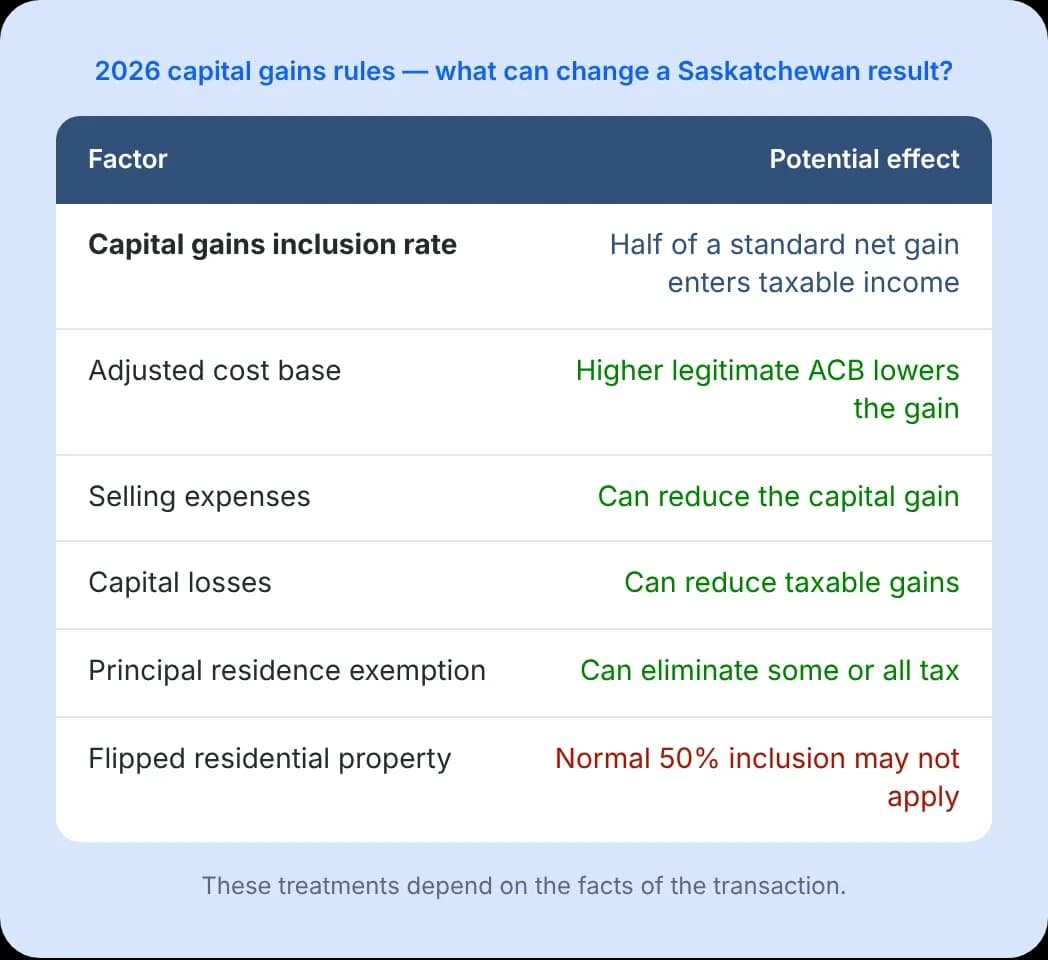

Adjusted cost base is the tax cost used when calculating your capital gain. It may include more than the asset’s original purchase price. Depending on the asset, acquisition fees, commissions and other permitted adjustments can change the amount that should be entered.

Eligible expenses incurred to dispose of an asset can reduce the capital gain. For investments, commissions are a common example. Using only the purchase and selling prices when additional eligible costs exist can overstate the gain and the resulting tax estimate.

Capital losses generally offset eligible capital gains rather than ordinary employment income. Unused net capital losses may be available for other tax years under the applicable carry-back and carry-forward rules.

A home that qualifies as your principal residence for the applicable years may have all or part of its capital gain sheltered. The sale still has reporting requirements, so the calculator should not assume every Saskatchewan home sale is automatically exempt.

Standard investment gains inside a TFSA are generally tax-free. Growth inside an RRSP is generally sheltered while the funds remain in the account, with withdrawals normally taxed as income rather than as individual capital gains.

Certain gains involving qualifying farm or fishing property or qualifying small-business corporation shares may be eligible for the Lifetime Capital Gains Exemption when the detailed requirements are satisfied. This can be particularly relevant to Saskatchewan asset sales, but eligibility should never be assumed by a general calculator.
COMPARE PROVINCES
Saskatchewan capital-gains tax rates compared with the rest of Canada
Province / Territory | Lowest rate | Highest basic rate | Number of brackets |
|---|---|---|---|
ABAlberta | 8% | 15% | 6 |
BCBritish Columbia | 5.6% | 20.5% | 7 |
MBManitoba | 10.8% | 17.4% | 3 |
NBNew Brunswick | 9.4% | 19.5% | 4 |
NLNewfoundland & Labrador | 8.7% | 21.8% | 8 |
NTNorthwest Territories | 5.9% | 14.05% | 4 |
NSNova Scotia | 8.79% | 21% | 5 |
NUNunavut | 4% | 11.5% | 4 |
ONOntario | 5.05% | 13.16% | 5 |
PEIPrince Edward Island | 9.5% | 20% | 6 |
QCQuebec | 14% | 25.75% | 4 |
SKSaskatchewan ← You are here | 10.5% | 14.5% | 3 |
YTYukon | 6.4% | 15% | 5 |