Quebec Capital Gains Tax Calculator 2026
A profitable sale does not tell you the tax bill by itself. Enter what the asset cost, what you sold it for and your other annual income to estimate the capital gain, the taxable portion and the federal and Quebec tax attributable to it.
Quebec preselected
Capital losses supported
Current 50% inclusion rate
- Capital gain
- $20,000.00
- Taxable portion
- $10,000.00 (50%)
- Combined marginal rate after Quebec abatement
- 36.12%
- Estimated capital gains tax
- $3,611.75
- Effective tax rate on full gain
- 18.06%
- Estimated after-tax proceeds
- $66,388.25
Estimate assumes an individual resident in Quebec, $60,000 of other taxable income, a standard capital-property disposition in 2026, no selling expenses, no capital losses, no principal-residence exemption and no other capital-gains deductions. Actual tax can differ because of your adjusted cost base, deductions, credits, alternative minimum tax or the way the property is classified.


In Quebec, the taxable half of your gain passes through two tax systems
The familiar “50% rule” does not mean Quebec charges a 50% tax. Half of a standard net capital gain is included in taxable income. Federal tax is calculated on that income, Quebec calculates its own provincial tax, and Quebec residents then receive a specific reduction of federal tax through the Quebec abatement.
Half of the standard net gain is taxable
The planned increase was cancelled
Quebec also cancelled its corresponding increase
Four provincial brackets
Second bracket begins above $54,345
Top rate begins above $132,245
Reduces basic federal tax
Applies to Quebec tax filers
Changes the combined marginal rate
Find the real gain before thinking about tax
Capital gain = Proceeds of disposition − adjusted cost base − selling expensesUsing the simplified example:
$70,000 − $50,000 = $20,000 capital gainIf eligible selling expenses were $1,000, the gain would be lower than the calculator example unless those expenses were already reflected in the amount entered.
Then determine how much becomes taxable income
Taxable capital gain = Net capital gain × 50%For the $20,000 example:
$20,000 × 50% = $10,000 taxable capital gainQuebec reports taxable capital gains through its provincial return, generally using Schedule G, while the federal return uses Schedule 3.
QUICK REFERENCE
Quebec and federal income tax brackets applied to capital gains in 2026
Quebec taxable income | Quebec rate | Federal taxable income | Federal rate |
|---|---|---|---|
$0 to $54,345 | 14% | $0 to $58,523 | 14% |
$54,345.01 to $108,680 | 19% | $58,523.01 to $117,045 | 20.5% |
$108,680.01 to $132,245 | 24% | $117,045.01 to $181,440 | 26% |
Over $132,245 | 25.75% | $181,440.01 to $258,482 | 29% |
— | — | Over $258,482 | 33% |
How to estimate capital gains tax in Quebec
Enter the adjusted cost of the asset and what you received when you disposed of it. If the transaction involved commissions or other eligible expenses, make sure those amounts are reflected in the final gain calculation.
The taxable half of the gain joins your other income. That makes existing income essential: the same $20,000 capital gain can produce a different tax bill for someone earning $40,000 than for someone already earning $150,000.
Quebec is already selected. Enter eligible capital losses carried forward where they can be used against taxable capital gains. Previous-year losses may require additional provincial schedules or forms when claimed.
The calculator applies Quebec's marginal rate, calculates the federal component and then accounts for the Quebec abatement. The result shows the taxable gain, estimated tax, effective rate and after-tax proceeds.
QUICK REFERENCE
The same capital gain can cost more as your other income rises
Other taxable income | Taxable capital gain | Approx. tax on gain | Effective rate on full gain |
|---|---|---|---|
$40,000 | $10,000 | $2,569.00 | 12.85% |
$60,000 | $10,000 | $3,611.75 | 18.06% |
$100,000 | $10,000 | $3,677.75 | 18.39% |
$120,000 | $10,000 | $4,571.00 | 22.86% |
$150,000 | $10,000 | $4,746.00 | 23.73% |
Quebec’s federal abatement is the detail generic capital-gains calculators often miss
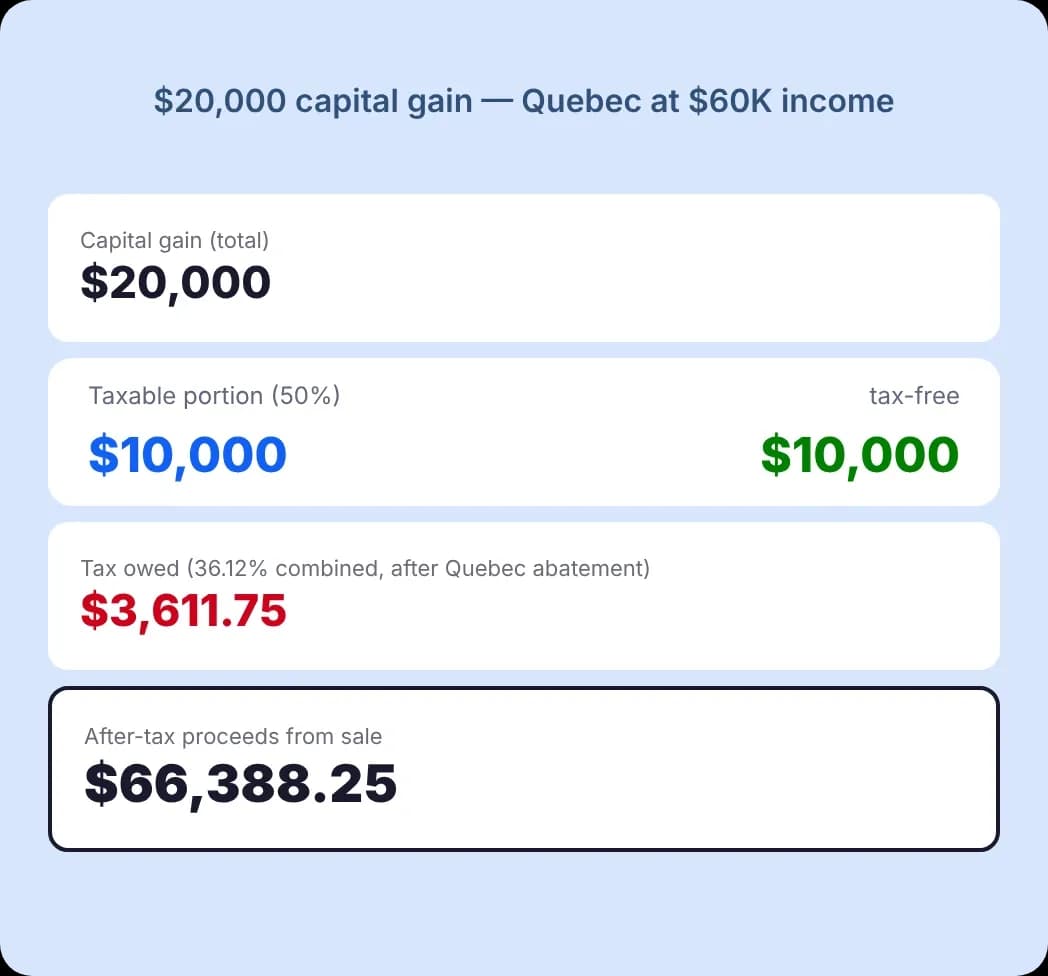

Quebec's 25.75% top rate is not a “capital gains tax rate.” Only the taxable portion of the gain enters Quebec taxable income, and federal tax applies as well.
Quebec residents still have a federal tax calculation. The 16.5% abatement reduces basic federal tax; it does not replace federal income tax or reduce Quebec tax by 16.5%.
Your taxable gain can be very different from the profit shown on a brokerage screen
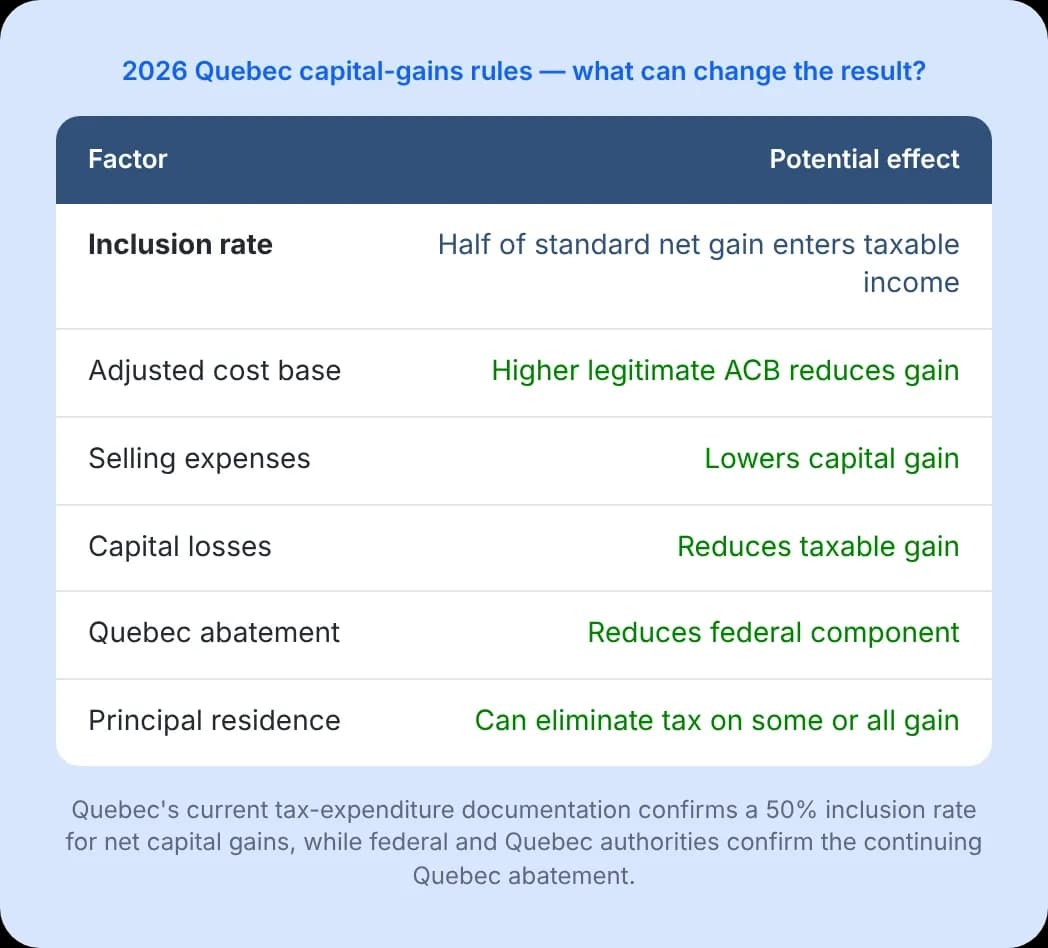

Your adjusted cost base is the tax cost used to calculate the gain, not necessarily only the original purchase price. Depending on the asset, eligible acquisition expenses or subsequent adjustments can change ACB. For identical securities purchased at different times, the CRA may require an average-cost calculation.

Previous net capital losses can generally be used against taxable capital gains when the conditions are met. Quebec's return has its own reporting mechanics, including line 290, Schedule N and form TP-729-V for carry-forward losses from other years.

A qualifying principal residence can be exempt from tax on all or part of the capital gain. Quebec requires form TP-274-V and the appropriate principal-residence designation on Schedule G. Revenu Québec states that failing to file the required designation form can trigger a late-filing penalty of $100 per month, up to $5,000.

As a rule, income, gains and losses arising from investments held in a TFSA are not included in taxable income in Quebec. Special rules still apply to non-qualified investments and business activity inside registered plans.

A Quebec resident may need to deal with capital gains on two returns: Schedule G for the Quebec return and Schedule 3 for the federal return. The calculator estimates the tax effect, but it does not replace either filing schedule.

Certain gains from qualifying small-business shares and qualifying farm or fishing property can be eligible for a capital-gains deduction. Eligibility is detailed and should never be assumed by a general calculator simply because an asset was used in a business.
COMPARE PROVINCES
How Quebec’s income-tax rates compare across Canada
Province / Territory | Lowest rate | Highest basic rate | Number of brackets |
|---|---|---|---|
ABAlberta | 8% | 15% | 6 |
BCBritish Columbia | 5.6% | 20.5% | 7 |
MBManitoba | 10.8% | 17.4% | 3 |
NBNew Brunswick | 9.4% | 19.5% | 4 |
NLNewfoundland & Labrador | 8.7% | 21.8% | 8 |
NTNorthwest Territories | 5.9% | 14.05% | 4 |
NSNova Scotia | 8.79% | 21% | 5 |
NUNunavut | 4% | 11.5% | 4 |
ONOntario | 5.05% | 13.16% | 5 |
PEIPrince Edward Island | 9.5% | 20% | 6 |
QCQuebec ← You are here | 14% | 25.75% | 4 |
SKSaskatchewan | 10.5% | 14.5% | 3 |
YTYukon | 6.4% | 15% | 5 |
Calculate capital gains tax in another province or territory: Ontario · Quebec · British Columbia · Alberta · Saskatchewan · Manitoba · Nova Scotia · New Brunswick · Newfoundland and Labrador · Prince Edward Island · Northwest Territories · Yukon · Nunavut