Nunavut Capital Gains Tax Calculator 2026
The profit from selling an investment or other capital asset is not normally the same as the amount added to your taxable income. Enter the asset’s adjusted cost, selling price and your other annual income to estimate your capital gain, taxable portion, federal and Nunavut tax, and what may remain after tax.
Nunavut preselected
Capital losses supported
Updated for the 2026 tax year
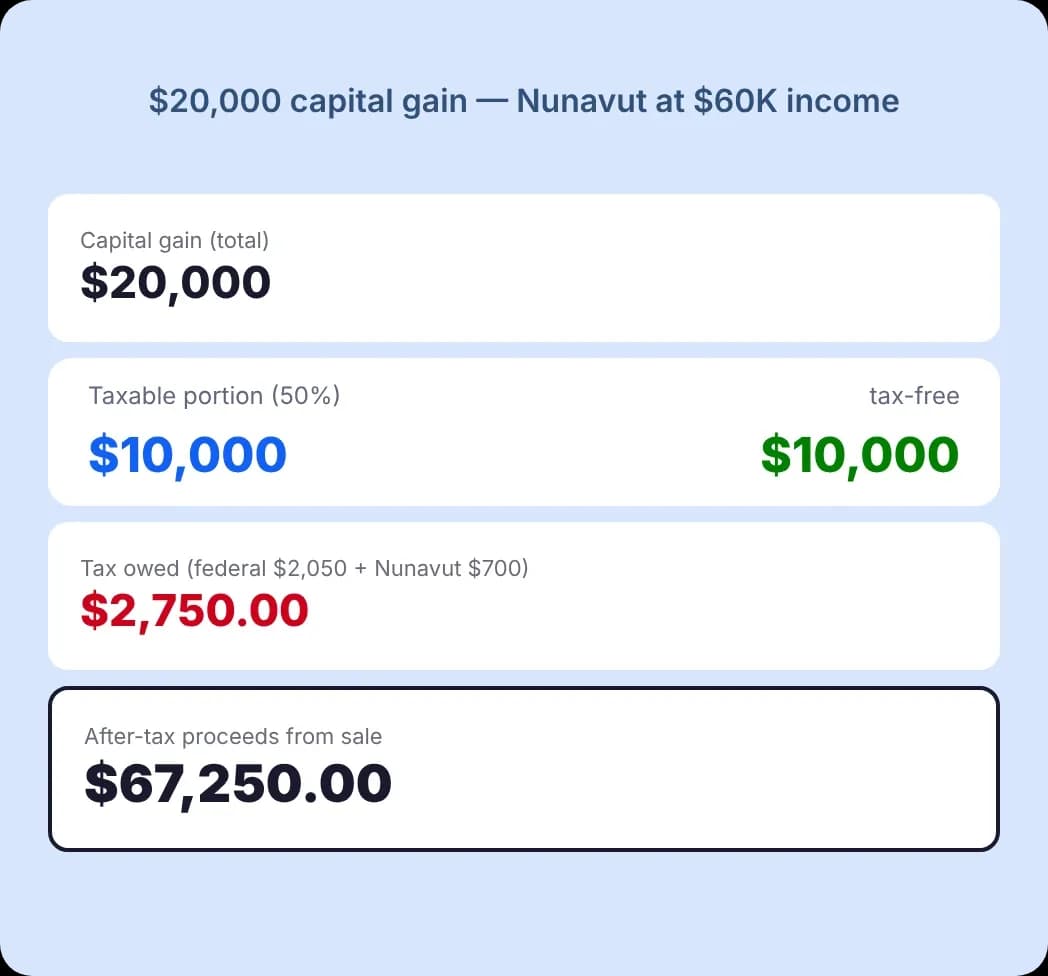
- Capital gain
- $20,000.00
- Taxable portion
- $10,000.00 (50%)
- Marginal rate applied
- 27.5%
- Estimated capital gains tax
- $2,750.00
- Effective tax rate on full gain
- 13.75%
- Estimated after-tax proceeds
- $67,250.00
Estimate assumes a Nunavut resident with $60,000 of other taxable income, a standard capital-property disposition in 2026, no eligible selling expenses, no capital losses, no principal-residence exemption, no Northern Residents Deduction and no additional capital-gains deductions. Actual tax can differ because of adjusted cost base, transaction expenses, losses, asset classification and individual tax circumstances.


Nunavut’s territorial rate may change before the federal one does
Nunavut does not charge a separate flat capital-gains tax. First, the inclusion calculation determines how much of the net gain becomes taxable. That amount is added to your other taxable income and then passes through the territorial and federal income-tax systems independently.
Half of a standard net gain is taxable
Applied after eligible capital losses
Not itself a 50% tax rate
Four territorial brackets
First threshold: $55,801
Top rate begins above $181,439
Five federal brackets
First threshold: $58,523
Top rate begins above $258,482
First calculate the gain itself
Capital gain = Proceeds of disposition − adjusted cost base − eligible selling expensesUsing the simplified example:
$70,000 − $50,000 = $20,000 capital gainIf eligible selling expenses also apply, they should be accounted for before the inclusion calculation.
Then calculate what becomes taxable income
Taxable capital gain = Net capital gain × 50%For the standard example:
$20,000 × 50% = $10,000 taxable capital gainThat taxable amount joins your other income. It is not placed into a separate Nunavut capital-gains bracket.
QUICK REFERENCE
Nunavut and federal tax brackets applied to capital gains in 2026
Nunavut taxable income | Nunavut rate | Federal taxable income | Federal rate |
|---|---|---|---|
$0 to $55,801 | 4% | $0 to $58,523 | 14% |
$55,801.01 to $111,602 | 7% | $58,523.01 to $117,045 | 20.5% |
$111,602.01 to $181,439 | 9% | $117,045.01 to $181,440 | 26% |
Over $181,439 | 11.5% | $181,440.01 to $258,482 | 29% |
— | — | Over $258,482 | 33% |
Follow a Nunavut asset sale from profit to estimated tax
Start with adjusted cost base and selling price. If eligible acquisition expenses or other adjustments changed the asset’s tax cost, use that figure instead of assuming the original purchase price is enough.
The taxable portion of the capital gain is added to your existing income. That tells the calculator which federal and Nunavut tax brackets the additional income reaches.
Enter available capital losses when they can reduce the gain. A smaller net gain means less income reaches the 50% inclusion calculation.
See the capital gain, taxable portion, marginal rate, estimated tax attributable to the gain, effective rate and after-tax proceeds. When a threshold is crossed, the calculator should apply each rate only to the portion inside its bracket.
QUICK REFERENCE
See how the same Nunavut gain changes at different incomes
Other taxable income | Taxable capital gain | Approx. tax on gain | Effective rate on full gain |
|---|---|---|---|
$40,000 | $10,000 | $1,800.00 | 9.00% |
$60,000 | $10,000 | $2,750.00 | 13.75% |
$80,000 | $10,000 | $2,750.00 | 13.75% |
$100,000 | $10,000 | $2,750.00 | 13.75% |
$150,000 | $10,000 | $3,500.00 | 17.50% |
Nunavut’s tax thresholds are close to the federal ones—but close is not the same as equal

Federal tax still applies to the taxable portion of the capital gain.
Qualifying deductions can change taxable income, but they should not automatically reduce the gain simply because the taxpayer lives in Nunavut.
The low territorial rate only helps after the gain is calculated correctly
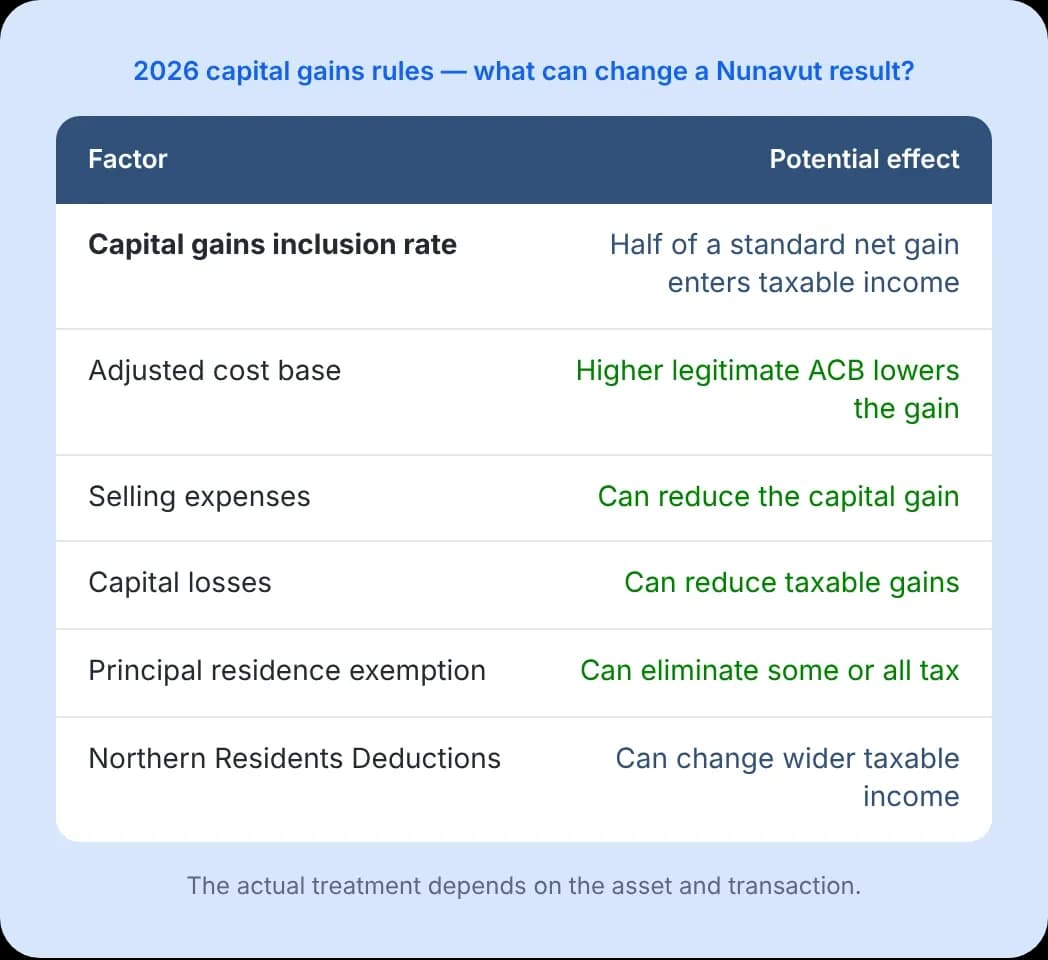

Adjusted cost base is the tax cost used to calculate the gain. Depending on the asset, it may include eligible acquisition expenses and other permitted adjustments in addition to the original purchase price.

Eligible expenses incurred to dispose of an asset can reduce the gain. Commissions are a common example for securities. Leaving legitimate selling costs out can overstate both the gain and the tax estimate.

Capital losses generally offset eligible capital gains rather than salary or other ordinary income. Eligible unused net capital losses may also be available in other permitted tax years.

A home that qualifies as a principal residence for the applicable ownership period may have some or all of its gain sheltered. Reporting requirements still apply, so a standard calculator should not automatically assume every owner-occupied property qualifies for a full exemption.

Every Nunavut community is located within prescribed Zone A. Eligible residents who meet the continuous-residency rules may claim residency and potentially travel deductions. These can affect taxable income but are not deductions from the capital gain itself.

The basic Nunavut Child Benefit is $58 per month for each qualifying child under 18, with income testing once adjusted family net income exceeds $22,065. Because a taxable capital gain can increase annual income, a gain may affect income-tested benefits even though the benefit itself is separate from capital-gains tax.
COMPARE PROVINCES
How Nunavut’s tax rates compare across Canada
Province / Territory | Lowest rate | Highest basic rate | Number of brackets |
|---|---|---|---|
ABAlberta | 8% | 15% | 6 |
BCBritish Columbia | 5.6% | 20.5% | 7 |
MBManitoba | 10.8% | 17.4% | 3 |
NBNew Brunswick | 9.4% | 19.5% | 4 |
NLNewfoundland & Labrador | 8.7% | 21.8% | 8 |
NTNorthwest Territories | 5.9% | 14.05% | 4 |
NSNova Scotia | 8.79% | 21% | 5 |
NUNunavut ← You are here | 4% | 11.5% | 4 |
ONOntario | 5.05% | 13.16% | 5 |
PEIPrince Edward Island | 9.5% | 20% | 6 |
QCQuebec | 14% | 25.75% | 4 |
SKSaskatchewan | 10.5% | 14.5% | 3 |
YTYukon | 6.4% | 15% | 5 |
Calculate capital gains tax in another province or territory: Ontario · Quebec · British Columbia · Alberta · Saskatchewan · Manitoba · Nova Scotia · New Brunswick · Newfoundland and Labrador · Prince Edward Island · Northwest Territories · Yukon · Nunavut