Manitoba Capital Gains Tax Calculator 2026
Selling an asset for more than it cost gives you a profit, but not all of that profit normally enters taxable income. Enter the adjusted cost of the asset, selling price and your other annual income to estimate your capital gain, taxable portion, federal and Manitoba tax, and what may remain after tax.
Manitoba preselected
Capital losses supported
Built around 2026 rules
- Capital gain
- $20,000.00
- Taxable portion
- $10,000.00 (50%)
- Marginal rate applied
- 33.25%
- Estimated capital gains tax
- $3,325.00
- Effective tax rate on full gain
- 16.63%
- Estimated after-tax proceeds
- $66,675.00
Estimate assumes a Manitoba resident with $60,000 of other taxable income, a standard capital-property disposition in 2026, no eligible selling expenses, no capital losses, no principal-residence exemption and no additional capital-gains deductions. Actual tax can change with adjusted cost base, transaction costs, asset classification, losses and individual tax circumstances.


Manitoba does not tax the whole gain — but the taxable half can cross a frozen threshold
A capital gain does not have its own flat Manitoba tax rate. First, the inclusion calculation determines how much of the net gain becomes taxable. That taxable amount is then added to your other income and moves through Manitoba’s ordinary 10.8%, 12.75% and 17.4% brackets alongside the federal tax system.
Half of a standard net gain is taxable
Applied after eligible losses
Not itself a 50% tax rate
Three provincial brackets
Second rate begins above $47,000
Top rate begins above $100,000
Five federal brackets
First threshold: $58,523
Taxable capital gains join other income
Work out the gain before thinking about tax
Capital gain = Proceeds of disposition − adjusted cost base − eligible selling expensesUsing the simplified example:
$70,000 − $50,000 = $20,000 capital gainIf eligible selling costs were also incurred, the final capital gain could be lower than $20,000.
Work out how much of that gain becomes taxable
Taxable capital gain = Net capital gain × 50%For the standard example:
$20,000 × 50% = $10,000 taxable capital gainThat amount is added to the taxpayer’s existing taxable income. Manitoba does not place it into a separate capital-gains bracket.
QUICK REFERENCE
Manitoba and federal tax brackets applied to capital gains in 2026
Manitoba taxable income | Manitoba rate | Federal taxable income | Federal rate |
|---|---|---|---|
$0 to $47,000 | 10.8% | $0 to $58,523 | 14% |
$47,000.01 to $100,000 | 12.75% | $58,523.01 to $117,045 | 20.5% |
Over $100,000 | 17.4% | $117,045.01 to $181,440 | 26% |
— | — | $181,440.01 to $258,482 | 29% |
— | — | Over $258,482 | 33% |
Four inputs turn an asset sale into a more useful Manitoba tax estimate
Enter the adjusted cost base and selling price. The amount you originally paid may need to be adjusted for eligible acquisition costs, commissions or other changes before it represents the correct tax cost.
Your other taxable income determines where the taxable portion of the gain lands within Manitoba and federal tax brackets. This is essential when income sits close to $47,000 or $100,000.
Add eligible unused capital losses where they can be applied. Reducing the net gain before the inclusion calculation can lower the amount eventually added to taxable income.
See the full gain, taxable portion, marginal rate, estimated tax attributable to the gain, effective tax rate and after-tax proceeds. If the gain crosses a bracket, the calculator should split it across the appropriate rates.
QUICK REFERENCE
See how the same Manitoba gain changes at different income levels
Other taxable income | Taxable capital gain | Approx. tax on gain | Effective rate on full gain |
|---|---|---|---|
$40,000 | $10,000 | $2,538.50 | 12.69% |
$60,000 | $10,000 | $3,325.00 | 16.63% |
$80,000 | $10,000 | $3,325.00 | 16.63% |
$100,000 | $10,000 | $3,790.00 | 18.95% |
$150,000 | $10,000 | $4,340.00 | 21.70% |
Manitoba froze its brackets. A capital gain can still move you through them.
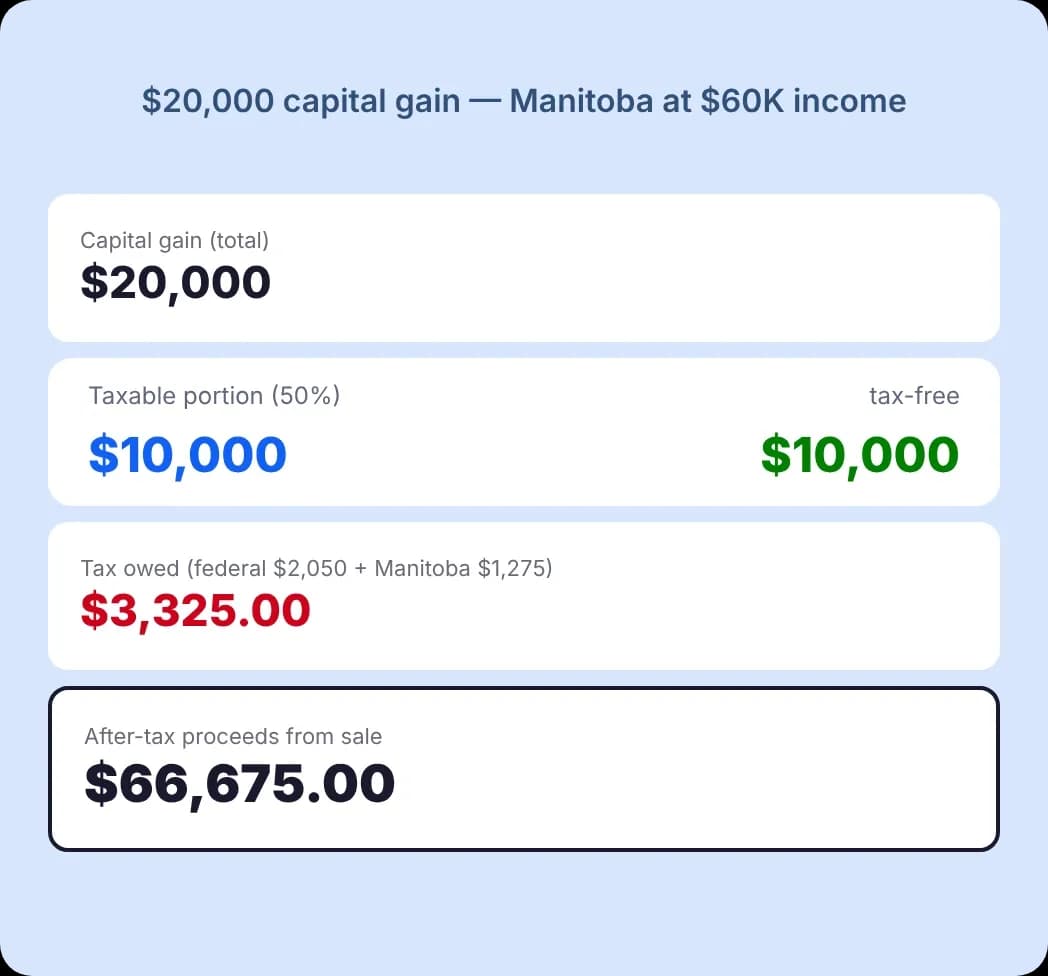

A larger share of a taxable gain can land in Manitoba’s 12.75% or 17.4% brackets once other income has already used the lower bracket room.
When the gain crosses $47,000 or $100,000, each portion needs to be taxed at the rate for its own bracket.
Your Manitoba capital-gains bill can change before a tax rate is ever applied
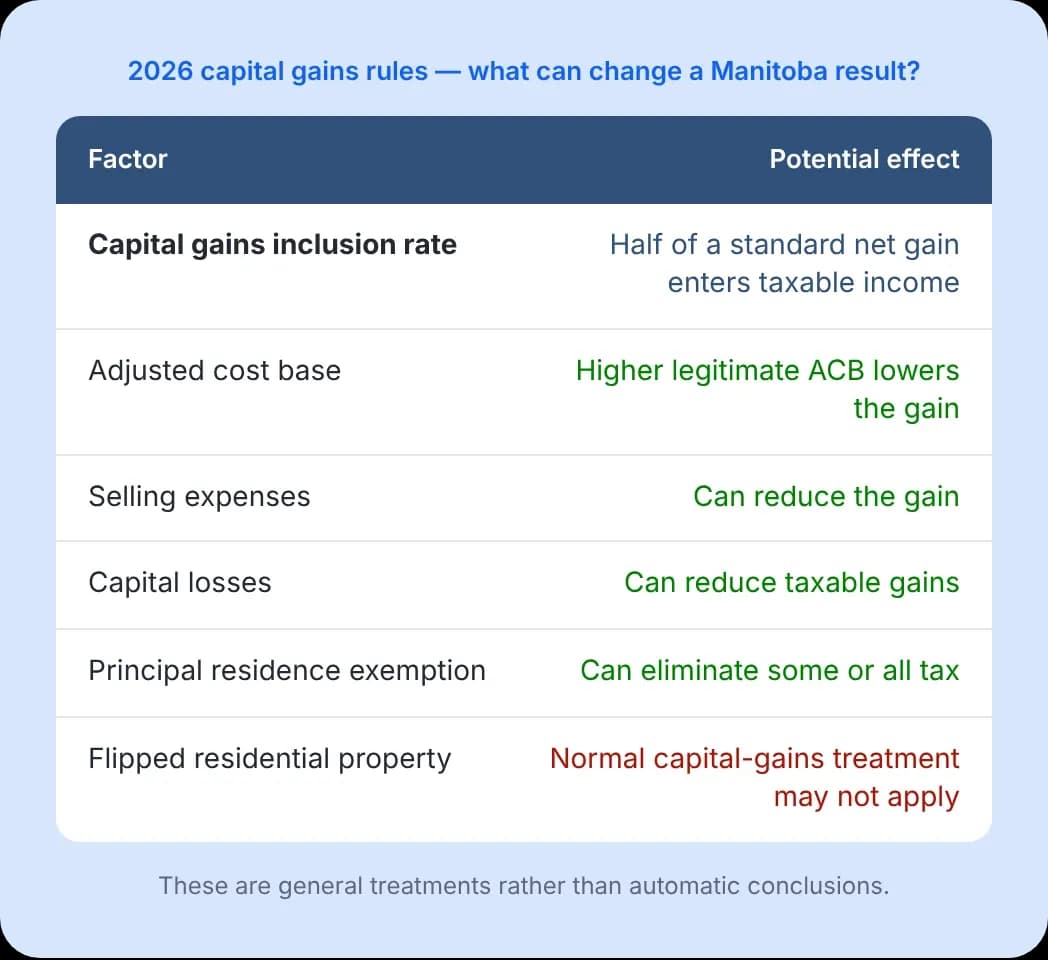

Adjusted cost base is the tax cost used to calculate the gain. It can include more than the original purchase price, depending on the asset and transaction. Using an accurate ACB prevents the calculator from overstating the profit subject to the inclusion calculation.

Eligible costs incurred to dispose of an asset can reduce the capital gain. Commissions are a common example for securities. Where eligible selling expenses exist, simply subtracting the original purchase price from the final sale price can overstate the gain.

Capital losses generally offset eligible capital gains rather than salary or ordinary employment income. Unused net capital losses may also be available in other permitted tax years.

A property that qualifies as your principal residence for the relevant ownership years may have all or part of its capital gain sheltered. The sale still carries reporting requirements, so a home should not automatically be treated as exempt simply because the owner lived there.

Standard investment gains inside a TFSA are generally tax-free. Investment growth inside an RRSP is generally sheltered while it remains in the plan, while withdrawals are typically taxed as income rather than as separate capital gains.

Manitoba’s maximum basic personal amount remains $15,780 in 2026. The amount begins to decline above $200,000 of income and reaches zero at $400,000. A large taxable capital gain can therefore affect the wider Manitoba tax calculation when it pushes income into the phaseout range.
COMPARE PROVINCES
How Manitoba’s tax rates compare across Canada
Province / Territory | Lowest rate | Highest basic rate | Number of brackets |
|---|---|---|---|
ABAlberta | 8% | 15% | 6 |
BCBritish Columbia | 5.6% | 20.5% | 7 |
MBManitoba ← You are here | 10.8% | 17.4% | 3 |
NBNew Brunswick | 9.4% | 19.5% | 4 |
NLNewfoundland & Labrador | 8.7% | 21.8% | 8 |
NTNorthwest Territories | 5.9% | 14.05% | 4 |
NSNova Scotia | 8.79% | 21% | 5 |
NUNunavut | 4% | 11.5% | 4 |
ONOntario | 5.05% | 13.16% | 5 |
PEIPrince Edward Island | 9.5% | 20% | 6 |
QCQuebec | 14% | 25.75% | 4 |
SKSaskatchewan | 10.5% | 14.5% | 3 |
YTYukon | 6.4% | 15% | 5 |