British Columbia Capital Gains Tax Calculator 2026
Selling an asset for a profit does not mean the entire gain becomes taxable. Enter the asset's adjusted cost, selling price and your other annual income to estimate how much of the gain is taxable and what the resulting federal and British Columbia income tax could be in 2026.
British Columbia preselected
Capital losses supported
Current 2026 tax rules
- Capital gain
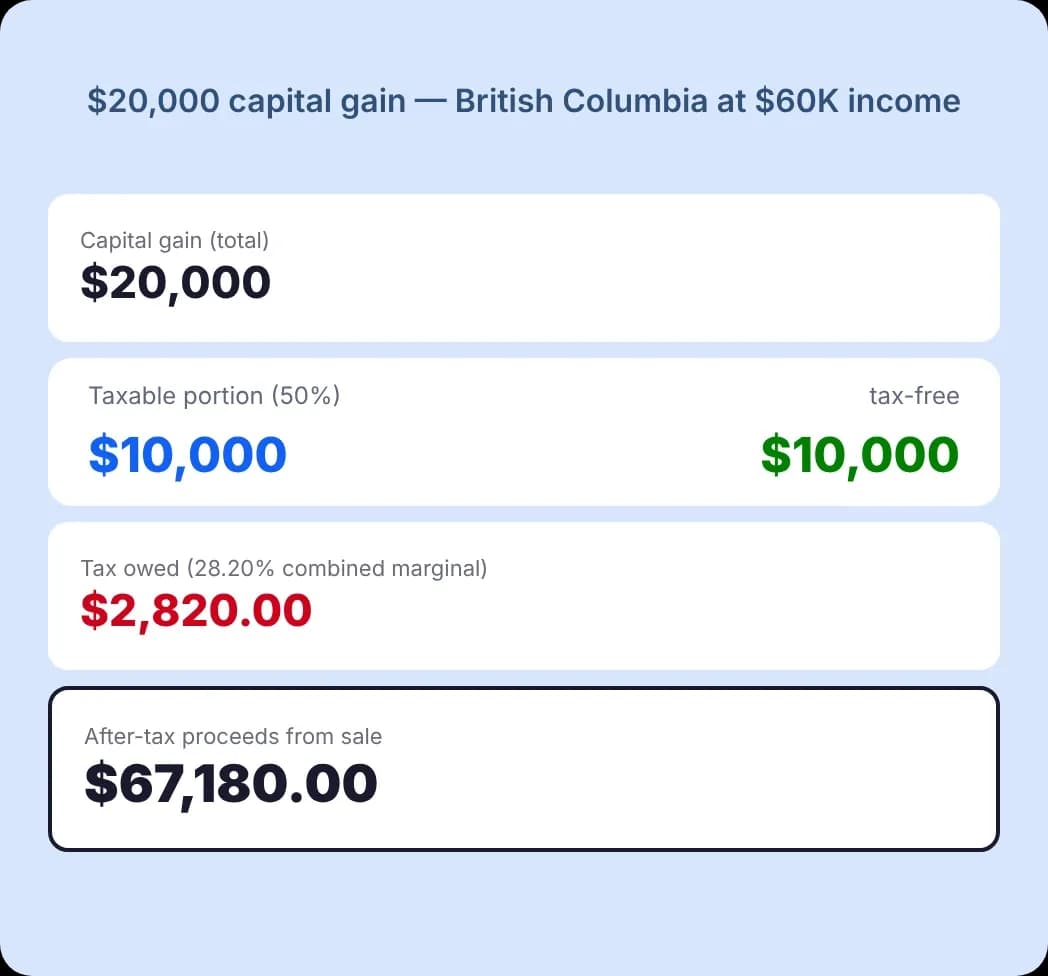
- $20,000.00
- Taxable portion
- $10,000.00 (50%)
- Marginal rate applied
- 28.2%
- Estimated capital gains tax
- $2,820.00
- Effective tax rate on full gain
- 14.1%
- Estimated after-tax proceeds
- $67,180.00
Estimate assumes an individual resident in British Columbia with $60,000 of other taxable income, a standard capital-property disposition in 2026, no selling expenses, no capital losses, no principal-residence exemption and no other deductions. The example does not include the separate B.C. home flipping tax.


Half the gain enters taxable income. Your existing income decides what happens next.
British Columbia does not charge one flat provincial capital-gains rate. Instead, the taxable portion of your gain joins the rest of your income. Someone with $60,000 of other income can therefore pay a different amount of tax on the same gain as someone who already earns $150,000.
Half of a standard net gain is taxable
The proposed federal increase was cancelled
50% remains the current 2026 rule
Seven provincial brackets
First threshold: $50,363
Top rate begins above $265,545
Five federal brackets
First threshold: $58,523
Taxable gains enter ordinary taxable income
Calculate the profit that actually counts as a capital gain
Capital gain = Proceeds of disposition − adjusted cost base − eligible selling expensesUsing the simplified example:
$70,000 − $50,000 = $20,000 capital gainThis is why a brokerage screen showing “profit” should not automatically be treated as the final tax calculation.
Then find the portion that enters taxable income
Taxable capital gain = Net capital gain × 50%For a $20,000 net gain:
$20,000 × 50% = $10,000 taxable capital gainThat $10,000 is added to your other taxable income. With $60,000 of existing income and British Columbia selected, the example places the additional income inside federal and provincial brackets with a combined basic marginal rate of 28.2%.
QUICK REFERENCE
British Columbia and federal tax brackets applied to capital gains in 2026
British Columbia taxable income | B.C. rate | Federal taxable income | Federal rate |
|---|---|---|---|
$0 to $50,363 | 5.6% | $0 to $58,523 | 14% |
$50,363.01 to $100,728 | 7.7% | $58,523.01 to $117,045 | 20.5% |
$100,728.01 to $115,648 | 10.5% | $117,045.01 to $181,440 | 26% |
$115,648.01 to $140,430 | 12.29% | $181,440.01 to $258,482 | 29% |
$140,430.01 to $190,405 | 14.7% | Over $258,482 | 33% |
$190,405.01 to $265,545 | 16.8% | — | — |
Over $265,545 | 20.5% | — | — |
From sale price to a B.C. capital-gains estimate in four steps
Enter your adjusted cost base and selling price. For a straightforward security purchase, those numbers may be close to what you paid and received, but commissions and other adjustments can change the actual gain.
The taxable portion of your capital gain does not exist in isolation. Your annual income shows the calculator where that additional taxable amount lands within the federal and British Columbia brackets.
Enter capital losses carried forward when they can be applied. Historical net capital losses require the correct CRA treatment because inclusion rates have changed in earlier periods.
See the full gain, taxable portion, marginal rate, estimated tax attributable to the gain, effective rate and estimated after-tax proceeds. If the transaction involves recently acquired B.C. residential property, check the separate home flipping rules as well.
QUICK REFERENCE
The same B.C. gain can produce a different tax bill at a different income
Other taxable income | Taxable capital gain | Approx. tax on gain | Effective rate on full gain |
|---|---|---|---|
$60,000 | $10,000 | $2,820.00 | 14.10% |
$80,000 | $10,000 | $2,820.00 | 14.10% |
$100,000 | $10,000 | $3,079.62 | 15.40% |
$120,000 | $10,000 | $3,829.00 | 19.15% |
$150,000 | $10,000 | $4,070.00 | 20.35% |
In B.C., a home sale can be running on two different tax clocks

365 days and 730 days are not competing versions of the same rule. The federal flipping rule can reclassify certain short-term property profits as business income. B.C.'s 730-day tax is a separate provincial tax.
The standard calculator result does not automatically include B.C. home flipping tax. That tax depends on the type of property, holding period, exemptions and other details that are not captured by the basic capital-gains inputs.
Before you apply the tax rates, make sure the gain itself is right
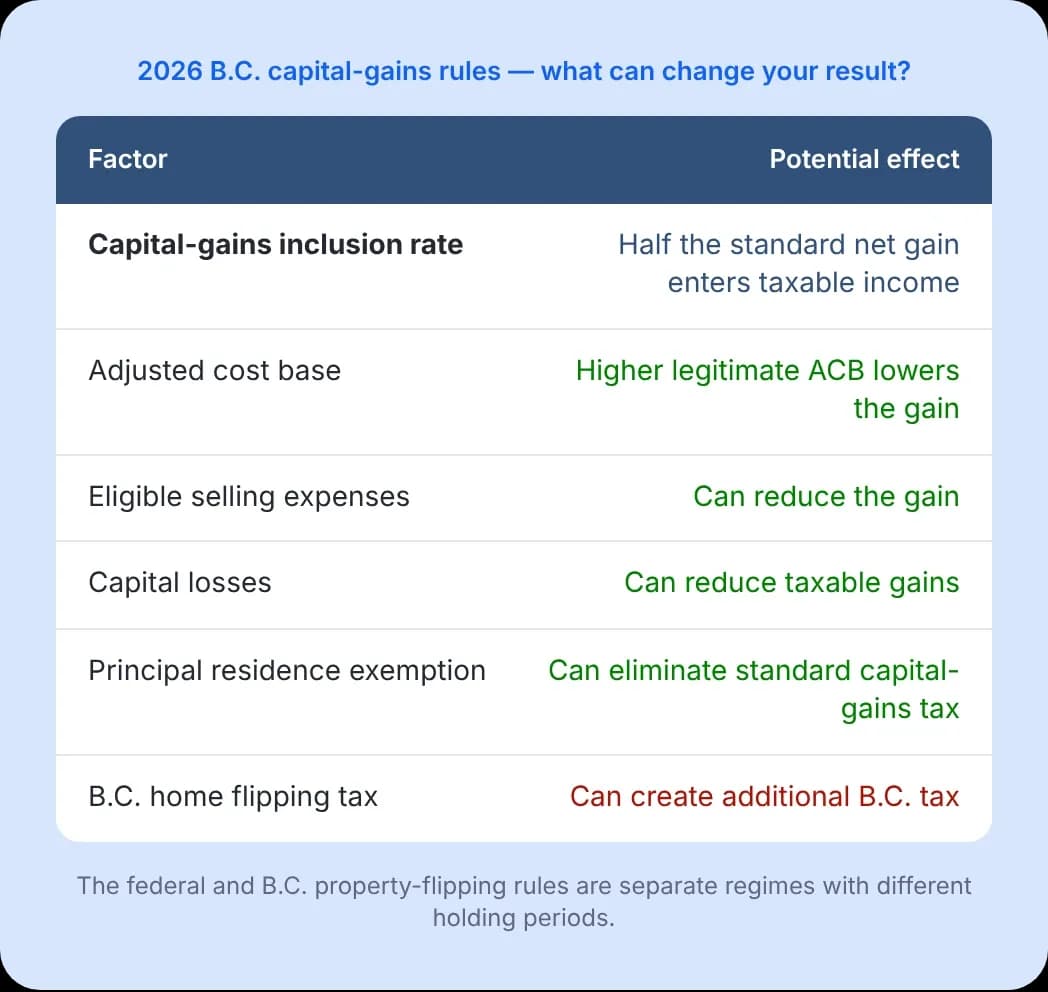

Adjusted cost base is the tax cost used to calculate your capital gain. It can include more than the asset's original price. Eligible acquisition expenses and other adjustments may change the figure, so using an accurate ACB can materially change the estimated tax.

Eligible expenses incurred to dispose of an asset can reduce the capital gain. Brokerage commissions are a common example for securities, while qualifying property-sale expenses may also matter. The calculator should use the net gain rather than assuming sale price minus original purchase price is always enough.

Capital losses can generally be used against eligible capital gains rather than employment income. Unused net capital losses may generally be carried back three years or forward to future years. Because Canada's inclusion rate has changed historically, older losses may require adjustment when claimed.

A home that qualifies as your principal residence for the relevant ownership period can potentially have all or part of its ordinary federal capital gain sheltered by the principal residence exemption. A separate review may still be required for B.C.'s home flipping tax if the property was held for less than 730 days.

Capital gains inside a TFSA are generally tax-free. Investment growth inside an RRSP is generally sheltered while it remains in the account, while withdrawals are normally included in taxable income rather than taxed as individual capital gains.

B.C.'s short-term property tax applies separately to certain residential property and presale dispositions within 730 days. The rate begins at 20% for qualifying dispositions within 365 days and declines over the following year until reaching zero at 730 days. Exemptions and a qualifying primary-residence deduction can apply.
COMPARE PROVINCES
Where B.C.’s income-tax rates sit across Canada
Province / Territory | Lowest rate | Highest basic rate | Number of brackets |
|---|---|---|---|
ABAlberta | 8% | 15% | 6 |
BCBritish Columbia ← You are here | 5.6% | 20.5% | 7 |
MBManitoba | 10.8% | 17.4% | 3 |
NBNew Brunswick | 9.4% | 19.5% | 4 |
NLNewfoundland & Labrador | 8.7% | 21.8% | 8 |
NTNorthwest Territories | 5.9% | 14.05% | 4 |
NSNova Scotia | 8.79% | 21% | 5 |
NUNunavut | 4% | 11.5% | 4 |
ONOntario | 5.05% | 13.16% | 5 |
PEIPrince Edward Island | 9.5% | 20% | 6 |
QCQuebec | 14% | 25.75% | 4 |
SKSaskatchewan | 10.5% | 14.5% | 3 |
YTYukon | 6.4% | 15% | 5 |
Calculate capital gains tax in another province or territory: Ontario · Quebec · British Columbia · Alberta · Saskatchewan · Manitoba · Nova Scotia · New Brunswick · Newfoundland and Labrador · Prince Edward Island · Northwest Territories · Yukon · Nunavut