Alberta Capital Gains Tax Calculator 2026
The profit on an investment is only the first number in a capital-gains calculation. Enter your adjusted purchase cost, selling price and annual income to estimate how much of the gain becomes taxable and how federal and Alberta income-tax rates could affect what remains.
Alberta preselected
Capital losses supported
Current 2026 tax rules
- Capital gain
- $20,000.00
- Taxable portion
- $10,000.00 (50%)
- Highest marginal rate reached
- 28.5%
- Estimated capital gains tax
- $2,850.00
- Effective tax rate on full gain
- 14.25%
- Estimated after-tax proceeds
- $67,150.00
Estimate assumes an Alberta resident with $60,000 of other taxable income, a standard capital-property disposition in 2026, no selling expenses, no capital losses, no principal-residence exemption, and no other capital-gains deductions. Actual tax can differ depending on adjusted cost base, credits, losses, asset classification, and other income.


Your gain can cross a tax bracket even when your salary does not
Alberta does not apply one special provincial percentage to capital gains. First, the inclusion rule determines how much of the gain enters taxable income. Then Alberta’s six ordinary income-tax brackets apply to that additional taxable amount alongside the federal brackets. The exact tax therefore depends on where your income sits before the gain arrives.
Half of a standard net gain is taxable
The proposed increase was cancelled
50% remains the current 2026 treatment
Six provincial brackets
First threshold: $61,200
Top rate begins above $370,220
Five federal brackets
First threshold: $58,523
Taxable gains join your other income
Work out the gain before applying any tax rate
Capital gain = Proceeds of disposition − adjusted cost base − eligible selling expensesUsing the simplified example:
$70,000 − $50,000 = $20,000 capital gainCRA’s Schedule 3 calculation likewise separates proceeds, adjusted cost base, and outlays or expenses before calculating the capital gain or loss.
Then calculate the amount that becomes taxable
Taxable capital gain = Net capital gain × 50%For this example:
$20,000 × 50% = $10,000 taxable capital gainThat $10,000 joins your other taxable income. The tax attributable to it must then be calculated across the federal and Alberta brackets it actually passes through rather than applying the final marginal rate to every dollar.
QUICK REFERENCE
Alberta and federal tax brackets applied to capital gains in 2026
Alberta taxable income | Alberta rate | Federal taxable income | Federal rate |
|---|---|---|---|
$0 to $61,200 | 8% | $0 to $58,523 | 14% |
$61,200.01 to $154,259 | 10% | $58,523.01 to $117,045 | 20.5% |
$154,259.01 to $185,111 | 12% | $117,045.01 to $181,440 | 26% |
$185,111.01 to $246,813 | 13% | $181,440.01 to $258,482 | 29% |
$246,813.01 to $370,220 | 14% | Over $258,482 | 33% |
Over $370,220 | 15% | — | — |
How to turn an Alberta asset sale into a tax estimate
Enter the adjusted cost base rather than relying automatically on the original purchase price. If eligible acquisition expenses changed the tax cost, those amounts belong in ACB.
Your other taxable income determines where the taxable portion of the gain lands. This matters in Alberta because provincial and federal thresholds do not line up exactly.
Enter eligible unused capital losses when they can be applied against gains. An available loss can reduce the net amount that ultimately becomes taxable.
Review the full capital gain, taxable portion, highest marginal rate reached, estimated tax attributable to the gain, effective rate, and after-tax proceeds. The calculation should split the taxable gain whenever it crosses a threshold.
QUICK REFERENCE
Watch the same Alberta gain change as income rises
Other taxable income | Taxable capital gain | Approx. tax on gain | Effective rate on full gain |
|---|---|---|---|
$40,000 | $10,000 | $2,200.00 | 11.00% |
$60,000 | $10,000 | $3,026.00 | 15.13% |
$100,000 | $10,000 | $3,050.00 | 15.25% |
$150,000 | $10,000 | $3,714.82 | 18.57% |
$200,000 | $10,000 | $4,200.00 | 21.00% |
Alberta’s $61,200 threshold shows why one “capital gains rate” can mislead
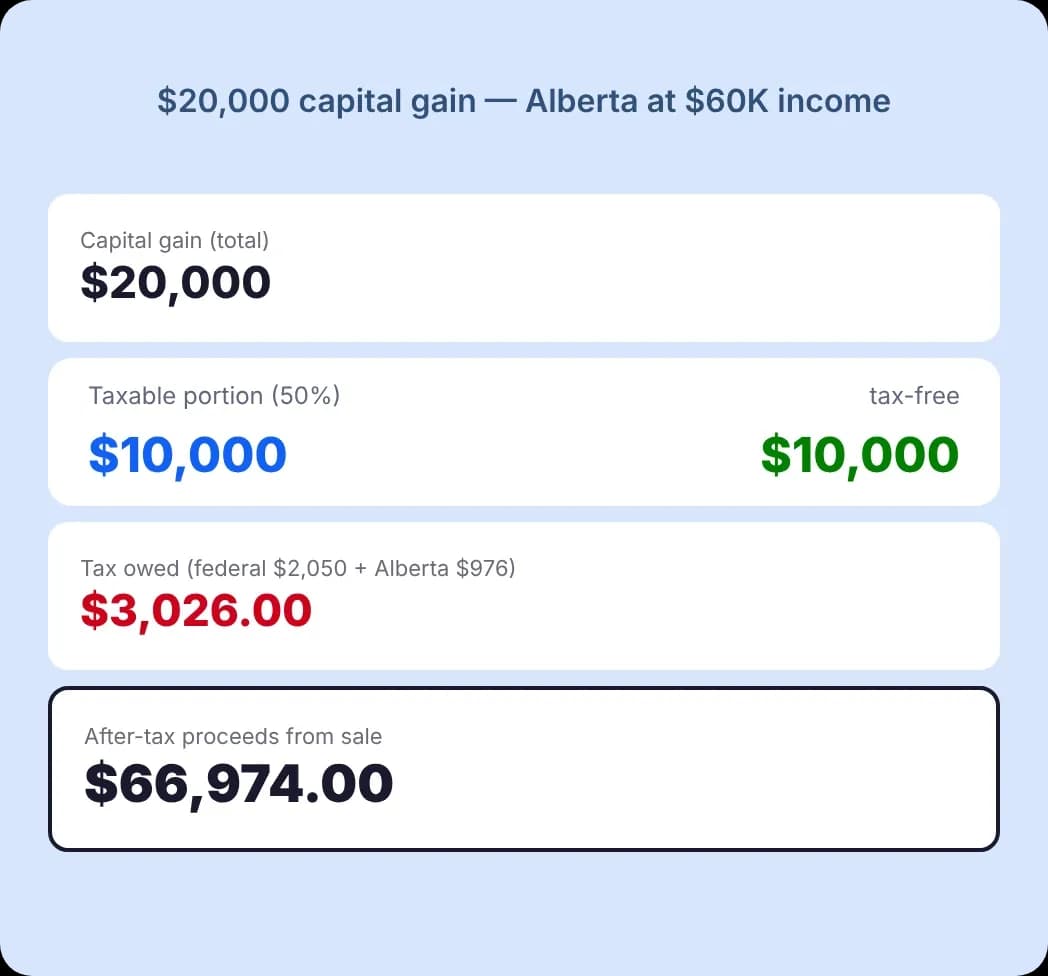

An 8% Alberta bracket does not mean an 8% capital-gains tax. Only 50% of a standard gain enters taxable income, and federal tax applies alongside Alberta tax.
Your highest marginal rate is not necessarily the rate on every dollar of the gain. If the taxable gain crosses an Alberta or federal threshold, each slice should be calculated at the rate for its own bracket.
Get the gain right before worrying about the tax rate
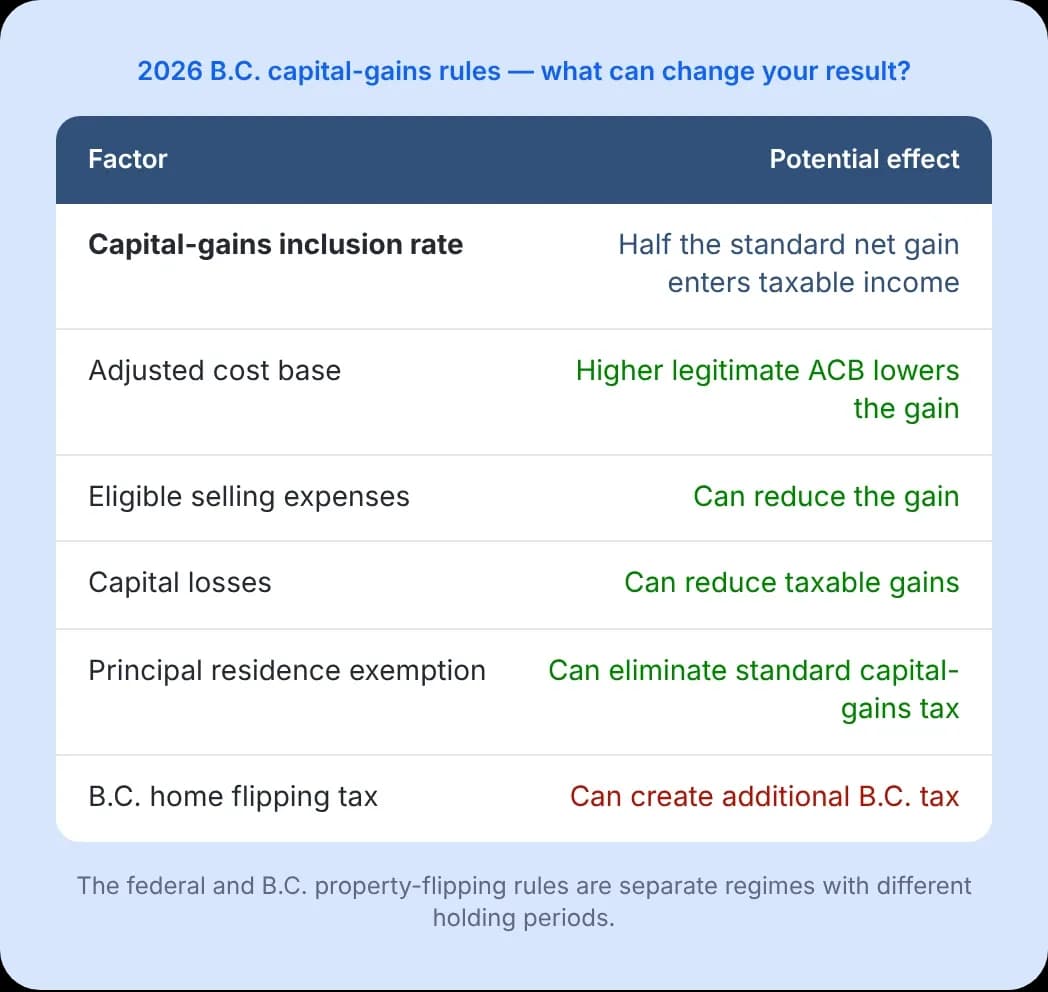

Adjusted cost base is the tax cost used to measure your gain. For investments, it can include the purchase cost plus acquisition expenses such as commissions and trading fees. If identical securities were bought in several transactions, the correct ACB may require more than looking at the price of the first purchase.

Eligible outlays and expenses incurred when selling an asset are deducted when calculating the capital gain. For securities, this can include commissions or redemption fees. Leaving them out can overstate both the gain and the estimated tax.

Ordinary capital losses generally offset capital gains rather than employment income. A net capital loss can normally be carried back three years or forward indefinitely, although losses from years with different historical inclusion rates may require adjustment.

If a property qualified as your principal residence for every relevant year of ownership, the resulting gain may be exempt. The sale still needs to be reported and the property designated appropriately for the exemption to apply.

Investment income and capital gains earned in a TFSA are generally tax-free, including when funds are withdrawn. RRSP investment growth is generally sheltered while it remains inside the account; withdrawals are normally taxed as income instead of individual capital gains.

Alberta’s 2026 basic personal amount is $22,769. It helps determine the provincial non-refundable credit on an Alberta tax return. A standard marginal capital-gains estimate should not treat this as $22,769 of every gain being tax-free; it is part of the broader personal income-tax calculation rather than a special capital-gains exemption.
COMPARE PROVINCES
How Alberta’s income-tax rates compare across Canada
Province / Territory | Lowest rate | Highest basic rate | Number of brackets |
|---|---|---|---|
ABAlberta ← You are here | 8% | 15% | 6 |
BCBritish Columbia | 5.6% | 20.5% | 7 |
MBManitoba | 10.8% | 17.4% | 3 |
NBNew Brunswick | 9.4% | 19.5% | 4 |
NLNewfoundland & Labrador | 8.7% | 21.8% | 8 |
NTNorthwest Territories | 5.9% | 14.05% | 4 |
NSNova Scotia | 8.79% | 21% | 5 |
NUNunavut | 4% | 11.5% | 4 |
ONOntario | 5.05% | 13.16% | 5 |
PEIPrince Edward Island | 9.5% | 20% | 6 |
QCQuebec | 14% | 25.75% | 4 |
SKSaskatchewan | 10.5% | 14.5% | 3 |
YTYukon | 6.4% | 15% | 5 |