Your bank is earning more from your money than you are. Time to change that.
Indian banks offer dramatically different interest rates, and if you're not paying attention, you're leaving money on the table.
Whether you're building savings, securing fixed deposits, or exploring high-yield options, it’s important to have a clear picture of what each option pays to determine your financial future.
We’ve pooled in all our knowledge and research to prep this guide, covering:
- Interest rates from different banks in India
- What factors determine these interest rates
- Which banks are currently offering the highest interest rates
- What should you consider before choosing a bank for your deposits
Let’s dive and explore.
What factors determine bank interest rates in India?
Bank interest rates are carefully calculated based on economic forces that shape how much banks need your money and what they can afford to pay for it.
When you deposit money, banks pay you interest for the privilege of using your funds. They take your deposits and lend them to borrowers at higher rates, keeping the difference as profit. This simple model drives everything from savings account rates to fixed deposit returns.
Several key factors influence these rates:
RBI repo rate : The cost for banks to borrow from the central bank
Inflation levels : Higher inflation pushes banks to offer competitive rates
Market competition : Smaller banks often pay more to attract customers
Liquidity needs : Banks desperate for deposits raise rates quickly
Credit demand : Strong loan demand allows banks to pay higher deposit rates
How do different types of accounts earn interest?
Not every account treats your money the same way. Some barely keep pace with inflation, while others can genuinely grow your wealth over time.
Here's how the most common interest-earning accounts work in India:
1. Savings accounts Your most liquid option, offering 2.5% to 7% depending on the bank. Money remains accessible anytime, but returns stay modest compared to other options.
Also Read: Savings account in Canada
2. Fixed Deposits (FDs) Lock your money for specific periods (7 days to 10 years) and earn 6.5% to 8.5%. The longer you commit, the higher your rate. Perfect for money you won't need soon.
3. Recurring Deposits (RDs) Deposit fixed amounts monthly and earn compound interest. Ideal for disciplined savers who want to build wealth gradually with predictable contributions.
4. Senior citizen fixed deposits Special FDs for people over 60, offering 0.25% to 0.75% higher than regular rates. Government recognition of seniors' need for a steady income.
5. Senior Citizen Savings Scheme (SCSS)
It is a Government-backed scheme offering 8.20% annually, among the safest high-yield options available for seniors.
6. Tax-saving fixed deposits
5-year lock-in FDs offering 7.20% to 7.40% with Section 80C deduction benefits up to ₹1.5 lakh annually.
7. NRE/NRO accounts NRE accounts offer tax-free, repatriable returns for NRIs. NRO accounts handle India-sourced income with similar interest rates but different tax implications.
Which banks currently offer the highest interest rates?
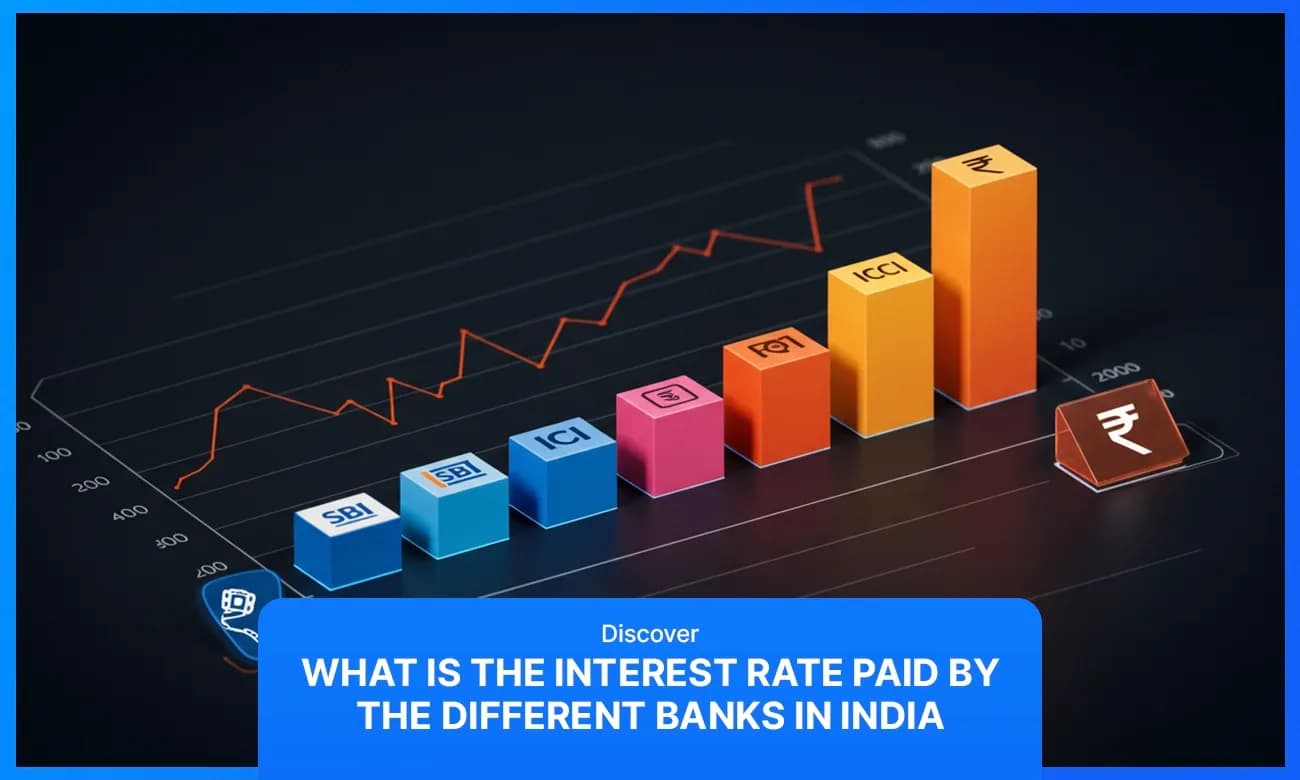
Here's a comprehensive comparison of current interest rates across different bank categories:
| Bank Name | Savings Rate | 1-Year FD Rate | Special Features |
|---|---|---|---|
| SBI | 2.70% | 6.80% | Largest network, high security |
| Bank of Baroda | 2.75% | 6.75% | Strong rural presence |
| Punjab National Bank | 2.70% | 6.70% | Wide accessibility |
| HDFC Bank | 3.00% | 7.10% | Premium digital services |
| ICICI Bank | 3.00% | 7.00% | Comprehensive banking |
| Axis Bank | 3.00% | 7.20% | Special tenure offers |
| AU Small Finance Bank | 6.50% | 8.25% | High minimum balance |
| Ujjivan Small Finance Bank | 6.75% | 8.00% | Focus on the underserved |
| Equitas Small Finance Bank | 6.75% | 7.90% | Competitive rates |
| Suryoday Small Finance Bank | 6.50% | 9.10% (5-year) | Highest long-term rates |
| Unity Small Finance Bank | 6.50% | 8.65% | Select tenure offers |
| NorthEast Small Finance Bank | 6.50% | 8.50% (9.50% seniors) | Regional focus |
| Utkarsh Small Finance Bank | 6.50% | 8.25% (8.85% seniors) | Strong senior benefits |
| Post Office | N/A | 6.90-7.50% | Government backing |
| Tax-Saving FDs | N/A | 7.20-7.40% | Section 80C benefits |
However, these numbers come with important caveats.
Higher rates often require substantial minimum balances, may have geographic restrictions, or come from institutions with less established track records.
How do tax-saving fixed deposits work?
Tax-saving FDs merge steady returns with Section 80C tax relief, creating a powerful combination for smart savers. These deposits lock your money for exactly five years while delivering predictable growth and immediate tax benefits.
If you haven't exhausted your ₹1.5 lakh deduction limit, these products deserve serious consideration. The mathematics works beautifully: someone in the 30% tax bracket saves ₹45,000 in taxes on a full ₹1.5 lakh deposit, effectively boosting their real return.
If you're immigrant in Canadia who wants to file tax in India read: How to file tax in India
Current rates across major players include:
- Ujjivan SFB: 7.40%
- HDFC Bank: 7.30%
- IndusInd Bank: 7.25%
- ICICI Bank: 7.20%–7.40%
Essential features you need to understand:
- Interest taxation :Fully taxable as income
- Tax benefit : Up to ₹1.5 lakh under Section 80C
- Lock-in period : 5 years (absolutely no early withdrawal allowed)
Availability
Major banks and small finance banks both offer these
Regular FDs provide more flexibility, but tax-saving variants deliver immediate relief during tax season. This trade-off between liquidity and tax efficiency makes them perfect for disciplined savers who want long-term growth with upfront tax optimization.
Are high-interest banks safe for your money?
Not every bank offering attractive rates maintains the same safety standards, despite the RBI regulation creating a baseline level of protection.
Smart depositors need to evaluate multiple safety factors beyond just regulatory approval. Your due diligence process should examine the institution's fundamental strength, not just its marketing promises.
Essential safety checks include:
- Credit ratings from recognized agencies
- RBI licensing and regular audit compliance
- Transparent rate and fee disclosure practices
- NPA (non-performing asset) levels and trends
- Customer complaint history and resolution patterns
- DICGC insurance verification (₹5 lakh per depositor coverage)
- Small finance banks often deliver impressive safety records while offering competitive returns.
However, they lack the operational scale and decades of experience that larger institutions provide. This creates a nuanced risk-reward equation that varies by individual bank.
Cooperative banks present a different challenge altogether.
They frequently offer higher returns but operate with elevated risk profiles compared to commercial banks. The regulatory framework differs, and deposit insurance coverage can be more complex.
What should you consider when choosing a bank?
Bank selection extends far beyond interest rate comparisons. A stellar rate becomes meaningless if the service quality or accessibility doesn't align with your actual banking behavior and needs.
Your decision-making process should start with honest self-assessment. Different savers have different priorities, and the perfect bank for your neighbor might frustrate you daily.
Critical evaluation factors include:
Digital Platforms
Assess the bank's mobile app and online banking services for ease of use, transaction capabilities, and customer support.
Branch Accessibility
Consider the number and location of physical branches and ATMs, especially if you prefer in-person services.
Loan Products
If you anticipate needing loans, check the bank's offerings in terms of interest rates and eligibility criteria.
Credit Cards & Bundled Services
Evaluate the availability of credit cards and other bundled services that may offer convenience and additional benefits.
Fee Structures
Review charges for account maintenance, ATM withdrawals, and other services.
Interest Calculation
Understand how interest is calculated (e.g., daily, monthly, quarterly) and any penalties for early withdrawal.
Deposit Insurance
Ensure the bank is a member of the Deposit Insurance and Credit Guarantee Corporation (DICGC), covering deposits up to ₹5 lakh per depositor.
Regulatory Compliance
Verify that the bank adheres to regulations set by the Reserve Bank of India (RBI) to ensure safety and transparency.
Risk Tolerance
Determine whether you prefer low-risk options with stable returns or are willing to accept higher risks for potentially higher returns.
Banking Preferences
Choose a bank that aligns with your preferences, whether it's digital-first services, personalized customer support, or a balance of both.
The relationship between you and your bank should feel natural and supportive. If you're constantly fighting their systems or questioning their practices, you've chosen poorly, regardless of the interest rate.
Consider your banking personality, too. Some people thrive with digital-first institutions that offer higher rates but minimal human interaction. Others need branch access and personal relationship managers, even if it means accepting slightly lower returns.
The optimal choice balances your behavioral patterns with your financial goals while maintaining security standards you can sleep soundly with.
How can you maximize your interest earnings?
Strategic savers understand that maximizing returns requires intentional money management, not just rate hunting. The difference between good and great results often comes down to a systematic approach rather than chasing the highest advertised rate.
Effective interest maximization involves understanding market dynamics and positioning your deposits accordingly. This means thinking beyond simple rate comparisons to consider timing, diversification, and product selection.
If you're a freelancer read this, How to File Taxes as an International Freelancer
Proven strategies for better returns:
- Maintain optimal balances to qualify for premium interest slabs
- Monitor interest rate trends and time your deposits strategically
- Choose frequent compounding (monthly or quarterly beats annual)
- Use laddered FDs to balance liquidity needs with yield optimization
- Watch for promotional offers, especially during rate increase cycles
- Explore specialized products like senior citizen FDs or tax-saving options
- Diversify across multiple banks to reduce risk while capturing higher rates
The laddering strategy deserves special attention. Instead of putting all your money in one five-year FD, you create multiple deposits with staggered maturity dates. This approach provides regular liquidity opportunities while maintaining exposure to longer-term rates.
Rate timing matters more than most people realize. Interest rates move in cycles, and depositing large amounts during rising rate environments can significantly impact your long-term returns. Conversely, locking in during rate peaks protects you from future declines.
Remember that the highest rate isn't always the best choice. A slightly lower rate at a more convenient bank might deliver better overall value when you factor in service quality, accessibility, and additional product benefits.
Key takeaways for smart savers
The market naturally segments into three primary categories, each with clear characteristics and trade-offs that smart savers can leverage effectively.
Market segments breakdown:
- Public banks : Safety-first approach with lower yields but rock-solid stability
- Private banks : Balanced proposition with competitive rates and comprehensive services
- Small finance banks : Rate leadership with trust and accessibility considerations
Your money needs different homes for different purposes.
Emergency funds require immediate liquidity, so safety and accessibility trump higher returns. Long-term savings can handle more aggressive rate-seeking strategies, including smaller institutions with attractive yields.
FAQs
1. What are the current fixed deposit interest rates offered by Indian banks in 2025?
As of mid-2025, most major Indian banks offer fixed deposit interest rates ranging between 3% and 7.5%, depending on the tenure and customer category. For example, SBI and HDFC offer around 6.5% for regular customers and up to 7.5% for senior citizens. Some private and smaller banks provide slightly higher rates, especially for special tenures like 444 days or 5-year deposits.
2. Which Indian banks are offering the highest FD interest rates in 2025?
Small finance banks such as Suryoday, Unity, and North East Small Finance Bank are offering the highest FD rates in 2025, with interest rates reaching up to 9.10% for regular customers and even more for senior citizens. These rates are significantly higher than those of public and private commercial banks, making them attractive options for those seeking maximum returns.
3. How do SBI and HDFC fixed deposit rates compare in 2025?
SBI’s FD rates for regular customers range from 3% to 6.85%, while HDFC offers between 3.50% and 7.20%. For senior citizens, SBI provides up to 7.50%, and HDFC slightly edges ahead with rates around 7.25–7.60%, especially for longer tenures. Overall, HDFC tends to offer marginally better rates in mid-to-long-term FDs.
4. What are the FD interest rates for senior citizens in 2025?
Senior citizens benefit from an additional interest rate of around 0.50%–0.75% across most banks in India. For instance, SBI offers up to 7.50% on certain tenures, while private banks and small finance banks like Unity and Suryoday offer rates as high as 9.25% for seniors. The government’s SCSS also provides a secure 8.20% annual return.
5. What is the FD interest rate for a 5-year tenure at Axis Bank in 2025?
Axis Bank offers an interest rate of approximately 6.50% for regular customers on a 5-year FD, while senior citizens can earn up to 7.25%. These rates are competitive among private sector banks and come with flexible payout options such as monthly or quarterly interest.