An overview of bank accounts in Canada
Types of bank accounts in Canada
Most Canadians need at least two accounts, one for spending, one for saving. But depending on your situation - running a business, receiving US income, or sending money abroad - you may need something more specific.

Chequing accounts handle everyday transactions — paying bills, receiving deposits, and accessing cash. Most come with a debit card, Interac e-Transfer access, and optional overdraft protection. Monthly fees range from $0 (digital banks like EQ Bank and Tangerine) to $30+ (premium packages at Big Five banks). The tradeoff is that fee-free accounts often limit transactions or ATM access.

Savings accounts earn interest on your balance — though rates vary wildly. High-interest savings accounts (HISAs) at digital banks can offer 3%–5%, while Big Five savings accounts often sit below 1%. Most savings accounts limit monthly withdrawals, so they work best for money you don't need immediately.

Business accounts separate personal and company finances - a requirement for incorporated businesses and a smart move for sole proprietors. They're designed for higher transaction volumes, multiple signatories, and tax reporting. Monthly fees run higher than personal accounts, but many banks waive them with minimum balances.

USD accounts hold funds in American dollars without automatic conversion to CAD. They're useful for freelancers with US clients, cross-border shoppers, and businesses paying or receiving USD. Without a USD account, every transaction triggers a currency conversion — and banks charge 2.5%–3% on each one.

Joint accounts give multiple people access to the same funds — common for couples and families managing shared expenses. Both account holders are equally responsible, meaning one person's overspending affects both.

Banks offer accounts tailored for specific groups: students (low or no fees), seniors (discounted packages), and newcomers (simplified ID requirements, multilingual support). If you fit one of these categories, check whether your bank offers a dedicated product before defaulting to a standard account.
How to choose the right bank account
The "best" account depends on how you actually bank — not marketing features you
Chequing accounts handle everyday transactions — paying bills, receiving deposits, and accessing cash. Most come with a debit card, Interac e-Transfer access, and optional overdraft protection. Monthly fees range from $0 (digital banks like EQ Bank and Tangerine) to $30+ (premium packages at Big Five banks). The tradeoff is that fee-free accounts often limit transactions or ATM access.
Fee-free accounts exist (especially at digital banks), but they may limit transactions or ATM access. Premium accounts at Big Five banks run $15–$30/month but often waive fees if you maintain minimum balances ($3,000–$6,000).
If you send or receive foreign currency regularly, a USD account (or multi-currency account) saves money on repeated conversions. Banks typically charge 2.5%–3% on each FX transaction — that adds up quickly on regular transfers.
Working with US clients? Receiving USD income? A Canadian USD account lets you hold dollars without forced conversion. Some accounts also provide US routing numbers for receiving ACH payments.
Incorporated businesses need separate accounts for legal and tax purposes. Even sole proprietors benefit from keeping business transactions separate — it simplifies bookkeeping and protects personal assets. Banks offer accounts tailored for specific groups: students (low or no fees), seniors (discounted packages), and newcomers (simplified ID requirements, multilingual support). If you fit one of these categories, check whether your bank offers a dedicated product before defaulting to a standard account.
Understanding fees and foreign exchange costs
Bank fees fall into two categories: the ones you see (monthly charges, transaction fees) and the ones you don't (FX markups buried in exchange rates).
Range from $0 (digital banks, basic accounts) to $30+ (premium packages). Many banks waive fees if you maintain a minimum balance or set up direct deposit. It's worth comparing fee structure before committing to an account.
Some accounts charge per-transaction after a monthly limit. A $1.50 fee per transaction doesn't sound like much — until you hit 20 transactions and pay $30. Look for accounts with flat monthly fees or unlimited transactions.
Most accounts now include free e-Transfers, but some basic plans still charge $1–$2 per send. If you send money frequently, those fees add up fast. Upgrading to a mid-tier account often eliminates them entirely.
Sending money via SWIFT costs $30–$80 at major banks, with receiving fees of $15–$20 on top. Digital alternatives like RemitBee avoid these fees entirely for most corridors. For regular international transfers, a digital-first provider can save hundreds annually.
When you convert CAD to USD, banks typically add a 2.5%–3% spread to the mid-market rate. On a $1,000 conversion, that's $25–$30 lost to markup. Services like RemitBee offer tighter spreads of 0.3%–0.5% for international transfers.
Using out-of-network ATMs typically costs $2–$5 per withdrawal, and fees stack if the ATM charges separately. Some premium accounts reimburse these fees each month. Digital banks increasingly offer unlimited free withdrawals at partner networks worldwide.
Are bank accounts in Canada insured?

GICs
Term deposits
Savings accounts
Chequing accounts
Certain foreign currency deposits held in CAD equivalent
What's not covered:

ETFs
Stocks
Mutual funds
Cryptocurrencies
Deposits at non-member institutions
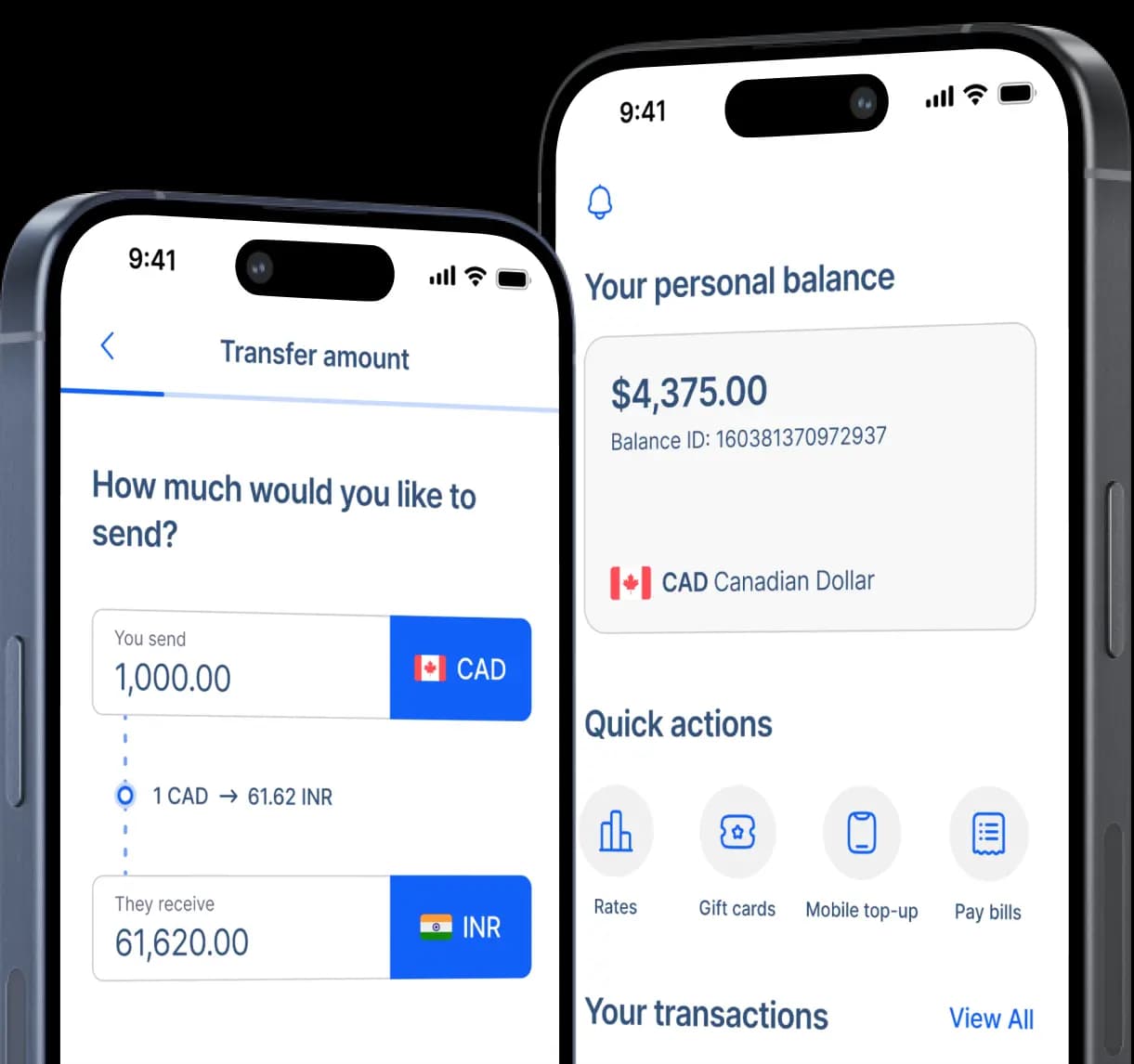
Take RemitBee With You
- Biometric login for quick access
- Transaction history at your fingertips
- Rate alerts for your preferred currencies
- Push notifications for every transfer update